| Weight | 1 lbs |
|---|---|
| Dimensions | 9 × 5 × 2 in |
| host | mouse |
| isotype | IgG3 |
| clonality | monoclonal |
| concentration | 1 mg/mL |
| applications | ELISA, ICC/IF, WB |
| reactivity | tagged fusion proteins |
| available sizes | 1 mg, 100 µg, 25 µg |

mouse anti-HA tag monoclonal antibody (HA.C5) 2742
Price range: $100.00 through $2,600.00
Antibody summary
- Mouse monoclonal to HA tag
- Suitable for: WB,ICC/IF,ELISA
- Reacts with: tagged fusion proteins
- Isotype: IgG3
- 100 µg, 25 µg, 1 mg
mouse anti-HA tag monoclonal antibody (HA.C5) 2742
| antibody |
|---|
| Database link: Sequence -YPYDVPDYA Derived from HA 118-127. Example strain H3N8 Q03909 |
| Tested applications WB,ICC/IF,ELISA |
| Recommended dilutions WB: 1:1000-3000 ICC/IF: 1:500-2000 For best results with other assays (e.g.: Dot, ELISA, IP, etc), please determine optimal working dilution by titration test. |
| Immunogen YPYDVPDYA (HA) synthetic peptide conjugated to KLH |
| Size and concentration 25, 100, 1000µg and 1 mg/mL |
| Form liquid |
| Storage Instructions -20°C for 2 years or more. Centrifuge after first thaw to maximize product recovery. Aliquot to avoid repeated freeze-thaw cycles. Store aliquots at 4°C for several days to weeks. |
| Storage buffer PBS, pH 7.2, 0.05% NaN3 |
| Purity affinity purified |
| Clonality monoclonal |
| Isotype IgG3 |
| Compatible secondaries goat anti-mouse IgG, H&L chain specific, peroxidase conjugated polyclonal antibody 5486 goat anti-mouse IgG, H&L chain specific, biotin conjugated, Conjugate polyclonal antibody 2685 goat anti-mouse IgG, H&L chain specific, FITC conjugated polyclonal antibody 7854 goat anti-mouse IgG, H&L chain specific, peroxidase conjugated polyclonal antibody, crossabsorbed 1706 goat anti-mouse IgG, H&L chain specific, biotin conjugated polyclonal antibody, crossabsorbed 1716 goat anti-mouse IgG, H&L chain specific, FITC conjugated polyclonal antibody, crossabsorbed 1721 |
| Isotype control Mouse monocolonal IgG3 - Isotype Control |
| target relevance |
|---|
| HA tag |
| Protein names Hemagglutinin epitope tag |
| Alternative names HA tag, HA epitope, Influenza HA tag, YPYDVPDYA tag |
| Function The HA tag is an artificial peptide epitope commonly fused to recombinant proteins to facilitate detection, purification, localization, and immunoprecipitation using anti-HA antibodies. |
| Description The HA tag is a synthetic peptide epitope derived from the human influenza A virus hemagglutinin (HA) protein. It is widely used for detection, purification, and characterization of recombinant proteins. |
| Keywords Epitope tag, Protein detection, Protein purification, Immunoprecipitation, Recombinant protein |
| Sequence YPYDVPDYA |
| Structure The HA tag is a 9-amino acid peptide epitope with the sequence YPYDVPDYA derived from the influenza A virus hemagglutinin protein. |
| Function The HA tag is used as a molecular tag for detection, purification, immunoprecipitation, and localization of recombinant proteins. |
| Detection HA-tagged proteins are commonly detected using anti-HA monoclonal antibodies such as clones 12CA5, 3F10, HA.11, and C29F4. |
| Applications HA-tagged proteins are routinely analyzed by western blotting, ELISA, immunofluorescence, immunohistochemistry, flow cytometry, immunoprecipitation, and affinity purification. |
| Research relevance The HA tag is one of the most widely used epitope tags in molecular biology and biotechnology and is often used alongside FLAG, Myc, V5, and His tags. |
Data
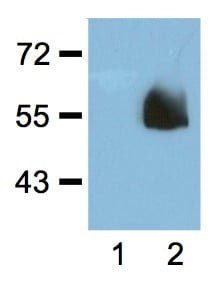 |
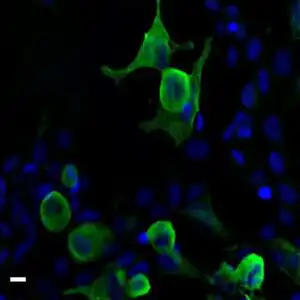
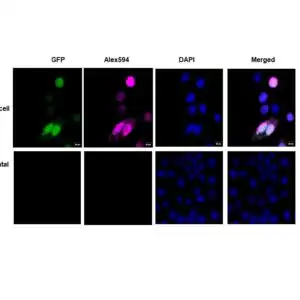
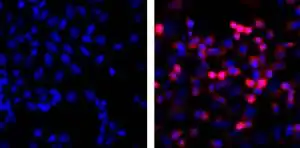
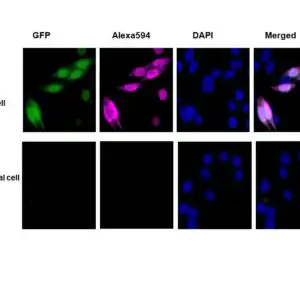
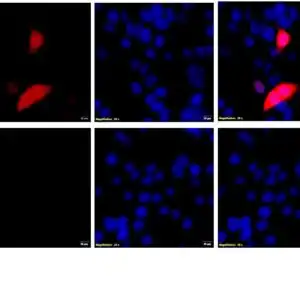
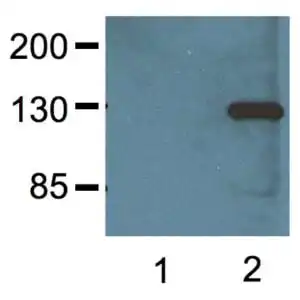
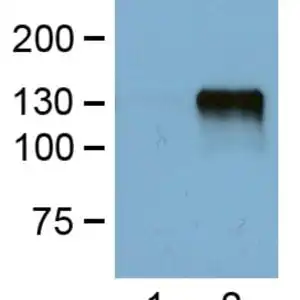
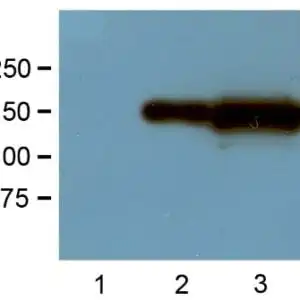
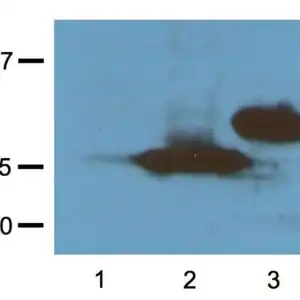
| 1:1000 (1µg/mL) Ab dilution probed against HEK293 cells transfected with HA-tagged protein vector; untransfected (1) and transfected (2). |
FAQ & Publications
Frequently Asked Questions
What applications is the mouse anti-HA tag monoclonal antibody (HA.C5) validated for, and what are the recommended dilutions?
This antibody is validated for Western blotting (WB), immunocytochemistry/immunofluorescence (ICC/IF), and ELISA. Recommended dilutions are 1:1000-3000 for WB and 1:500-2000 for ICC/IF. For other assays, such as Dot blot or immunoprecipitation, optimal dilutions should be determined by titration.
How should the mouse anti-HA tag monoclonal antibody (HA.C5) be stored to maintain stability and activity?
The antibody should be stored at -20°C for long-term storage of two years or more. After the first thaw, centrifuge to maximize product recovery and aliquot to avoid repeated freeze-thaw cycles. Aliquots can be stored at 4°C for several days to weeks. The antibody is supplied in PBS buffer, pH 7.2, with 0.05% sodium azide as a preservative.
Publications
| pmid | title | authors | citation |
|---|---|---|---|
| 36321378 | A NR2E1-interacting peptide of LSD1 inhibits the proliferation of brain tumour initiating cells. | Rong Hu, Umar Farook Shahul Hameed, Xiang Sun, Balakrishnan Shenbaga Moorthy, Wen Zhang, Philip D Jeffrey, Li Zhou, Xin Ma, Fangjin Chen, Jianfeng Pei, Pankaj K Giri, Yonggao Mou, Kunchithapadam Swaminathan, Ping Yuan | Cell Prolif 56:e13350 |
| 36119843 | NDRG2 inhibits pyruvate carboxylase-mediated anaplerosis and combines with glutamine blockade to inhibit the proliferation of glioma cells. | Jiancai Wang, Xiang Sun, Jiayuan Wang, Kun Zhang, Yiyi Yuan, Yan Guo, Libo Yao, Xia Li, Lan Shen | Am J Cancer Res 12:3729-3744 |
| 36090478 | Stabilization of DEPTOR sensitizes hypopharyngeal cancer to radiotherapy via targeting degradation. | Xuecen Wang, Zhirui Cao, Xin Yue, Tingyu Liu, Gesi Wen, Dongmei Jiang, Weijian Wu, Liyuan Le, Yan Wang, Chengtao Wang, Ziyang Wang, Meng Jin, Meiyan Zhu, Shasha He, Xiaoyue Zhang, Xianzhang Bu, Ran-Yi Liu, Zhenwei Peng, Yong Chen | Mol Ther Oncolytics 26:330-346 |
| 35847954 | The NFAT3/RERG Complex in Luminal Breast Cancers Is Required to Inhibit Cell Invasion and May Be Correlated With an Absence of Axillary Lymph Nodes Colonization. | Lucie Coillard, Frédéric Guaddachi, Maëlle Ralu, Eva Brabencova, Christian Garbar, Armand Bensussan, Morgane Le Bras, Jacqueline Lehmann-Che, Sébastien Jauliac | Front Oncol 12:804868 |
| 35761309 | Targeting ferroptosis with miR-144-3p to attenuate pancreatic β cells dysfunction via regulating USP22/SIRT1 in type 2 diabetes. | Shanshan Zhang, Xiao Liu, Jihong Wang, Fengjuan Yuan, Yali Liu | Diabetol Metab Syndr 14:89 |
Published literature highly relevant to the biological target of this product and referencing this antibody or clone are retrieved from the PubMed database provided by the United States National Library of Medicine at the National Institutes of Health.
Protocols
| relevant to this product |
|---|
| Western blot ICC |
Documents
| Batch Number | QC File | SDS |
|---|---|---|
| 1024 | QC Certificate | Safety Data Sheet |
Only logged in customers who have purchased this product may leave a review.


Reviews
There are no reviews yet.