| Weight | 1 lbs |
|---|---|
| Dimensions | 9 × 5 × 2 in |
| host | mouse |
| isotype | IgG1 |
| clonality | monoclonal |
| concentration | 1 mg/mL |
| applications | ELISA, ICC/IF, WB |
| reactivity | tagged fusion proteins |
| available sizes | 1 mg, 100 µg, 25 µg |

mouse anti-DYDDDDK tag monoclonal antibody (FG4R) 5299
Price range: $100.00 through $2,600.00
Antibody summary
- Mouse monoclonal to DYDDDDK tag
- Suitable for: WB,ICC/IF,ELISA
- Reacts with: tagged fusion proteins
- Isotype: IgG1
- 100 µg, 25 µg, 1 mg
mouse anti-DYDDDDK tag monoclonal antibody (FG4R) 5299
| antibody |
|---|
| Database link: DYDDDDK tag (FLAG tag) |
| Tested applications WB,ICC/IF,ELISA |
| Recommended dilutions WB: 1:1000-3000 ICC/IF: 1:500-2000 For best results with other assays (e.g.: Dot, ELISA, IP, etc), please determine optimal working dilution by titration test. |
| Immunogen DYKDDDDK (FLAG) synthetic peptide conjugated to KLH |
| Size and concentration 25, 100, 1000µg and 1 mg/mL |
| Form liquid |
| Storage Instructions -20°C for 2 years or more. Centrifuge after first thaw to maximize product recovery. Aliquot to avoid repeated freeze-thaw cycles. Store aliquots at 4°C for several days to weeks. |
| Storage buffer PBS, pH 7.2, 0.05% NaN3 |
| Purity affinity purified |
| Clonality monoclonal |
| Isotype IgG1 |
| Compatible secondaries goat anti-mouse IgG, H&L chain specific, peroxidase conjugated polyclonal antibody 5486 goat anti-mouse IgG, H&L chain specific, biotin conjugated, Conjugate polyclonal antibody 2685 goat anti-mouse IgG, H&L chain specific, FITC conjugated polyclonal antibody 7854 goat anti-mouse IgG, H&L chain specific, peroxidase conjugated polyclonal antibody, crossabsorbed 1706 goat anti-mouse IgG, H&L chain specific, biotin conjugated polyclonal antibody, crossabsorbed 1716 goat anti-mouse IgG, H&L chain specific, FITC conjugated polyclonal antibody, crossabsorbed 1721 |
| Isotype control Mouse monocolonal IgG1 - Isotype Control |
| target relevance |
|---|
| DDDDK |
| Protein names FLAG tag |
| Alternative names FLAG tag, FLAG epitope, DYKDDDDK tag, DYDDDDK tag, FLAG peptide |
| Function The FLAG tag serves as an affinity and detection tag that can be fused to recombinant proteins. It is recognized by anti-FLAG antibodies and affinity reagents for purification, immunoprecipitation, western blotting, immunofluorescence, flow cytometry, and ELISA. |
| Description The FLAG tag is a short artificial peptide epitope widely used in recombinant protein expression, purification, detection, and localization studies. The canonical FLAG sequence is DYKDDDDK. |
| Biological role Recombinant protein detection Affinity purification Immunoprecipitation Protein localization studies |
| Research relevance FLAG-tagged proteins are extensively used in molecular biology and protein expression systems because the tag is small, highly immunogenic, and generally does not interfere with protein folding or function. |
| Keywords Epitope tag, Protein purification, Protein detection, Recombinant protein |
| Structure The FLAG tag is a synthetic peptide epitope with the canonical amino acid sequence DYKDDDDK. |
| Function FLAG serves as a molecular tag for detection, purification, and characterization of recombinant proteins. |
| Detection FLAG-tagged proteins are commonly detected using anti-FLAG antibodies such as M1 and M2 clones in western blotting, ELISA, immunofluorescence, and immunoprecipitation assays. |
| Purification FLAG affinity resins and magnetic beads enable rapid purification of FLAG-tagged proteins under native or denaturing conditions. |
| Research relevance The FLAG tag is one of the most widely used epitope tags in molecular biology, biotechnology, and recombinant protein production. |
Data
 |
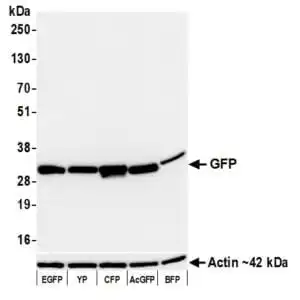
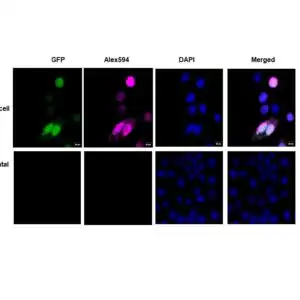
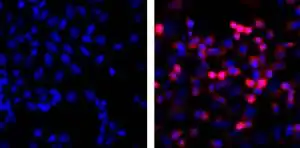
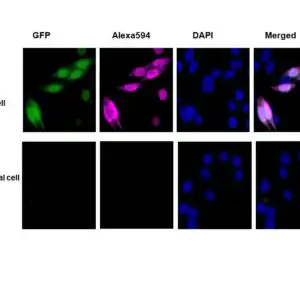
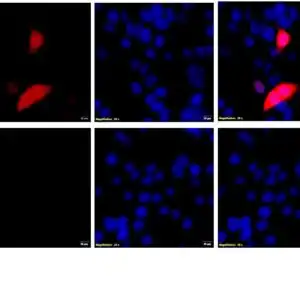
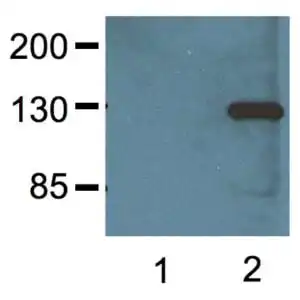
| 1:1000 (1µg/mL) Ab dilution probed against HEK293 cells transfected with DYKDDDDK-tagged protein vector; untransfected (1) and transfected (2). |
FAQ & Publications
Frequently Asked Questions
What applications has the mouse anti-DYDDDDK tag monoclonal antibody (FG4R) been validated for?
This antibody is suitable for Western blotting (WB), immunocytochemistry/immunofluorescence (ICC/IF), and ELISA applications.
How should the mouse anti-DYDDDDK tag antibody be stored to maintain its stability?
Store the antibody at -20°C for long-term storage up to 2 years or more. After the first thaw, centrifuge to maximize product recovery and aliquot to avoid repeated freeze-thaw cycles. Aliquots can be stored at 4°C for several days to weeks.
What is the recommended dilution range for the antibody in Western blot and ICC/IF assays?
For Western blotting, the recommended dilution is between 1:1000 and 1:3000. For ICC/IF, use a dilution range of 1:500 to 1:2000. For other assays like dot blot, ELISA, or immunoprecipitation, optimal dilutions should be determined empirically by titration.
What is the immunogen used to generate the mouse anti-DYDDDDK tag monoclonal antibody (FG4R)?
The immunogen is a synthetic DYKDDDDK (FLAG) peptide conjugated to keyhole limpet hemocyanin (KLH).
Which secondary antibodies are compatible with this mouse anti-DYDDDDK tag antibody for detection?
Compatible secondaries include goat anti-mouse IgG, H&L chain specific, conjugated to peroxidase, biotin, or FITC. Both standard and cross-absorbed polyclonal antibodies are suitable for use.
Publications
| pmid | title | authors | citation |
|---|---|---|---|
| 36765089 | Loss of phosphatase CTDNEP1 potentiates aggressive medulloblastoma by triggering MYC amplification and genomic instability. | Zaili Luo, Dazhuan Xin, Yunfei Liao, Kalen Berry, Sean Ogurek, Feng Zhang, Liguo Zhang, Chuntao Zhao, Rohit Rao, Xinran Dong, Hao Li, Jianzhong Yu, Yifeng Lin, Guoying Huang, Lingli Xu, Mei Xin, Ryuichi Nishinakamura, Jiyang Yu, Marcel Kool, Stefan M Pfister, Martine F Roussel, Wenhao Zhou, William A Weiss, Paul Andreassen, Q Richard Lu | Nat Commun 14:762 |
| 36685538 | Duck TRIM29 negatively regulates type I IFN production by targeting MAVS. | Weiqiang Li, Yating Song, Yuqing Du, Zhanhong Huang, Meng Zhang, Zuxian Chen, Zhuoliang He, Yangbao Ding, Junsheng Zhang, Luxiang Zhao, Hailiang Sun, Peirong Jiao | Front Immunol 13:1016214 |
| 36622167 | Diverse Partners of the Partitioning ParB Protein in Pseudomonas aeruginosa. | Adam Kawalek, Krzysztof Glabski, Aneta Agnieszka Bartosik, Dominika Wozniak, Magdalena Kusiak, Jan Gawor, Karolina Zuchniewicz, Grazyna Jagura-Burdzy | Microbiol Spectr 11:e0428922 |
| 36441793 | GluR2Q and GluR2R AMPA Subunits are not Targets of lypd2 Interaction. | Anna Lauriello, Quinn McVeigh, Rou-Jia Sung | PLoS One 17:e0278278 |
| 35906245 | TRIM28-dependent SUMOylation protects the adult ovary from activation of the testicular pathway. | Moïra Rossitto, Stephanie Déjardin, Chris M Rands, Stephanie Le Gras, Roberta Migale, Mahmoud-Reza Rafiee, Yasmine Neirijnck, Alain Pruvost, Anvi Laetitia Nguyen, Guillaume Bossis, Florence Cammas, Lionel Le Gallic, Dagmar Wilhelm, Robin Lovell-Badge, Brigitte Boizet-Bonhoure, Serge Nef, Francis Poulat | Nat Commun 13:4412 |
Published literature highly relevant to the biological target of this product and referencing this antibody or clone are retrieved from the PubMed database provided by the United States National Library of Medicine at the National Institutes of Health.
Protocols
| relevant to this product |
|---|
| Western blot ICC |
Documents
| Batch Number | QC File | SDS |
|---|---|---|
| 1024 | QC Certificate | Safety Data Sheet |
Only logged in customers who have purchased this product may leave a review.



Reviews
There are no reviews yet.