| Weight | 1 lbs |
|---|---|
| Dimensions | 9 × 5 × 2 in |
| accession | P13236 |
| express system | E.coli |
| product tag | biotin at C-terminal |
| purity | > 97% by SDS PAGE |
| molecular weight | Predicted Molecular Mass: 10,269.7258 Da Extinction Coefficient: 18,020 M-1 cm-1 Actual Molecular Mass: 10,269.7258 Da by ESI Mass Spec |
| available size | 10 µg, 100 µg, 2 µg, 50 µg |
| endotoxin | <0.01 EU per 1μg of the protein by the LAL method |

Biotinylated Macrophage inflammatory proteins 1-B (MIP-1B/CCL4) 8018
Price range: $134.00 through $2,862.00
Summary
- Expression: E.coli
- Amino Acid Range: 24-92
Biotinylated Macrophage inflammatory proteins 1-B (MIP-1B/CCL4) 8018
| antibody |
|---|
| Database link: human P13236 |
| Size and concentration 2, 10, 50, 100µg and lyophilized |
| Form Lyophilized |
| Storage Instructions Avoid repeated freeze-thaw cycles: • 12 months from date of receipt, -20 to -70 °C as supplied. • 1 month, 2 to 8 °C under sterile conditions after reconstitution. • 3 months, -20 to -70 °C under sterile conditions after reconstitution |
| Storage buffer Reconstitution: Spin sample prior to reconstitution. Recommended concentration of 100µg/mL in sterile water. Shipping: Room Temp |
| Purity > 97% by SDS PAGE and HPLC |
| target relevance |
|---|
| Homo sapiens CCL4 C-C motif chemokine 4 |
| Protein names C-C motif chemokine 4 |
| Alternative names G-26 T-lymphocyte-secreted protein, HC21, Lymphocyte activation gene 1 protein, MIP-1-beta(1-69), Macrophage inflammatory protein 1-beta, PAT 744, Protein H400, SIS-gamma, Small-inducible cytokine A4, T-cell activation protein 2 |
| Gene names CCL4 |
| Protein family Belongs to the intercrine beta (chemokine CC) family |
| Function Monokine with inflammatory and chemokinetic properties. Binds to CCR5. One of the major HIV-suppressive factors produced by CD8+ T-cells. Recombinant MIP-1-beta induces a dose-dependent inhibition of different strains of HIV-1, HIV-2, and simian immunodeficiency virus (SIV). The processed form MIP-1-beta(3-69) retains the abilities to induce down-modulation of surface expression of the chemokine receptor CCR5 and to inhibit the CCR5-mediated entry of HIV-1 in T-cells. MIP-1-beta(3-69) is also a ligand for CCR1 and CCR2 isoform B |
| Subcellular location Secreted |
| Structure Homodimer and heterodimer of MIP-1-alpha(4-69) and MIP-1-beta(3-69) |
| Post-translational modification N-terminal processed form MIP-1-beta(3-69) is produced by proteolytic cleavage after secretion from peripheral blood lymphocytes |
| Keywords 3D-structure, Chemotaxis, Cytokine, Disulfide bond, Inflammatory response, Proteomics identification, Reference proteome, Secreted, Signal |
| Sequence MKLCVTVLSLLMLVAAFCSPALSAPMGSDPPTACCFSYTARKLPRNFVVDYYETSSLCSQ PAVVFQTKRSKQVCADPSESWVQEYVYDLELN |
| UniProt accession: P13236 |
Data
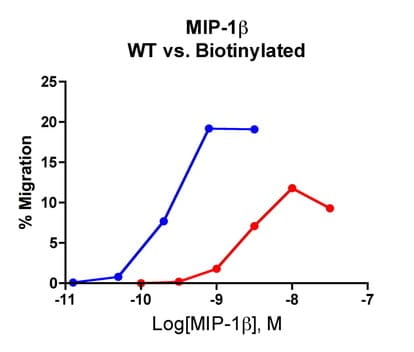 |
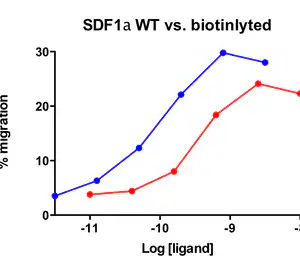
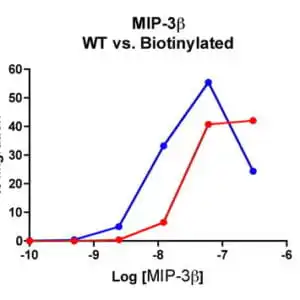
| Cells expressing recombinant CCR5 were assayed for migration through a transwell filter at various concentrations of WT or Biotinylated MIP-1β. Responses are expressed as the % of total input cells (Blue: wild type; Red: biotinylated). |
FAQ & Publications
Frequently Asked Questions
What is the recommended storage condition for the Biotinylated MIP-1B to maintain its stability?
The Biotinylated MIP-1B should be stored at -20 to -70 °C as supplied for up to 12 months. After reconstitution, it can be kept at 2 to 8 °C under sterile conditions for 1 month or at -20 to -70 °C for 3 months to preserve stability.
What is the source of expression and purity level of this Biotinylated MIP-1B protein?
This protein is expressed in E.coli and has a purity greater than 97% as determined by SDS PAGE and HPLC analysis.
What biological function does the Biotinylated MIP-1B (CCL4) serve and which receptor does it primarily target?
Biotinylated MIP-1B acts as a monokine with inflammatory and chemokinetic properties. It primarily binds to the CCR5 receptor and is known as a major HIV-suppressive factor produced by CD8+ T-cells, capable of inhibiting various strains of HIV-1, HIV-2, and SIV.
Publications
| pmid | title | authors | citation |
|---|---|---|---|
| We haven't added any publications to our database yet. | |||
Published literature highly relevant to the biological target of this product and referencing this antibody or clone are retrieved from the PubMed database provided by the United States National Library of Medicine at the National Institutes of Health.
Protocols
| relevant to this product |
|---|
| Migration assay |
Documents
| # | ||
|---|---|---|
| Please enter your product and batch number here. | ||
Only logged in customers who have purchased this product may leave a review.
Reviews
There are no reviews yet.