| Weight | 1 lbs |
|---|---|
| Dimensions | 9 × 5 × 2 in |
| accession | P10145 |
| express system | E.coli |
| product tag | none |
| purity | > 97% by SDS PAGE |
| molecular weight | Predicted Molecular Mass: 8.386 kDa Extinction Coefficient: 7,450 M-1 cm-1 Actual Molecular Mass: 8.386 kDa by ESI Mass Spec |
| available size | 100 µg, 1mg, 20 µg, 5 µg, 50 µg |
| endotoxin | <0.01 EU per 1μg of the protein by the LAL method |
| sequence | SAKELRCQCIKTYSKPFHPKFIKELRVIESGPHCANTEIIVKLSDGRELCLDPKENWVQ RVVEKFLKRAEN |
Interleukin 8 (IL-8 /CXCL8) 8013
Price range: $61.00 through $2,189.00
Summary
- Expression: E.coli
- Amino Acid Range: 28-99
Interleukin 8 (IL-8 /CXCL8) 8013
| antibody |
|---|
| Database link: human P10145 |
| Size and concentration 5, 20, 50, 100, 1000µg and lyophilized |
| Form Lyophilized |
| Storage Instructions Avoid repeated freeze-thaw cycles: • 12 months from date of receipt, -20 to -70 °C as supplied. • 1 month, 2 to 8 °C under sterile conditions after reconstitution. • 3 months, -20 to -70 °C under sterile conditions after reconstitution |
| Storage buffer Reconstitution: Spin sample prior to reconstitution. Recommended concentration of 100µg/mL in sterile water. Shipping: Room Temp |
| Purity > 97% by SDS PAGE and HPLC |
| target relevance |
|---|
| Homo sapiens CXCL8 Interleukin-8 |
| Protein names Interleukin-8 |
| Alternative names C-X-C motif chemokine 8, Chemokine (C-X-C motif) ligand 8, Emoctakin, Granulocyte chemotactic protein 1, Monocyte-derived neutrophil chemotactic factor, Monocyte-derived neutrophil-activating peptide, Neutrophil-activating protein 1, Protein 3-10C, T-cell chemotactic factor |
| Gene names CXCL8 |
| Protein family Belongs to the intercrine alpha (chemokine CxC) family |
| Function Chemotactic factor that mediates inflammatory response by attracting neutrophils, basophils, and T-cells to clear pathogens and protect the host from infection (PubMed:18692776, PubMed:7636208). Also plays an important role in neutrophil activation (PubMed:2145175, PubMed:9623510). Released in response to an inflammatory stimulus, exerts its effect by binding to the G-protein-coupled receptors CXCR1 and CXCR2, primarily found in neutrophils, monocytes and endothelial cells (PubMed:1840701, PubMed:1891716). G-protein heterotrimer (alpha, beta, gamma subunits) constitutively binds to CXCR1/CXCR2 receptor and activation by IL8 leads to beta and gamma subunits release from Galpha (GNAI2 in neutrophils) and activation of several downstream signaling pathways including PI3K and MAPK pathways (PubMed:11971003, PubMed:8662698) |
| Subcellular location Secreted |
| Structure Homodimer (PubMed:31235521). Dimer formation is disrupted by tick evasin-3 (PubMed:31235521). Interacts with TNFAIP6 (via Link domain); this interaction interferes with chemokine binding to glycosaminoglycans |
| Post-translational modification Several N-terminal processed forms are produced by proteolytic cleavage after secretion from at least peripheral blood monocytes, leukcocytes and endothelial cells. In general, IL-8(1-77) is referred to as interleukin-8. IL-8(6-77) is the most promiment form Citrullination at Arg-27 prevents proteolysis, and dampens tissue inflammation, it also enhances leukocytosis, possibly through impaired chemokine clearance from the blood circulation (Microbial infection) Cleaved by group A Streptococcus protease SpyCEP; leading to impaired neutrophil endothelial transmigration and thus increased virulence |
| Keywords 3D-structure, Chemotaxis, Citrullination, Cytokine, Direct protein sequencing, Disulfide bond, Inflammatory response, Proteomics identification, Reference proteome, Secreted, Signal |
| Sequence MTSKLAVALLAAFLISAALCEGAVLPRSAKELRCQCIKTYSKPFHPKFIKELRVIESGPH CANTEIIVKLSDGRELCLDPKENWVQRVVEKFLKRAENS |
| UniProt accession: P10145 |
Data
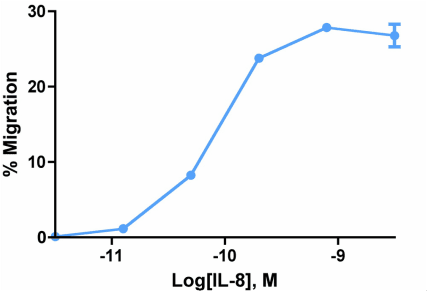 |
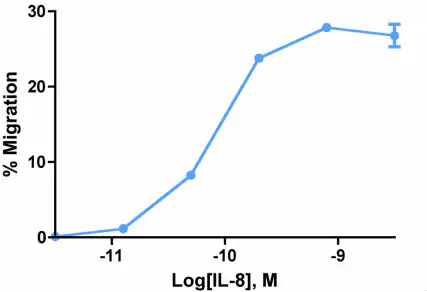
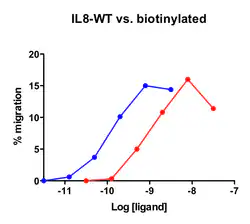
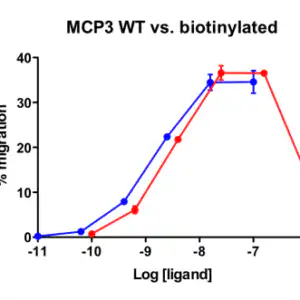
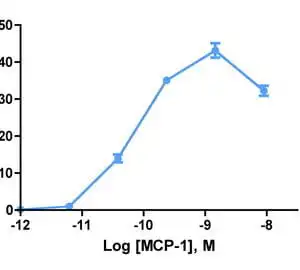
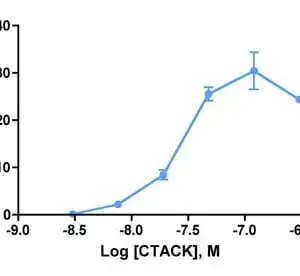
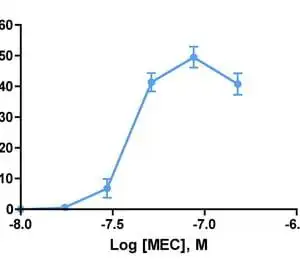
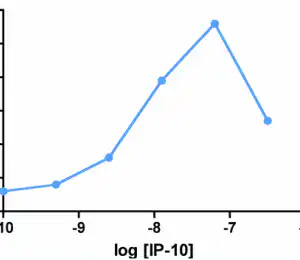
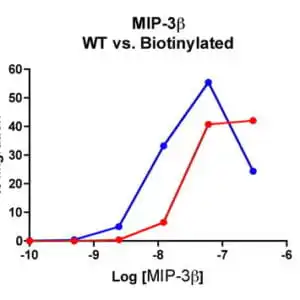
| Migration Assay: Cells expressing recombinant CXCR1 were assayed for migration through a transwell filter at various concentrations of WT IL-8. Responses are expressed as the % of total input cells. |
FAQ & Publications
Frequently Asked Questions
What is the source organism for the Interleukin 8 (IL-8/CXCL8) 8013 protein?
This product is expressed in Escherichia coli (E. coli).
How should I store the Interleukin 8 (IL-8/CXCL8) 8013 protein to maintain its stability?
Store the lyophilized protein at -20 to -70 °C for up to 12 months as supplied. After reconstitution, keep it at 2 to 8 °C under sterile conditions for up to 1 month or at -20 to -70 °C under sterile conditions for up to 3 months. Avoid repeated freeze-thaw cycles.
What is the purity level of the Interleukin 8 (IL-8/CXCL8) 8013 protein?
The protein is greater than 97% pure as determined by SDS-PAGE and HPLC analysis.
Which biological receptors does Interleukin 8 (IL-8/CXCL8) primarily bind to exert its function?
Interleukin 8 binds primarily to the G-protein-coupled receptors CXCR1 and CXCR2 found on neutrophils, monocytes, and endothelial cells.
In what forms and sizes is Interleukin 8 (IL-8/CXCL8) 8013 available for purchase?
The product is available lyophilized in sizes of 5 µg, 20 µg, 50 µg, 100 µg, and 1 mg.
Publications
| pmid | title | authors | citation |
|---|---|---|---|
| We haven't added any publications to our database yet. | |||
Published literature highly relevant to the biological target of this product and referencing this antibody or clone are retrieved from the PubMed database provided by the United States National Library of Medicine at the National Institutes of Health.
Protocols
| relevant to this product |
|---|
| Migration assay |
Documents
| # | ||
|---|---|---|
| Please enter your product and batch number here. | ||
Only logged in customers who have purchased this product may leave a review.
Reviews
There are no reviews yet.