| Weight | 1 lbs |
|---|---|
| Dimensions | 9 × 5 × 2 in |
| accession | P10145 |
| express system | E.coli |
| product tag | none |
| purity | > 97% by SDS PAGE |
| molecular weight | Predicted Molecular Mass: 8.386 kDa Extinction Coefficient: 7,450 M-1 cm-1 Actual Molecular Mass: 8.386 kDa by ESI Mass Spec |
| available size | 100 µg, 1mg, 20 µg, 5 µg, 50 µg |
| endotoxin | <0.01 EU per 1μg of the protein by the LAL method |
| sequence | FLLPPSTACCTQLYRKPLSDKLLRKVIQVELQEADGDCHLQAFVLHLAQRSICIHPQNP SLSQWFEHQERKLHGTLPKLNFGMLRKMG |

Human CCL27 (CTACK) 7027
Price range: $61.00 through $2,189.00
Summary
- Expression: E.coli
- Amino Acid Range: 25-112
Human CCL27 (CTACK) 7027
| protein |
|---|
| Database link: human Q9Y4X3 |
| Size and concentration 5, 20, 50, 100, 1000µg and lyophilized |
| Form Lyophilized |
| Storage Instructions Avoid repeated freeze-thaw cycles: • 12 months from date of receipt, -20 to -70 °C as supplied. • 1 month, 2 to 8 °C under sterile conditions after reconstitution. • 3 months, -20 to -70 °C under sterile conditions after reconstitution |
| Storage buffer ​Reconstitution: Spin sample prior to reconstitution. Recommended concentration of 100µg/mL in sterile water. Shipping: Room Temp |
| Purity > 97% by SDS PAGE and HPLC |
| target relevance |
|---|
| Cutaneous T-cell-attracting chemokine (CTACK/CCL27) is a ligand for cell surface receptor CCR10. It is responsible for chemotaxis of skin-homing memory T cells during cutaneous inflammation. Interestingly, after CCR10-mediated internalization, CTACK, as well as a non-secreted splice variant of the same gene, can reach the nucleus and modulate transcription and cell behavior. |
| Protein names C-C motif chemokine 27 (CC chemokine ILC) (Cutaneous T-cell-attracting chemokine) (CTACK) (ESkine) (IL-11 R-alpha-locus chemokine) (Skinkine) (Small-inducible cytokine A27) |
| Gene names CCL27,CCL27 ILC SCYA27 |
| Protein family Intercrine beta (chemokine CC) family |
| Mass 12618Da |
| Function FUNCTION: Chemotactic factor that attracts skin-associated memory T-lymphocytes. May play a role in mediating homing of lymphocytes to cutaneous sites. Binds to CCR10. |
| Subellular location SUBCELLULAR LOCATION: Secreted {ECO:0000250|UniProtKB:Q9Z1X0}. |
| Tissues TISSUE SPECIFICITY: Testis, thymus, placenta, ovary and skin. |
| Structure SUBUNIT: Monomer, dimer, and tetramer. Heparin avidly promotes oligomerization. Interacts with TNFAIP6 (via Link domain). {ECO:0000269|PubMed:20200157, ECO:0000269|PubMed:27044744}. |
| Target Relevance information above includes information from UniProt accession: Q9Y4X3 |
| The UniProt Consortium |
Data
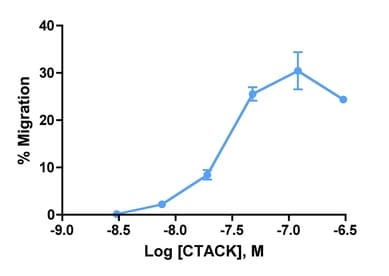 |
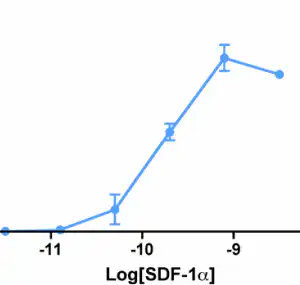
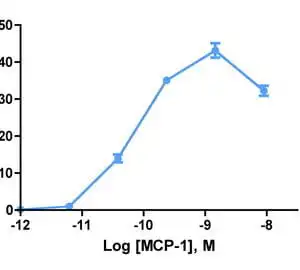
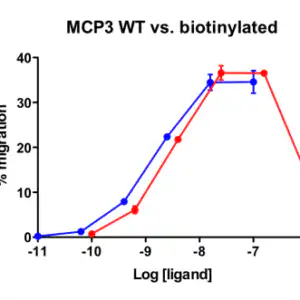
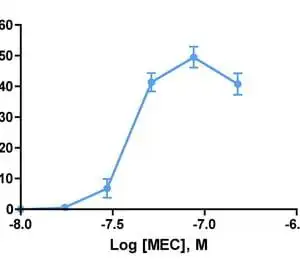
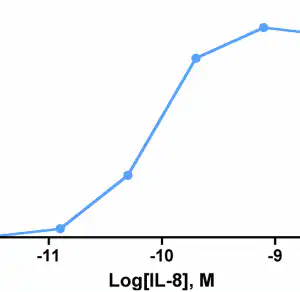
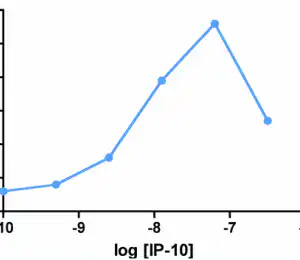
| Migration Assay: Cells expressing recombinant CCR10 were assayed for migration through a transwell filter at various concentrations of CTACK. Responses are expressed as the % of total input cells |
FAQ & Publications
Frequently Asked Questions
What organism is the Human CCL27 (CTACK) 7027 protein expressed in?
The Human CCL27 (CTACK) 7027 protein is expressed in Escherichia coli (E.coli).
How should the Human CCL27 (CTACK) 7027 protein be stored after reconstitution?
After reconstitution, the protein can be stored for 1 month at 2 to 8 °C under sterile conditions or for 3 months at -20 to -70 °C under sterile conditions. Avoid repeated freeze-thaw cycles.
What is the purity level of Human CCL27 (CTACK) 7027, and how is it determined?
The purity of Human CCL27 (CTACK) 7027 is greater than 97%, as determined by SDS-PAGE and HPLC analysis.
What is the endotoxin level present in the Human CCL27 (CTACK) 7027 protein preparation?
The endotoxin level is less than 0.01 Endotoxin Units (EU) per 1 microgram of protein, measured by the Limulus Amebocyte Lysate (LAL) method.
Which receptor does CCL27 (CTACK) bind to, and what is its biological function?
CCL27 (CTACK) binds to the CCR10 receptor and functions as a chemotactic factor attracting skin-associated memory T-lymphocytes, playing a role in lymphocyte homing to cutaneous sites.
Publications
| pmid | title | authors | citation |
|---|---|---|---|
| We haven't added any publications to our database yet. | |||
Published literature highly relevant to the biological target of this product and referencing this antibody or clone are retrieved from the PubMed database provided by the United States National Library of Medicine at the National Institutes of Health.
Protocols
| relevant to this product |
|---|
| Migration assay |
Documents
| # | ||
|---|---|---|
| Please enter your product and batch number here. | ||
Only logged in customers who have purchased this product may leave a review.
Reviews
There are no reviews yet.