| Weight | 1 lbs |
|---|---|
| Dimensions | 9 × 5 × 2 in |
| host | mouse |
| isotype | IgG |
| clonality | monoclonal |
| concentration | concentrate, predilute |
| applications | IHC |
| reactivity | human |
| available size | 0.1 mL, 0.5 mL, 1 mL concentrated, 7 mL prediluted |

rabbit anti-LEF1 monoclonal antibody (ZR336) 6241
Price range: $160.00 through $528.00
Antibody summary
- Rabbit monoclonal to LEF1
- Suitable for: Immunohistochemistry (formalin-fixed, paraffin-embedded tissues)
- Reacts with: Human
- Isotype:IgG
- Control: CLL/SLL
- Visualization: Nuclear
- 0.1, 0.5, 1.0 mL concentrated, 7 mL prediluted
rabbit anti-LEF1 monoclonal antibody ZR336 6241
| target relevance |
|---|
| Protein names Lymphoid enhancer-binding factor 1 (LEF-1) (T cell-specific transcription factor 1-alpha) (TCF1-alpha) |
| Gene names LEF1,LEF1 |
| Protein family TCF/LEF family |
| Mass 44201Da |
| Function FUNCTION: Transcription factor that binds DNA in a sequence-specific manner (PubMed:2010090). Participates in the Wnt signaling pathway (By similarity). Activates transcription of target genes in the presence of CTNNB1 and EP300 (By similarity). PIAG antagonizes both Wnt-dependent and Wnt-independent activation by LEF1 (By similarity). TLE1, TLE2, TLE3 and TLE4 repress transactivation mediated by LEF1 and CTNNB1 (PubMed:11266540). Regulates T-cell receptor alpha enhancer function (PubMed:19653274). Required for IL17A expressing gamma-delta T-cell maturation and development, via binding to regulator loci of BLK to modulate expression (By similarity). Acts as a positive regulator of odontoblast differentiation during mesenchymal tooth germ formation, expression is repressed during the bell stage by MSX1-mediated inhibition of CTNNB1 signaling (By similarity). May play a role in hair cell differentiation and follicle morphogenesis (By similarity). {ECO:0000250|UniProtKB:P27782, ECO:0000269|PubMed:11266540, ECO:0000269|PubMed:19653274, ECO:0000269|PubMed:2010090}.; FUNCTION: [Isoform 1]: Transcriptionally activates MYC and CCND1 expression and enhances proliferation of pancreatic tumor cells. {ECO:0000269|PubMed:19653274}.; FUNCTION: [Isoform 3]: Lacks the CTNNB1 interaction domain and may therefore be an antagonist for Wnt signaling. {ECO:0000269|PubMed:11326276}.; FUNCTION: [Isoform 5]: Transcriptionally activates the fibronectin promoter, binds to and represses transcription from the E-cadherin promoter in a CTNNB1-independent manner, and is involved in reducing cellular aggregation and increasing cell migration of pancreatic cancer cells. {ECO:0000269|PubMed:19653274}. |
| Subellular location SUBCELLULAR LOCATION: Nucleus {ECO:0000255|PROSITE-ProRule:PRU00267}. Note=Found in nuclear bodies upon PIASG binding. {ECO:0000250}. |
| Tissues TISSUE SPECIFICITY: Detected in thymus. Not detected in normal colon, but highly expressed in colon cancer biopsies and colon cancer cell lines. Expressed in several pancreatic tumors and weakly expressed in normal pancreatic tissue. Isoforms 1 and 5 are detected in several pancreatic cell lines. {ECO:0000269|PubMed:19653274}. |
| Structure SUBUNIT: Binds the armadillo repeat of CTNNB1 and forms a stable complex. Interacts with EP300, TLE1 and PIASG (By similarity). Binds ALYREF/THOC4, MDFI and MDFIC. Interacts with NLK. Interacts with DAZAP2 (PubMed:19304756). {ECO:0000250|UniProtKB:P27782, ECO:0000269|PubMed:12192039, ECO:0000269|PubMed:12556497, ECO:0000269|PubMed:19304756, ECO:0000269|PubMed:9119228, ECO:0000269|PubMed:9488439, ECO:0000269|PubMed:9751710}. |
| Post-translational modification PTM: Phosphorylated at Thr-155 and/or Ser-166 by NLK. Phosphorylation by NLK at these sites represses LEF1-mediated transcriptional activation of target genes of the canonical Wnt signaling pathway. {ECO:0000269|PubMed:12556497}. |
| Domain DOMAIN: Proline-rich and acidic regions are implicated in the activation functions of RNA polymerase II transcription factors. |
| Target Relevance information above includes information from UniProt accession: Q9UJU2 |
| The UniProt Consortium |
Data
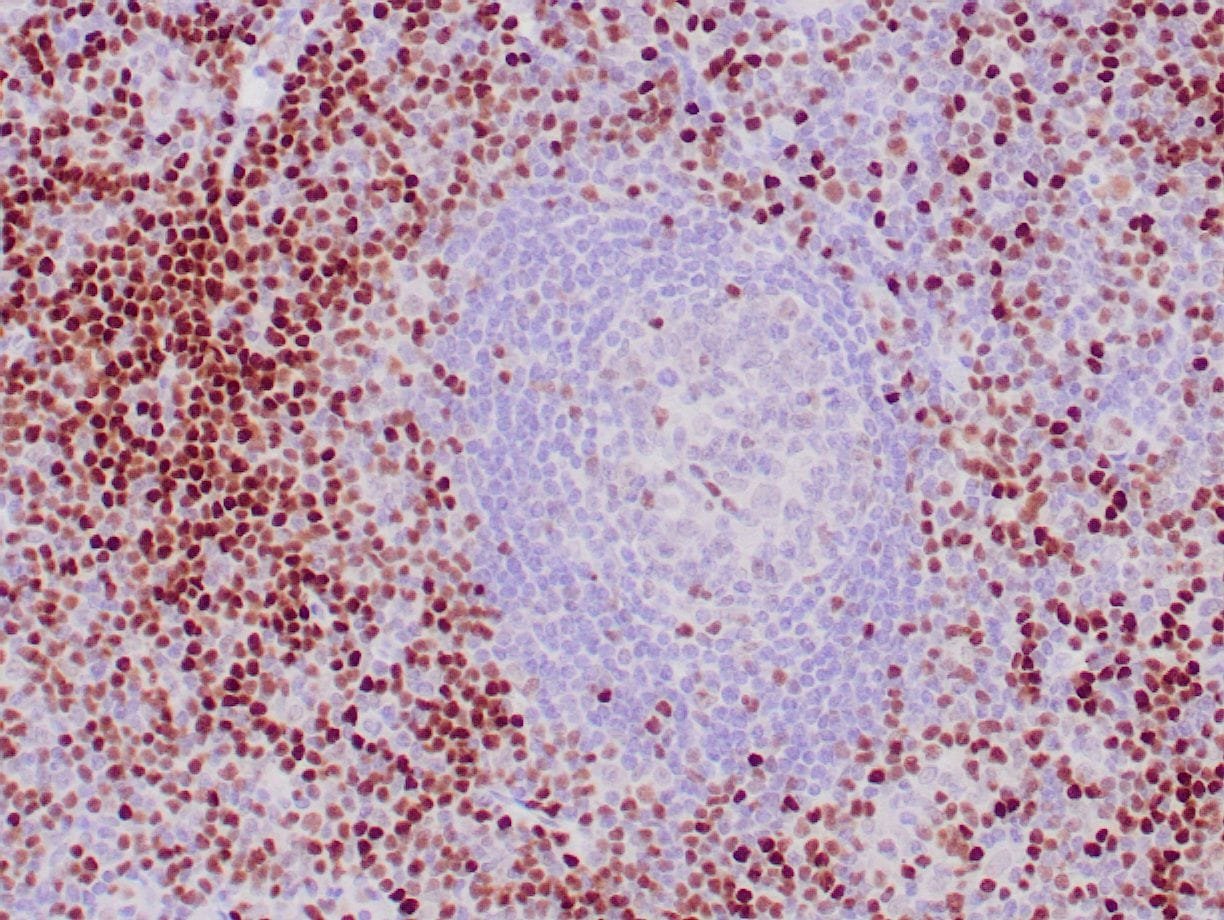 |
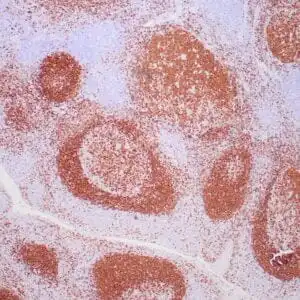
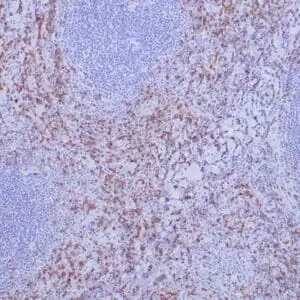
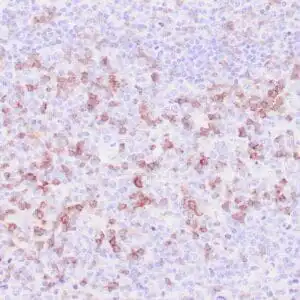
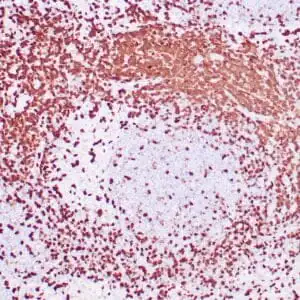
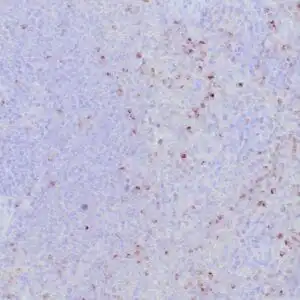
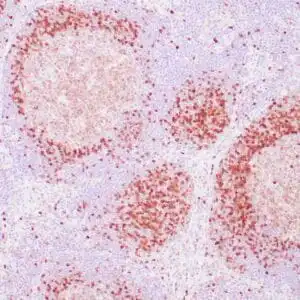
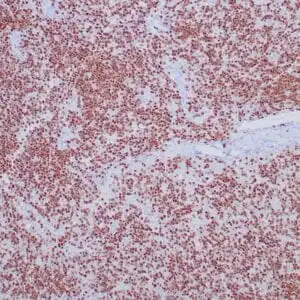
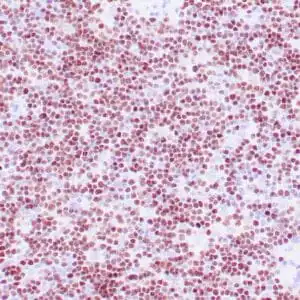
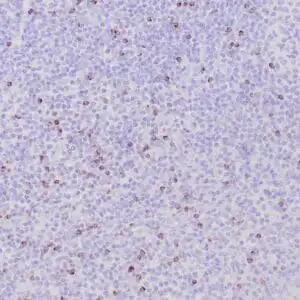
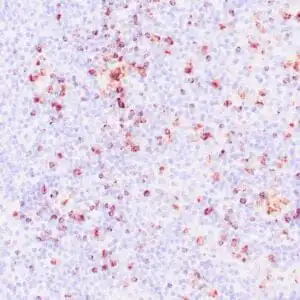
| Human tonsil stained with anti-LEF1 using peroxidase conjugate and DAB chromogen. Note nuclear staining of subset of B cells. |
FAQ & Publications
Frequently Asked Questions
What species does the rabbit anti-LEF1 monoclonal antibody (ZR336) specifically react with?
This antibody is reactive with human tissues only.
Which applications is the rabbit anti-LEF1 monoclonal antibody (ZR336) validated for?
The antibody is suitable and tested for Immunohistochemistry (IHC) on formalin-fixed, paraffin-embedded tissues.
What are the recommended storage conditions for this LEF1 antibody?
For short-term storage, keep the antibody at 2-8°C. For long-term storage, it should be kept at -20°C, and freeze/thaw cycles should be avoided.
What is the host species and clonality of the anti-LEF1 antibody ZR336?
The antibody is a rabbit monoclonal antibody.
What dilutions are recommended when using the concentrated form of this LEF1 antibody for IHC?
The recommended dilution range for the concentrated antibody is 1:100 to 1:200 for immunohistochemistry.
Publications
| pmid | title | authors | citation |
|---|---|---|---|
| We haven't added any publications to our database yet. | |||
Published literature highly relevant to the biological target of this product and referencing this antibody or clone are retrieved from the PubMed database provided by the United States National Library of Medicine at the National Institutes of Health.
Protocols
| relevant to this product |
|---|
| IHC |
Documents
| Batch Number | QC File | SDS |
|---|---|---|
| To view batch-specific Safety Datasheets and Quality Certificates associated with your account, please Log In. | ||
Only logged in customers who have purchased this product may leave a review.


Reviews
There are no reviews yet.