| Weight | 1 lbs |
|---|---|
| Dimensions | 9 × 5 × 2 in |
| host | mouse |
| isotype | IgG1 |
| clonality | monoclonal |
| concentration | concentrate, predilute |
| applications | IHC |
| reactivity | human |
| available size | 0.1 mL, 0.5 mL, 1 mL concentrated, 7 mL prediluted |

mouse anti-TIA-1 monoclonal antibody (2G9A10F5) 6386
Price range: $160.00 through $528.00
Antibody summary
- Mouse monoclonal to TIA-1
- Suitable for: Immunohistochemistry (formalin-fixed, paraffin-embedded tissues)
- Reacts with: Human
- Isotype:IgG1
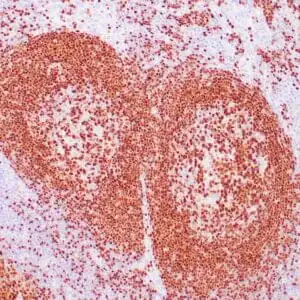
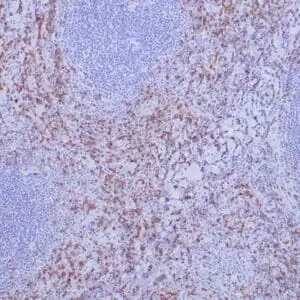
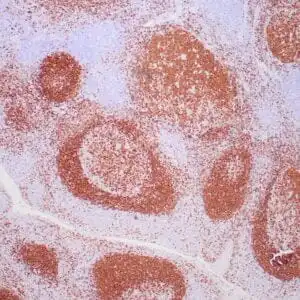
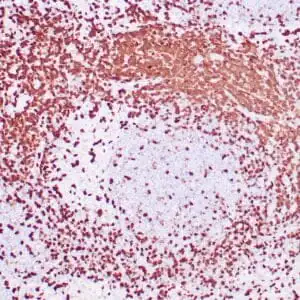
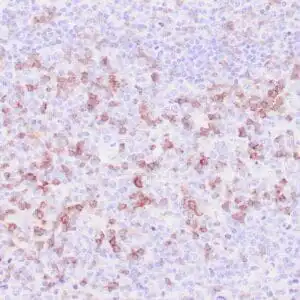
- Control: Tonsil
- Visualization: Cytoplasmic
- 0.1, 0.5, 1.0 mL concentrated, 7 mL prediluted
mouse anti-TIA-1 monoclonal antibody 2G9A10F5 6386
| target relevance |
|---|
| Homo sapiens TIA1 Cytotoxic granule associated RNA binding protein TIA1 |
| Protein names Cytotoxic granule associated RNA binding protein TIA1 |
| Alternative names Nucleolysin TIA-1 isoform p40, RNA-binding protein TIA-1, T-cell-restricted intracellular antigen-1, p40-TIA-1 |
| Gene names TIA1 |
| Function RNA-binding protein involved in the regulation of alternative pre-RNA splicing and mRNA translation by binding to uridine-rich (U-rich) RNA sequences (PubMed:11106748, PubMed:12486009, PubMed:17488725, PubMed:8576255). Binds to U-rich sequences immediately downstream from a 5' splice sites in a uridine-rich small nuclear ribonucleoprotein (U snRNP)-dependent fashion, thereby modulating alternative pre-RNA splicing (PubMed:11106748, PubMed:8576255). Preferably binds to the U-rich IAS1 sequence in a U1 snRNP-dependent manner; this binding is optimal if a 5' splice site is adjacent to IAS1 (By similarity). Activates the use of heterologous 5' splice sites; the activation depends on the intron sequence downstream from the 5' splice site, with a preference for a downstream U-rich sequence (PubMed:11106748). By interacting with SNRPC/U1-C, promotes recruitment and binding of spliceosomal U1 snRNP to 5' splice sites followed by U-rich sequences, thereby facilitating atypical 5' splice site recognition by U1 snRNP (PubMed:11106748, PubMed:12486009, PubMed:17488725). Activates splicing of alternative exons with weak 5' splice sites followed by a U-rich stretch on its own pre-mRNA and on TIAR mRNA (By similarity). Acts as a modulator of alternative splicing for the apoptotic FAS receptor, thereby promoting apoptosis (PubMed:11106748, PubMed:17488725, PubMed:1934064). Binds to the 5' splice site region of FAS intron 5 to promote accumulation of transcripts that include exon 6 at the expense of transcripts in which exon 6 is skipped, thereby leading to the transcription of a membrane-bound apoptotic FAS receptor, which promotes apoptosis (PubMed:11106748, PubMed:17488725, PubMed:1934064). Binds to a conserved AU-rich cis element in COL2A1 intron 2 and modulates alternative splicing of COL2A1 exon 2 (PubMed:17580305). Also binds to the equivalent AT-rich element in COL2A1 genomic DNA, and may thereby be involved in the regulation of transcription (PubMed:17580305). Binds specifically to a polypyrimidine-rich controlling element (PCE) located between the weak 5' splice site and the intronic splicing silencer of CFTR mRNA to promote exon 9 inclusion, thereby antagonizing PTB1 and its role in exon skipping of CFTR exon 9 (PubMed:14966131). Involved in the repression of mRNA translation by binding to AU-rich elements (AREs) located in mRNA 3' untranslated regions (3' UTRs), including target ARE-bearing mRNAs encoding TNF and PTGS2 (By similarity). Also participates in the cellular response to environmental stress, by acting downstream of the stress-induced phosphorylation of EIF2S1/EIF2A to promote the recruitment of untranslated mRNAs to cytoplasmic stress granules (SGs), leading to stress-induced translational arrest (PubMed:10613902). Formation and recruitment to SGs is regulated by Zn(2+) (By similarity). Possesses nucleolytic activity against cytotoxic lymphocyte target cells (PubMed:1934064) |
| Subcellular location Nucleus, Cytoplasm, Cytoplasm, Stress granule |
| Structure Homooligomer; homooligomerization is induced by Zn(2+) (By similarity). Interacts with FASTK; the interactions leads to its phosphorylation (PubMed:17135269, PubMed:7544399). Interacts (via RRM1 and the C-terminal glutamine-rich (Q) sequence) with SNRPC/U1-C (via N-terminus); thereby facilitating spliceosomal U1 snRNP recruitment to 5' splice sites (PubMed:12486009) |
| Post-translational modification Phosphorylated by FASTK; phosphorylation occurs after FAS ligation in FAS-mediated apoptosis and before DNA fragmentation |
| Involvement in disease Welander distal myopathy An autosomal dominant disorder characterized by adult onset of distal muscle weakness predominantly affecting the distal long extensors of the hands, with slow progression to involve all small hand muscles and the lower legs. Skeletal muscle biopsy shows myopathic changes and prominent rimmed vacuoles. Rare homozygous patients showed earlier onset, faster progression, and proximal muscle involvement. Amyotrophic lateral sclerosis 26, with or without frontotemporal dementia A form of amyotrophic lateral sclerosis, a neurodegenerative disorder affecting upper motor neurons in the brain and lower motor neurons in the brain stem and spinal cord, resulting in fatal paralysis. Sensory abnormalities are absent. The pathologic hallmarks of the disease include pallor of the corticospinal tract due to loss of motor neurons, presence of ubiquitin-positive inclusions within surviving motor neurons, and deposition of pathologic aggregates. The etiology of amyotrophic lateral sclerosis is likely to be multifactorial, involving both genetic and environmental factors. The disease is inherited in 5-10% of the cases. ALS26 inheritance is autosomal dominant. Some patients may develop frontotemporal dementia. |
| Keywords 3D-structure, Acetylation, Alternative splicing, Amyotrophic lateral sclerosis, Apoptosis, Cytoplasm, Disease variant, mRNA processing, mRNA splicing, Neurodegeneration, Nucleus, Proteomics identification, Reference proteome, Repeat, RNA-binding |
| Sequence MEDEMPKTLYVGNLSRDVTEALILQLFSQIGPCKNCKMIMDTAGNDPYCFVEFHEHRHAA AALAAMNGRKIMGKEVKVNWATTPSSQKKDTSSSTVVSTQRSQDHFHVFVGDLSPEITTE DIKAAFAPFGRISDARVVKDMATGKSKGYGFVSFFNKWDAENAIQQMGGQWLGGRQIRTN WATRKPPAPKSTYESNTKQLSYDEVVNQSSPSNCTVYCGGVTSGLTEQLMRQTFSPFGQI MEIRVFPDKGYSFVRFNSHESAAHAIVSVNGTTIEGHVVKCYWGKETLDMINPVQQQNQI GYPQPYGQWGQWYGNAQQIGQYMPNGWQVPAYGMYGQAWNQQGFNQTQSSAPWMGPNYGV QPPQGQNGSMLPNQPSGYRVAGYETQ |
| UniProt accession: P31483 |
Data
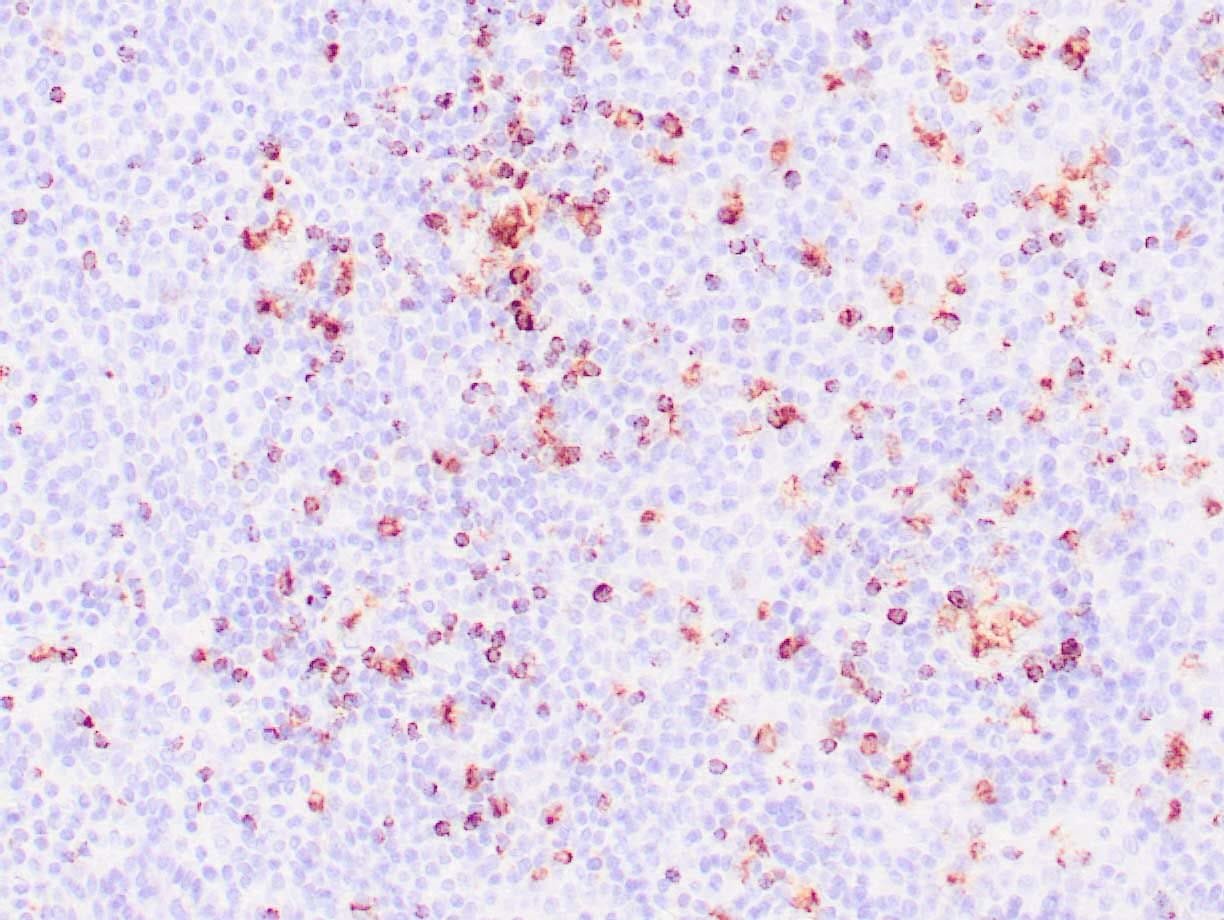 |
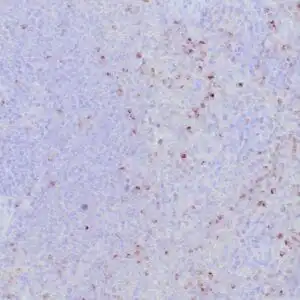
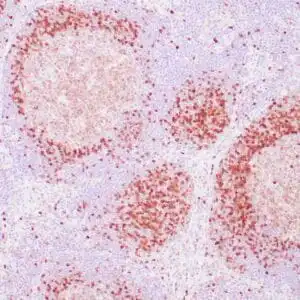
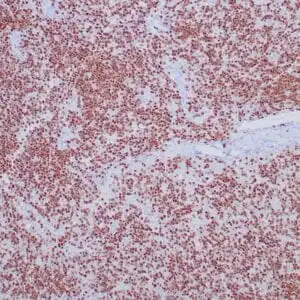
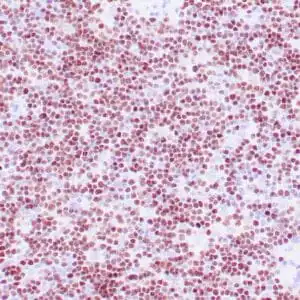
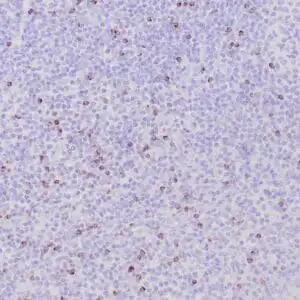
| Human nasal T/NK cell lymphoma stained with anti-TIA-1 antibody using peroxidase-conjugate and DAB chromogen. Note the cytoplasmic granular staining of lymphoma cells. |
FAQ & Publications
Frequently Asked Questions
What species does the mouse anti-TIA-1 monoclonal antibody (2G9A10F5) specifically react with?
This antibody specifically reacts with human species and is validated for use in human tissue samples.
How should the mouse anti-TIA-1 monoclonal antibody be stored to maintain stability?
For short-term storage, keep the antibody at 2-8°C. For long-term storage, it should be kept at -20°C. Avoid repeated freeze/thaw cycles to preserve antibody activity.
What is the recommended dilution for using the concentrated mouse anti-TIA-1 monoclonal antibody in immunohistochemistry?
The recommended dilution for immunohistochemistry applications using the concentrated antibody is 1:100.
Publications
| pmid | title | authors | citation |
|---|---|---|---|
| We haven't added any publications to our database yet. | |||
Published literature highly relevant to the biological target of this product and referencing this antibody or clone are retrieved from the PubMed database provided by the United States National Library of Medicine at the National Institutes of Health.
Protocols
| relevant to this product |
|---|
| IHC |
Documents
| Batch Number | QC File | SDS |
|---|---|---|
| To view batch-specific Safety Datasheets and Quality Certificates associated with your account, please Log In. | ||
Only logged in customers who have purchased this product may leave a review.


Reviews
There are no reviews yet.