| Weight | 1 lbs |
|---|---|
| Dimensions | 9 × 5 × 2 in |
| host | mouse |
| isotype | IgG1 |
| clonality | monoclonal |
| concentration | concentrate, predilute |
| applications | IHC |
| reactivity | human |
| available size | 0.1 mL, 0.5 mL, 1 mL concentrated, 7 mL prediluted |

mouse anti-PAX-5 monoclonal antibody (ZM26) 6320
Price range: $160.00 through $528.00
Antibody summary
- Mouse monoclonal to PAX-5
- Suitable for: Immunohistochemistry (formalin-fixed, paraffin-embedded tissues)
- Reacts with: Human
- Isotype:IgG1
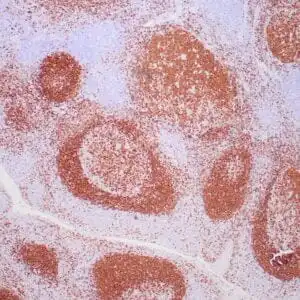
- Control: Tonsil
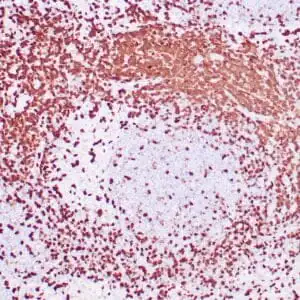
- Visualization: Nuclear
- 0.1, 0.5, 1.0 mL concentrated, 7 mL prediluted
mouse anti-PAX-5 monoclonal antibody ZM26 6320
| target relevance |
|---|
| Homo sapiens PAX5 Paired box protein Pax-5 |
| Protein names Paired box protein Pax-5 |
| Alternative names B-cell-specific transcription factor |
| Gene names PAX5 |
| Function Transcription factor that plays an essential role in commitment of lymphoid progenitors to the B-lymphocyte lineage (PubMed:10811620, PubMed:27181361). Fulfills a dual role by repressing B-lineage inappropriate genes and simultaneously activating B-lineage-specific genes (PubMed:10811620, PubMed:27181361). In turn, regulates cell adhesion and migration, induces V(H)-to-D(H)J(H) recombination, facilitates pre-B-cell receptor signaling and promotes development to the mature B-cell stage (PubMed:32612238). Repression of the cohesin-release factor WAPL causes global changes of the chromosomal architecture in pro-B cells to facilitate the generation of a diverse antibody repertoire (PubMed:32612238) |
| Subcellular location Nucleus |
| Structure (Microbial infection) Interacts (via N-terminus) with Epstein-Barr virus protein BZLF1 (via C-terminus); this interaction inhibits BZLF1-mediated lytic viral reactivation (PubMed:23678172). Interacts also with EBNA1; this interaction promotes EBNA1-dependent transcription (PubMed:31941781) |
| Post-translational modification O-glycosylated Phosphorylated by SYK. This phosphorylation plays an important role in the abolition of BLIMP1 repression by PAX5 in order to trigger plasma cell differentiation |
| Involvement in disease Leukemia, acute lymphoblastic, 3 A subtype of acute leukemia, a cancer of the white blood cells. Acute lymphoblastic anemia is a malignant disease of bone marrow and the most common malignancy diagnosed in children. The malignant cells are lymphoid precursor cells (lymphoblasts) that are arrested in an early stage of development. The lymphoblasts replace the normal marrow elements, resulting in a marked decrease in the production of normal blood cells. Consequently, anemia, thrombocytopenia, and neutropenia occur to varying degrees. The lymphoblasts also proliferate in organs other than the marrow, particularly the liver, spleen, and lymphnodes. |
| Keywords 3D-structure, Alternative splicing, Chromosomal rearrangement, Developmental protein, Differentiation, Disease variant, DNA-binding, Glycoprotein, Neurogenesis, Nucleus, Paired box, Proteomics identification, Proto-oncogene, Reference proteome, Spermatogenesis, Transcription, Transcription regulation |
| Sequence MDLEKNYPTPRTSRTGHGGVNQLGGVFVNGRPLPDVVRQRIVELAHQGVRPCDISRQLRV SHGCVSKILGRYYETGSIKPGVIGGSKPKVATPKVVEKIAEYKRQNPTMFAWEIRDRLLA ERVCDNDTVPSVSSINRIIRTKVQQPPNQPVPASSHSIVSTGSVTQVSSVSTDSAGSSYS ISGILGITSPSADTNKRKRDEGIQESPVPNGHSLPGRDFLRKQMRGDLFTQQQLEVLDRV FERQHYSDIFTTTEPIKPEQTTEYSAMASLAGGLDDMKANLASPTPADIGSSVPGPQSYP IVTGRDLASTTLPGYPPHVPPAGQGSYSAPTLTGMVPGSEFSGSPYSHPQYSSYNDSWRF PNPGLLGSPYYYSAAARGAAPPAAATAYDRH |
| UniProt accession: Q02548 |
Data
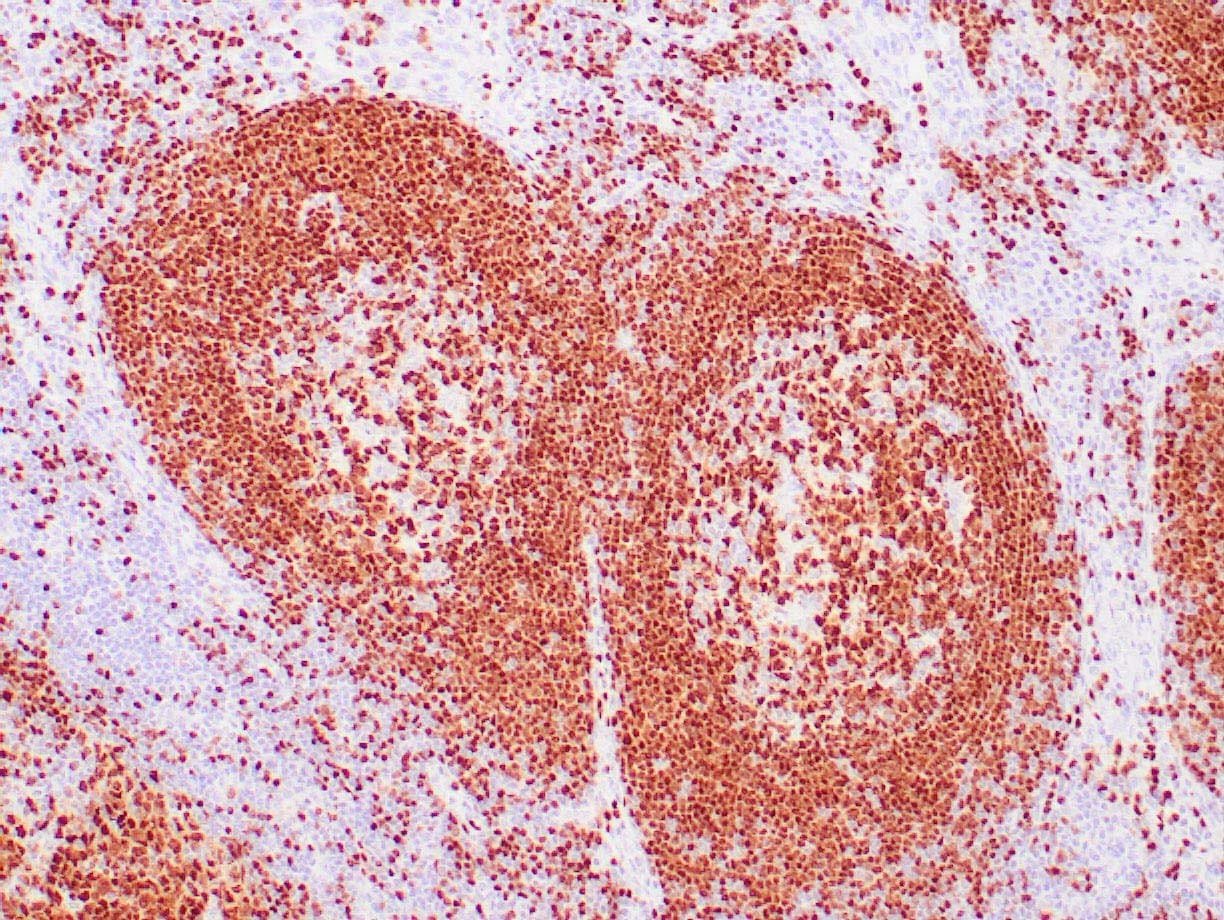 |
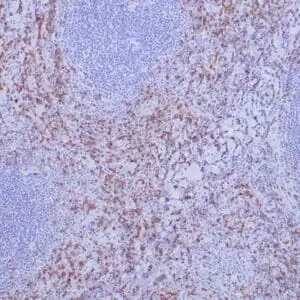
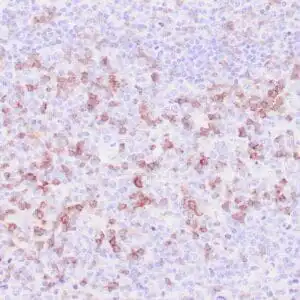
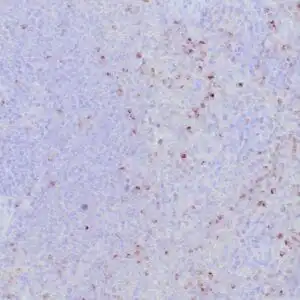
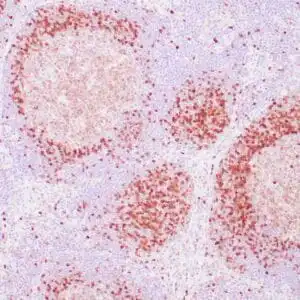
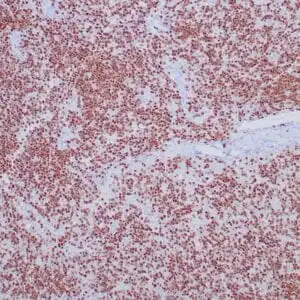
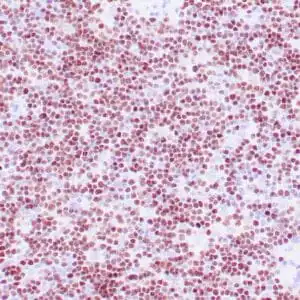
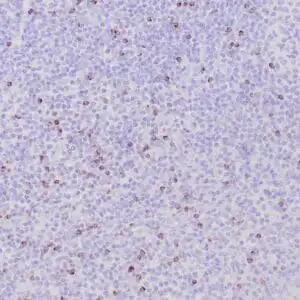
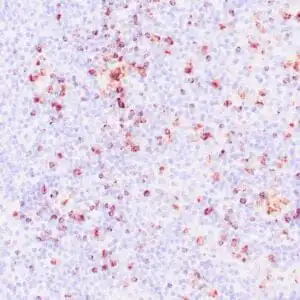
| Human lymph node stained with anti-PAX-5 antibody using peroxidase-conjugate and DAB chromogen. Note the nuclear staining in B cells in follicle. |
FAQ & Publications
Frequently Asked Questions
What applications is the mouse anti-PAX-5 monoclonal antibody (ZM26) validated for?
This antibody is validated for immunohistochemistry (IHC) on formalin-fixed, paraffin-embedded human tissues, with tonsil tissue recommended as a positive control.
How should the mouse anti-PAX-5 monoclonal antibody (ZM26) be stored to maintain stability?
For short-term storage, keep the antibody at 2-8°C, and for long-term storage, it is recommended to store at -20°C while avoiding freeze/thaw cycles to preserve antibody integrity.
Publications
| pmid | title | authors | citation |
|---|---|---|---|
| We haven't added any publications to our database yet. | |||
Published literature highly relevant to the biological target of this product and referencing this antibody or clone are retrieved from the PubMed database provided by the United States National Library of Medicine at the National Institutes of Health.
Protocols
| relevant to this product |
|---|
| IHC |
Documents
| Batch Number | QC File | SDS |
|---|---|---|
| To view batch-specific Safety Datasheets and Quality Certificates associated with your account, please Log In. | ||
Only logged in customers who have purchased this product may leave a review.


Reviews
There are no reviews yet.