| Weight | 1 lbs |
|---|---|
| Dimensions | 9 × 5 × 2 in |
| host | rabbit |
| isotype | IgG |
| clonality | polyclonal |
| concentration | 1 mg/mL |
| applications | ICC/IF, IHC, WB |
| available sizes | 100 µg |


rabbit anti-Hsp60 polyclonal antibody 9023
$409.00
Antibody summary
- Rabbit polyclonal to Hsp60
- Suitable for: WB, ICC/IF, IHC
- Reacts with: human, mouse, rat
- Isotype: IgG
- 100 µg
rabbit anti-Hsp60 polyclonal antibody 9023
| target relevance |
|---|
| Homo sapiens HSPD1 60 kDa heat shock protein, mitochondrial |
| Protein names 60 kDa heat shock protein, mitochondrial |
| Alternative names 60 kDa chaperonin, Chaperonin 60, Heat shock protein 60, Heat shock protein family D member 1, HuCHA60, Mitochondrial matrix protein P1, P60 lymphocyte protein |
| Gene names HSPD1 |
| Protein family Belongs to the chaperonin (HSP60) family |
| Function Chaperonin implicated in mitochondrial protein import and macromolecular assembly. Together with Hsp10, facilitates the correct folding of imported proteins. May also prevent misfolding and promote the refolding and proper assembly of unfolded polypeptides generated under stress conditions in the mitochondrial matrix (PubMed:11422376, PubMed:1346131). The functional units of these chaperonins consist of heptameric rings of the large subunit Hsp60, which function as a back-to-back double ring. In a cyclic reaction, Hsp60 ring complexes bind one unfolded substrate protein per ring, followed by the binding of ATP and association with 2 heptameric rings of the co-chaperonin Hsp10. This leads to sequestration of the substrate protein in the inner cavity of Hsp60 where, for a certain period of time, it can fold undisturbed by other cell components. Synchronous hydrolysis of ATP in all Hsp60 subunits results in the dissociation of the chaperonin rings and the release of ADP and the folded substrate protein (Probable) |
| Catalytic activity ATP + H2O + an unfolded polypeptide = ADP + phosphate + a folded polypeptide. |
| Subcellular location Mitochondrion matrix |
| Structure (Microbial infection) Interacts with HTLV-1 protein p40tax |
| Involvement in disease Spastic paraplegia 13, autosomal dominant A form of spastic paraplegia, a neurodegenerative disorder characterized by a slow, gradual, progressive weakness and spasticity of the lower limbs. Rate of progression and the severity of symptoms are quite variable. Initial symptoms may include difficulty with balance, weakness and stiffness in the legs, muscle spasms, and dragging the toes when walking. In some forms of the disorder, bladder symptoms (such as incontinence) may appear, or the weakness and stiffness may spread to other parts of the body. Leukodystrophy, hypomyelinating, 4 A severe autosomal recessive hypomyelinating leukodystrophy. Clinically characterized by infantile-onset rotary nystagmus, progressive spastic paraplegia, neurologic regression, motor impairment, profound intellectual disability. Death usually occurs within the first two decades of life. |
| Keywords 3D-structure, Acetylation, Alternative splicing, ATP-binding, Chaperone, Direct protein sequencing, Disease variant, Hereditary spastic paraplegia, Host-virus interaction, Isomerase, Isopeptide bond, Leukodystrophy, Mitochondrion, Neurodegeneration, Nucleotide-binding, Phosphoprotein, Proteomics identification, Reference proteome, Transit peptide, Ubl conjugation |
| Sequence MLRLPTVFRQMRPVSRVLAPHLTRAYAKDVKFGADARALMLQGVDLLADAVAVTMGPKGR TVIIEQSWGSPKVTKDGVTVAKSIDLKDKYKNIGAKLVQDVANNTNEEAGDGTTTATVLA RSIAKEGFEKISKGANPVEIRRGVMLAVDAVIAELKKQSKPVTTPEEIAQVATISANGDK EIGNIISDAMKKVGRKGVITVKDGKTLNDELEIIEGMKFDRGYISPYFINTSKGQKCEFQ DAYVLLSEKKISSIQSIVPALEIANAHRKPLVIIAEDVDGEALSTLVLNRLKVGLQVVAV KAPGFGDNRKNQLKDMAIATGGAVFGEEGLTLNLEDVQPHDLGKVGEVIVTKDDAMLLKG KGDKAQIEKRIQEIIEQLDVTTSEYEKEKLNERLAKLSDGVAVLKVGGTSDVEVNEKKDR VTDALNATRAAVEEGIVLGGGCALLRCIPALDSLTPANEDQKIGIEIIKRTLKIPAMTIA KNAGVEGSLIVEKIMQSSSEVGYDAMAGDFVNMVEKGIIDPTKVVRTALLDAAGVASLLT TAEVVVTEIPKEEKDPGMGAMGGMGGGMGGGMF |
| UniProt accession: P10809 |
Data
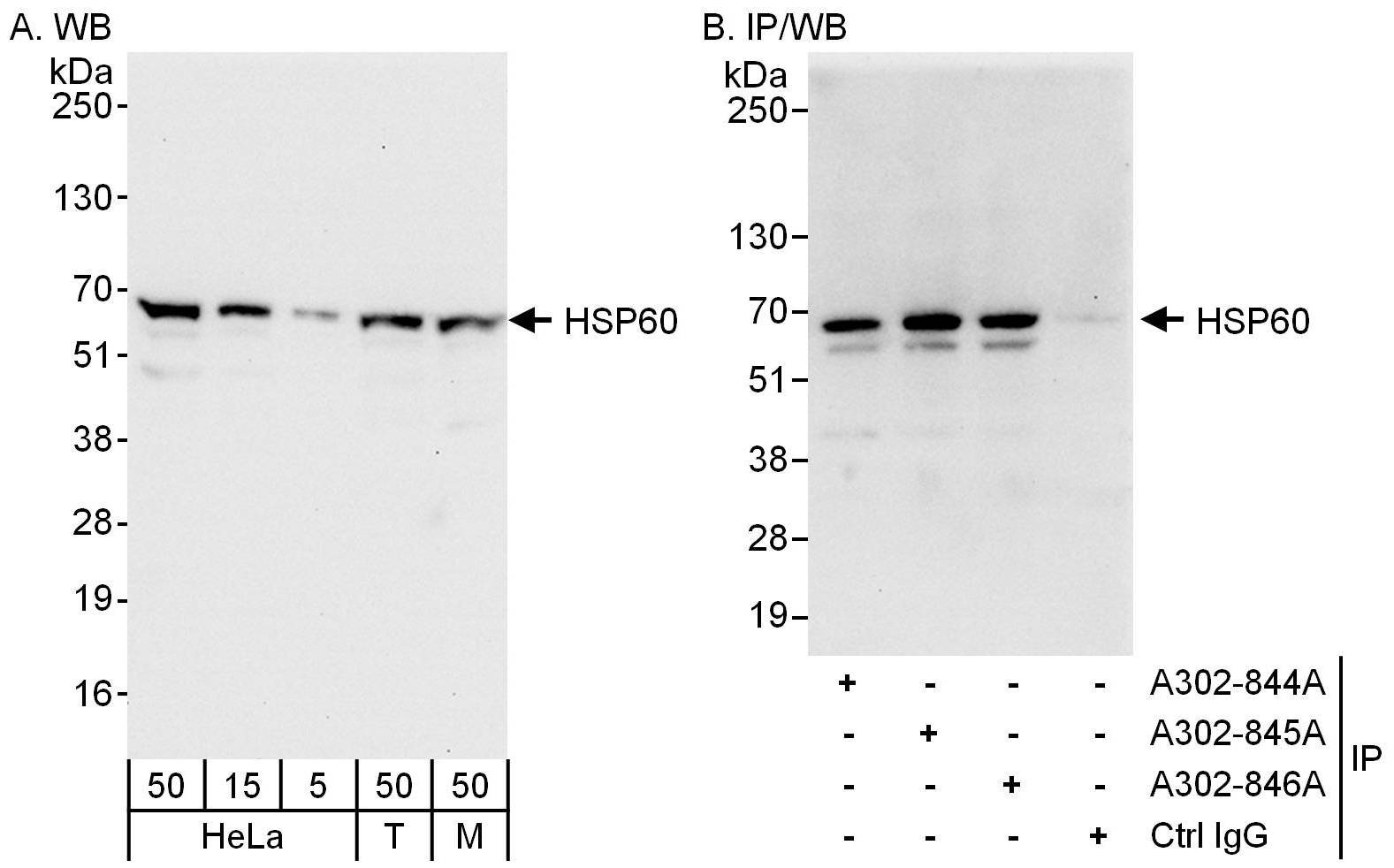 |
| Detection of human and mouse HSP60 by western blot (h&m) and immunoprecipitation (h). Samples: Whole cell lysate from HeLa (5, 15 and 50 µg for WB; 1 mg for IP, 20% of IP loaded), HEK293T (T; 50 µg), and mouse NIH 3T3 (M; 50 µg) cells. Antibodies: Affinity purified rabbit anti-HSP60 antibody used for WB at 0.04 µg/ml (A) and 0.4 µg/ml (B) and used for IP at 3 µg/mg lysate. HSP60 was also immunoprecipitated by rabbit anti-HSP60 antibodies, which recognize other epitopes. Detection: Chemiluminescence with exposure times of 10 seconds (A and B). |
 |
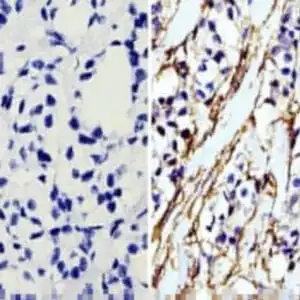
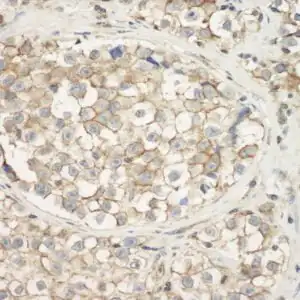
| Detection of human HSP60 by immunohistochemistry. Sample: FFPE section of human ovarian carcinoma. Antibody: Affinity purified rabbit anti-HSP60 used at a dilution of 1:200 (1µg/ml). Detection: Vector Laboratories ImmPACT NovaRED Peroxidase Substrate |
FAQ & Publications
Frequently Asked Questions
What species does the rabbit anti-Hsp60 polyclonal antibody 9023 react with?
This antibody reacts with human, mouse, and rat species.
Which applications has the rabbit anti-Hsp60 polyclonal antibody 9023 been validated for?
It has been tested and is suitable for Western blot (WB), immunocytochemistry/immunofluorescence (ICC/IF), and immunohistochemistry (IHC).
How should the rabbit anti-Hsp60 polyclonal antibody 9023 be stored for optimal stability?
For short-term storage, keep the antibody at 2-8°C, and for long-term storage, keep it at -20°C while avoiding repeated freeze/thaw cycles.
What is the immunogen used to generate the rabbit anti-Hsp60 polyclonal antibody 9023?
The immunogen is recombinant full-length human HSP60 protein expressed and purified from E. coli.
Publications
| pmid | title | authors | citation |
|---|---|---|---|
| We haven't added any publications to our database yet. | |||
Published literature highly relevant to the biological target of this product and referencing this antibody or clone are retrieved from the PubMed database provided by the United States National Library of Medicine at the National Institutes of Health.
Protocols
| relevant to this product |
|---|
| Western blot IHC ICC |
Documents
| Batch Number | QC File | SDS |
|---|---|---|
| To view batch-specific Safety Datasheets and Quality Certificates associated with your account, please Log In. | ||
Only logged in customers who have purchased this product may leave a review.



Reviews
There are no reviews yet.