| Weight | 1 lbs |
|---|---|
| Dimensions | 9 × 5 × 2 in |
| host | mouse |
| isotype | IgG2b |
| clonality | monoclonal |
| concentration | 1 mg/mL |
| applications | ELISA, ICC/IF, IHC, WB |
| reactivity | human, mouse, rat |
| available sizes | 1 mg, 100 µg, 25 µg |


mouse anti-beta actin monoclonal antibody (BA3R) 5132
Price range: $100.00 through $2,600.00
Antibody summary
- Mouse monoclonal to beta actin
- Suitable for: IHC, WB,ICC/IF,ELISA
- Reacts with: human, mouse, rat
- Isotype: IgG2b
- 100 µg, 25 µg, 1 mg
mouse anti-beta actin monoclonal antibody (BA3R) 5132
| antibody |
|---|
| Database link: human P60709 mouse P60710 rat P60711 |
| Tested applications IHC, WB,ICC/IF,ELISA |
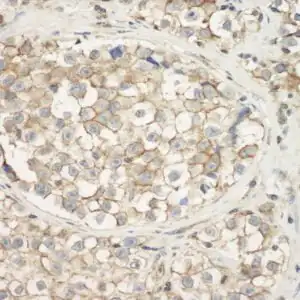
| Recommended dilutions WB: 1:1000-5000 IHC (parafin): 1:100-1:1,000 |
| Immunogen β-Actin N-terminal peptide-KLH conjugates. |
| Size and concentration 25, 100, 1000µg and 1 mg/mL |
| Form liquid |
| Storage Instructions -20°C for 2 years or more. Centrifuge after first thaw to maximize product recovery. Aliquot to avoid repeated freeze-thaw cycles. Store aliquots at 4°C for several days to weeks. |
| Storage buffer PBS, pH 7.2, 0.05% NaN3 |
| Purity affinity purified |
| Clonality monoclonal |
| Isotype IgG2b |
| Compatible secondaries goat anti-mouse IgG, H&L chain specific, peroxidase conjugated polyclonal antibody 5486 goat anti-mouse IgG, H&L chain specific, biotin conjugated, Conjugate polyclonal antibody 2685 goat anti-mouse IgG, H&L chain specific, FITC conjugated polyclonal antibody 7854 goat anti-mouse IgG, H&L chain specific, peroxidase conjugated polyclonal antibody, crossabsorbed 1706 goat anti-mouse IgG, H&L chain specific, biotin conjugated polyclonal antibody, crossabsorbed 1716 goat anti-mouse IgG, H&L chain specific, FITC conjugated polyclonal antibody, crossabsorbed 1721 |
| Isotype control Mouse monocolonal IgG2b - Isotype Control |
| target relevance |
|---|
| Homo sapiens ACTB Actin, cytoplasmic 1 |
| Protein names Actin, cytoplasmic 1 |
| Alternative names Beta-actin |
| Gene names ACTB |
| Protein family Belongs to the actin family |
| Function Actin is a highly conserved protein that polymerizes to produce filaments that form cross-linked networks in the cytoplasm of cells (PubMed:25255767, PubMed:29581253). Actin exists in both monomeric (G-actin) and polymeric (F-actin) forms, both forms playing key functions, such as cell motility and contraction (PubMed:29581253). In addition to their role in the cytoplasmic cytoskeleton, G- and F-actin also localize in the nucleus, and regulate gene transcription and motility and repair of damaged DNA (PubMed:29925947). Plays a role in the assembly of the gamma-tubulin ring complex (gTuRC), which regulates the minus-end nucleation of alpha-beta tubulin heterodimers that grow into microtubule protafilaments (PubMed:39321809, PubMed:38609661). Part of the ACTR1A/ACTB filament around which the dynactin complex is built (By similarity). The dynactin multiprotein complex activates the molecular motor dynein for ultra-processive transport along microtubules (By similarity) |
| Catalytic activity ATP + H2O = ADP + phosphate + H(+) |
| Subcellular location Cytoplasm, cytoskeleton, Nucleus |
| Structure Polymerization of globular actin (G-actin) leads to a structural filament (F-actin) in the form of a two-stranded helix (PubMed:16685646, PubMed:28604741). Each actin can bind to 4 others (PubMed:16685646, PubMed:28604741). Identified in a IGF2BP1-dependent mRNP granule complex containing untranslated mRNAs (PubMed:17289661). Component of the BAF complex, which includes at least actin (ACTB), ARID1A, ARID1B/BAF250, SMARCA2, SMARCA4/BRG1, ACTL6A/BAF53, ACTL6B/BAF53B, SMARCE1/BAF57 SMARCC1/BAF155, SMARCC2/BAF170, SMARCB1/SNF5/INI1, and one or more of SMARCD1/BAF60A, SMARCD2/BAF60B, or SMARCD3/BAF60C (PubMed:18765789). In muscle cells, the BAF complex also contains DPF3 (PubMed:18765789). Found in a complex with XPO6, Ran, ACTB and PFN1 (PubMed:14592989). Interacts with PFN1 (PubMed:10411937, PubMed:25255767). Interacts with XPO6 and EMD (PubMed:15328537). Interacts with ERBB2 (PubMed:21555369). Interacts with GCSAM (PubMed:17823310). Interacts with TBC1D21 (By similarity). Interacts with CPNE1 (via VWFA domain) and CPNE4 (via VWFA domain) (By similarity). Interacts with DHX9 (via C-terminus); this interaction is direct and mediates the attachment to nuclear ribonucleoprotein complexes (PubMed:11687588). Interacts with FAM107A (PubMed:21969592, PubMed:28604741). Associates with the gamma-tubulin ring complex (gTuRC) consisting of TUBGCP2, TUBGCP3, TUBGCP4, TUBGCP5 and TUBGCP6 and gamma-tubulin TUBG1 or TUBG2; within the complex, interacts with TUBGCP3 and TUBGCP6 to form a luminal bridge with MZT1 that stabilizes the initial structure during complex assembly (PubMed:39321809, PubMed:38609661). Part of the ACTR1A/ACTB filament around which the dynactin complex is built (By similarity). The filament contains 8 copies of ACTR1A and 1 ACTB (By similarity). Interacts with TPRN which forms ring-like structures in the stereocilium taper region; the interaction may stabilize stereocilia in inner ear hair cells (By similarity). Interacts with AMOTL2 (via N-terminus), the interaction facilitates binding of cell junction complexes to actin fibers in endothelial cells (By similarity) |
| Post-translational modification ISGylated Oxidation of Met-44 and Met-47 by MICALs (MICAL1, MICAL2 or MICAL3) to form methionine sulfoxide promotes actin filament depolymerization. MICAL1 and MICAL2 produce the (R)-S-oxide form. The (R)-S-oxide form is reverted by MSRB1 and MSRB2, which promote actin repolymerization Monomethylation at Lys-84 (K84me1) regulates actin-myosin interaction and actomyosin-dependent processes (PubMed:23673617). Demethylation by ALKBH4 is required for maintaining actomyosin dynamics supporting normal cleavage furrow ingression during cytokinesis and cell migration (PubMed:23673617) Methylated at His-73 by SETD3 (PubMed:30526847, PubMed:30626964, PubMed:30785395, PubMed:31388018). Methylation at His-73 is required for smooth muscle contraction of the laboring uterus during delivery (By similarity) N-terminal cleavage of acetylated methionine of immature cytoplasmic actin by ACTMAP N-terminal acetylation by NAA80 affects actin filament depolymerization and elongation, including elongation driven by formins (PubMed:29581253). In contrast, filament nucleation by the Arp2/3 complex is not affected (PubMed:29581253) (Microbial infection) Monomeric actin is cross-linked by V.cholerae toxins RtxA and VgrG1 in case of infection: bacterial toxins mediate the cross-link between Lys-50 of one monomer and Glu-270 of another actin monomer, resulting in formation of highly toxic actin oligomers that cause cell rounding (PubMed:19015515). The toxin can be highly efficient at very low concentrations by acting on formin homology family proteins: toxic actin oligomers bind with high affinity to formins and adversely affect both nucleation and elongation abilities of formins, causing their potent inhibition in both profilin-dependent and independent manners (PubMed:26228148) |
| Involvement in disease Dystonia-deafness syndrome 1 An autosomal dominant form of dystonia with juvenile onset, associated with congenital or childhood-onset sensorineural deafness. Dystonia is defined by the presence of sustained involuntary muscle contraction, often leading to abnormal postures. Some DDS1 patients have dysmorphic features, skeletal anomalies, and/or mild developmental delay with impaired intellectual development. Baraitser-Winter syndrome 1 A rare developmental disorder characterized by the combination of congenital ptosis, high-arched eyebrows, hypertelorism, ocular colobomata, and a brain malformation consisting of anterior-predominant lissencephaly. Other typical features include postnatal short stature and microcephaly, intellectual disability, seizures, and hearing loss. Thrombocytopenia 8, with dysmorphic features and developmental delay A form of thrombocytopenia, a hematologic disorder defined by a decrease in the number of platelets in circulating blood, resulting in the potential for increased bleeding and decreased ability for clotting. THC8 is an autosomal dominant form characterized by early-childhood onset of thrombocytopenia with platelet anisotropy. Affected individuals also have dysmorphic facial features and variable developmental delay with speech delay and mildly impaired intellectual development. Becker nevus syndrome A syndrome characterized by the association of Becker nevi with musculoskeletal abnormalities, unilateral breast hypoplasia, intellectual disability, developmental delay, and cardiomyopathy. Becker nevus is a cutaneous hamartoma that appears in childhood as a unilateral tan patch and increases in thickness, pigmentation, and hair growth during adolescence. Histologically, epidermal acanthosis is accompanied by irregularly dispersed ectopic smooth muscle bundles and increased terminal hair follicles. Most cases are sporadic. Congenital smooth muscle hamartoma, with or without hemihypertrophy A benign skin lesion that usually presents as an indurated, slightly pigmented or flesh-colored plaque with perifollicular papules or coarse hair. Histopathologically, there is excessive proliferation of ectopic smooth muscle within the dermis. Hair follicles are normal in number and hyperkeratosis, acanthosis and hyperpigmentation of the basal cell layer can sometimes be seen. Rarely, CSMH is associated with hemihypertrophy. |
| Keywords 3D-structure, Acetylation, ATP-binding, Cytoplasm, Cytoskeleton, Deafness, Direct protein sequencing, Disease variant, Dystonia, Hydrolase, Intellectual disability, Isopeptide bond, Methylation, Nucleotide-binding, Nucleus, Oxidation, Proteomics identification, Reference proteome, Ubl conjugation |
| Sequence MDDDIAALVVDNGSGMCKAGFAGDDAPRAVFPSIVGRPRHQGVMVGMGQKDSYVGDEAQS KRGILTLKYPIEHGIVTNWDDMEKIWHHTFYNELRVAPEEHPVLLTEAPLNPKANREKMT QIMFETFNTPAMYVAIQAVLSLYASGRTTGIVMDSGDGVTHTVPIYEGYALPHAILRLDL AGRDLTDYLMKILTERGYSFTTTAEREIVRDIKEKLCYVALDFEQEMATAASSSSLEKSY ELPDGQVITIGNERFRCPEALFQPSFLGMESCGIHETTFNSIMKCDVDIRKDLYANTVLS GGTTMYPGIADRMQKEITALAPSTMKIKIIAPPERKYSVWIGGSILASLSTFQQMWISKQ EYDESGPSIVHRKCF |
| UniProt accession: P60709 |
Data
 |
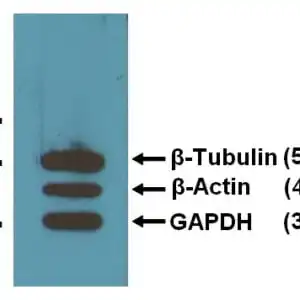
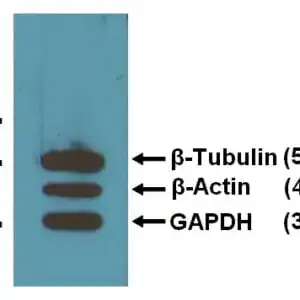
| 10µg/lane of mouse brain tissue lysates. 42kDa band is Anti-β-Actin (5132) at 1:1000 dilution (1µg/mL); |
 |
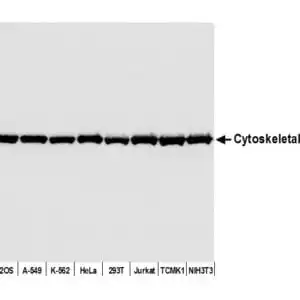
| 1:1000 (1µg/mL) 5132 vAb dilution used in WB of 20µg/lane tissue lysates from human (1), mouse (2), rat (3), and rabbit (4). |
 |
FAQ & Publications
Frequently Asked Questions
What species does the mouse anti-beta actin monoclonal antibody (BA3R) 5132 react with?
This antibody reacts with human, mouse, and rat species, making it suitable for studies involving these organisms.
Which applications has the BA3R 5132 antibody been validated for, and what are the recommended dilutions?
The antibody has been tested and is suitable for immunohistochemistry (IHC), Western blotting (WB), immunocytochemistry/immunofluorescence (ICC/IF), and ELISA. Recommended dilutions are 1:1000 to 1:5000 for Western blot, and 1:100 to 1:1000 for paraffin-embedded IHC.
How should the mouse anti-beta actin antibody be stored to maintain stability and activity?
Store the antibody at -20°C for long-term storage of two years or more. After the first thaw, centrifuge to maximize product recovery, aliquot to avoid repeated freeze-thaw cycles, and keep aliquots at 4°C for several days to weeks.
Publications
| pmid | title | authors | citation |
|---|---|---|---|
| 36852950 | Hsa_circ_0070440 promotes lung adenocarcinoma progression by SLC7A11-mediated-ferroptosis. | Yong Zhao, Qichen Cui, Jian Shen, Weihong Shen, Yuan Weng | Histol Histopathol 38:1429-1441 |
| 36780482 | HIV-1 release requires Nef-induced caspase activation. | Jason Segura, Joanna Ireland, Zhongcheng Zou, Gwynne Roth, Julianna Buchwald, Thomas J Shen, Elizabeth Fischer, Susan Moir, Tae-Wook Chun, Peter D Sun | PLoS One 18:e0281087 |
| 36596993 | Aβ efflux impairment and inflammation linked to cerebrovascular accumulation of amyloid-forming amylin secreted from pancreas. | Nirmal Verma, Gopal Viswanathan Velmurugan, Edric Winford, Han Coburn, Deepak Kotiya, Noah Leibold, Laura Radulescu, Sanda Despa, Kuey C Chen, Linda J Van Eldik, Peter T Nelson, Donna M Wilcock, Gregory A Jicha, Ann M Stowe, Larry B Goldstein, David K Powel, Jeffrey H Walton, Manuel F Navedo, Matthew A Nystoriak, Andrew J Murray, Geert Jan Biessels, Claire Troakes, Henrik Zetterberg, John Hardy, Tammaryn Lashley, Florin Despa | Commun Biol 6:2 |
| 36588703 | Naringin attenuates fructose-induced NAFLD progression in rats through reducing endogenous triglyceride synthesis and activating the Nrf2/HO-1 pathway. | Sirinat Pengnet, Phinsuda Sumarithum, Nuttaphong Phongnu, Sakdina Prommaouan, Napapas Kantip, Ittipon Phoungpetchara, Wachirawadee Malakul | Front Pharmacol 13:1049818 |
| 36561613 | Ligustroflavone exerts neuroprotective activity through suppression of NLRP1 inflammasome in ischaemic stroke mice. | Fangfang Bi, Ya Bai, Yiyong Zhang, Wenbo Liu | Exp Ther Med 25:8 |
Published literature highly relevant to the biological target of this product and referencing this antibody or clone are retrieved from the PubMed database provided by the United States National Library of Medicine at the National Institutes of Health.
Protocols
| relevant to this product |
|---|
| Western blot ICC IHC |
Only logged in customers who have purchased this product may leave a review.



Reviews
There are no reviews yet.