| Weight | 1 lbs |
|---|---|
| Dimensions | 9 × 5 × 2 in |
| host | mouse |
| isotype | IgG2a |
| clonality | monoclonal |
| concentration | 1 mg/mL |
| applications | ELISA, ICC/IF, WB |
| reactivity | human, mouse, rat |
| available sizes | 1 mg, 100 µg, 25 µg |


mouse anti-beta Tubulin monoclonal antibody (BT7R) 5007
Price range: $100.00 through $2,600.00
Antibody summary
- Mouse monoclonal to beta Tubulin
- Suitable for: WB,ICC/IF,ELISA
- Reacts with: human, mouse, rat
- Isotype: IgG2a
- 100 µg, 25 µg, 1 mg
mouse anti-beta Tubulin monoclonal antibody (BT7R) 5007
| antibody |
|---|
| Database link: human P07437 mouse P99024 rat P69897 |
| Tested applications WB,ICC/IF,ELISA |
| Recommended dilutions WB: 1:2000-5000 |
| Immunogen β-Tubulin N-terminal peptide-KLH conjugates. |
| Size and concentration 25, 100, 1000µg and 1 mg/mL |
| Form liquid |
| Storage Instructions -20°C for 2 years or more. Centrifuge after first thaw to maximize product recovery. Aliquot to avoid repeated freeze-thaw cycles. Store aliquots at 4°C for several days to weeks. |
| Storage buffer PBS, pH 7.2, 0.05% NaN3 |
| Purity affinity purified |
| Clonality monoclonal |
| Isotype IgG2a |
| Compatible secondaries goat anti-mouse IgG, H&L chain specific, peroxidase conjugated polyclonal antibody 5486 goat anti-mouse IgG, H&L chain specific, biotin conjugated, Conjugate polyclonal antibody 2685 goat anti-mouse IgG, H&L chain specific, FITC conjugated polyclonal antibody 7854 goat anti-mouse IgG, H&L chain specific, peroxidase conjugated polyclonal antibody, crossabsorbed 1706 goat anti-mouse IgG, H&L chain specific, biotin conjugated polyclonal antibody, crossabsorbed 1716 goat anti-mouse IgG, H&L chain specific, FITC conjugated polyclonal antibody, crossabsorbed 1721 |
| Isotype control Mouse monocolonal IgG2a - Isotype Control |
| target relevance |
|---|
| Homo sapiens TUBB Tubulin beta chain |
| Protein names Tubulin beta chain |
| Alternative names Tubulin beta-5 chain |
| Gene names TUBB |
| Protein family Belongs to the tubulin family |
| Function Tubulin is the major constituent of microtubules, a cylinder consisting of laterally associated linear protofilaments composed of alpha- and beta-tubulin heterodimers. Microtubules grow by the addition of GTP-tubulin dimers to the microtubule end, where a stabilizing cap forms. Below the cap, tubulin dimers are in GDP-bound state, owing to GTPase activity of alpha-tubulin |
| Subcellular location Cytoplasm, cytoskeleton |
| Structure Heterodimer of alpha and beta chains (PubMed:26637975). A typical microtubule is a hollow water-filled tube with an outer diameter of 25 nm and an inner diameter of 15 nM. Alpha-beta heterodimers associate head-to-tail to form protofilaments running lengthwise along the microtubule wall with the beta-tubulin subunit facing the microtubule plus end conferring a structural polarity. Microtubules usually have 13 protofilaments but different protofilament numbers can be found in some organisms and specialized cells. Interacts with CIMAP3 (PubMed:20643351). Interacts with DIAPH1 (PubMed:23325789). Interacts with MX1 (By similarity). May interact with RNABP10 (By similarity). Interacts with CFAP157 (By similarity). Nascent tubulin polypeptide interacts (via beta-tubulin MREI motif) with TTC5/STRAP; this interaction results in tubulin mRNA-targeted degradation (PubMed:31727855) |
| Post-translational modification Some glutamate residues at the C-terminus are polyglutamylated, resulting in polyglutamate chains on the gamma-carboxyl group (PubMed:26875866, PubMed:28576883). Polyglutamylation plays a key role in microtubule severing by spastin (SPAST). SPAST preferentially recognizes and acts on microtubules decorated with short polyglutamate tails: severing activity by SPAST increases as the number of glutamates per tubulin rises from one to eight, but decreases beyond this glutamylation threshold (PubMed:26875866). Glutamylation is also involved in cilia motility (By similarity) Some glutamate residues at the C-terminus are monoglycylated but not polyglycylated due to the absence of functional TTLL10 in human. Monoglycylation is mainly limited to tubulin incorporated into cilia and flagella axonemes, which is required for their stability and maintenance. Flagella glycylation controls sperm motility (Probable) (PubMed:28576883). Both polyglutamylation and monoglycylation can coexist on the same protein on adjacent residues, and lowering glycylation levels increases polyglutamylation, and reciprocally (Probable) (PubMed:28576883) Phosphorylated on Ser-172 by CDK1 during the cell cycle, from metaphase to telophase, but not in interphase. This phosphorylation inhibits tubulin incorporation into microtubules |
| Involvement in disease Cortical dysplasia, complex, with other brain malformations 6 A disorder of aberrant neuronal migration and disturbed axonal guidance. Affected individuals have microcephaly, ataxia, and severe delayed psychomotor development. Brain imaging shows variable malformations of cortical development, including white matter streaks, dysmorphic basal ganglia, corpus callosum abnormalities, brainstem and cerebellar hypoplasia, cortical dysplasia, polymicrogyria. Skin creases, congenital symmetric circumferential, 1 An autosomal dominant disease characterized by multiple, symmetric, circumferential rings of folded skin, affecting primarily the limbs. Affected individuals also exhibit intellectual disability, cleft palate, and dysmorphic features. |
| Keywords 3D-structure, Acetylation, Cytoplasm, Cytoskeleton, Direct protein sequencing, Disease variant, GTP-binding, Isopeptide bond, Magnesium, Metal-binding, Methylation, Microtubule, Nucleotide-binding, Phosphoprotein, Proteomics identification, Reference proteome, Ubl conjugation |
| Sequence MREIVHIQAGQCGNQIGAKFWEVISDEHGIDPTGTYHGDSDLQLDRISVYYNEATGGKYV PRAILVDLEPGTMDSVRSGPFGQIFRPDNFVFGQSGAGNNWAKGHYTEGAELVDSVLDVV RKEAESCDCLQGFQLTHSLGGGTGSGMGTLLISKIREEYPDRIMNTFSVVPSPKVSDTVV EPYNATLSVHQLVENTDETYCIDNEALYDICFRTLKLTTPTYGDLNHLVSATMSGVTTCL RFPGQLNADLRKLAVNMVPFPRLHFFMPGFAPLTSRGSQQYRALTVPELTQQVFDAKNMM AACDPRHGRYLTVAAVFRGRMSMKEVDEQMLNVQNKNSSYFVEWIPNNVKTAVCDIPPRG LKMAVTFIGNSTAIQELFKRISEQFTAMFRRKAFLHWYTGEGMDEMEFTEAESNMNDLVS EYQQYQDATAEEEEDFGEEAEEEA |
| UniProt accession: P07437 |
Data
 |
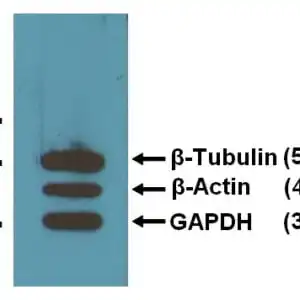
| 10µg/lane of mouse brain tissue lysates. 50kDa band is Anti-β-Tubulin (5007) at 1:2000 dilution (0.5µg/mL). |
 |
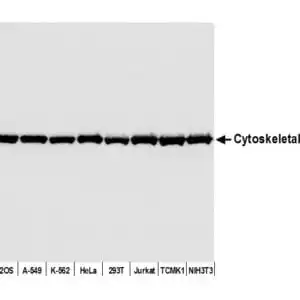
| 1:4000 (0.25µg/mL) Ab dilution used in WB of 10µg/lane (1), 5µg/lane (2), 2.5µg/lane (3), 1.25µg/lane (4) mouse brain tissue lysates. |
FAQ & Publications
Frequently Asked Questions
What species does the mouse anti-beta Tubulin monoclonal antibody (BT7R) 5007 react with?
This antibody reacts with human, mouse, and rat species, making it suitable for experiments involving these organisms.
How should the mouse anti-beta Tubulin monoclonal antibody (BT7R) 5007 be stored to maintain stability and activity?
The antibody should be stored at -20°C for long-term storage of up to two years or more. After the first thaw, centrifuge to maximize product recovery and aliquot to avoid repeated freeze-thaw cycles. Aliquots can be kept at 4°C for several days to weeks.
Publications
| pmid | title | authors | citation |
|---|---|---|---|
| We haven't added any publications to our database yet. | |||
Published literature highly relevant to the biological target of this product and referencing this antibody or clone are retrieved from the PubMed database provided by the United States National Library of Medicine at the National Institutes of Health.
Protocols
| relevant to this product |
|---|
| Western blot ICC |
Documents
| Batch Number | QC File | SDS |
|---|---|---|
| To view batch-specific Safety Datasheets and Quality Certificates associated with your account, please Log In. | ||
Only logged in customers who have purchased this product may leave a review.



Reviews
There are no reviews yet.