| Weight | 1 lbs |
|---|---|
| Dimensions | 9 × 5 × 2 in |
| host | mouse |
| isotype | IgG |
| clonality | monoclonal |
| concentration | concentrate, predilute |
| applications | IHC |
| reactivity | human |
| available size | 0.1 mL, 0.5 mL, 1 mL concentrated, 7 mL prediluted |

rabbit anti-CD5 monoclonal antibody (ZR228) 6101
Price range: $160.00 through $528.00
Antibody summary
- Rabbit monoclonal to CD5
- Suitable for: Immunohistochemistry (formalin-fixed, paraffin-embedded tissues)
- Reacts with: Human
- Isotype:IgG
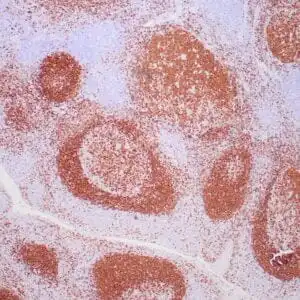
- Control: Tonsil
- Visualization: Membrane
- 0.1, 0.5, 1.0 mL concentrated, 7 mL prediluted
rabbit anti-CD5 monoclonal antibody ZR228 6101
| target relevance |
|---|
| Homo sapiens CD5 T-cell surface glycoprotein CD5 |
| Protein names T-cell surface glycoprotein CD5 |
| Alternative names Lymphocyte antigen T1/Leu-1 |
| Gene names CD5 |
| Function Lymphoid-specific receptor expressed by all T-cells and in a subset of B-cells known as B1a cells. Plays a role in the regulation of TCR and BCR signaling, thymocyte selection, T-cell effector differentiation and immune tolerance. Acts by interacting with several ligands expressed on B-cells such as CD5L or CD72 and thereby plays an important role in contact-mediated, T-dependent B-cell activation and in the maintenance of regulatory T and B-cell homeostasis. Functions as a negative regulator of TCR signaling during thymocyte development by associating with several signaling proteins including LCK, CD3Z chain, PI3K or CBL (PubMed:1384049, PubMed:1385158). Mechanistically, co-engagement of CD3 with CD5 enhances phosphorylated CBL recruitment leading to increased VAV1 phosphorylation and degradation (PubMed:23376399). Modulates B-cell biology through ERK1/2 activation in a Ca(2+)-dependent pathway via the non-selective Ca(2+) channel TRPC1, leading to IL-10 production (PubMed:27499044) |
| Subcellular location Cell membrane |
| Structure Interacts with CD72/LYB-2 (PubMed:1711157). Interacts with PTPN6/SHP-1 (By similarity). Interacts with CBL (PubMed:23376399). Interacts with CD5L (By similarity). Interacts with CD3Z/CD247 (PubMed:1384049, PubMed:1385158) |
| Post-translational modification Phosphorylated on serine, threonine and tyrosine residues following TCR stimulation (PubMed:1385158). Phosphorylated by LCK on Tyr-453 and Tyr-487 upon TCR engagement |
| Keywords 3D-structure, Cell membrane, Disulfide bond, Glycoprotein, Membrane, Phosphoprotein, Proteomics identification, Receptor, Reference proteome, Repeat, Signal, Transmembrane, Transmembrane helix |
| Sequence MPMGSLQPLATLYLLGMLVASCLGRLSWYDPDFQARLTRSNSKCQGQLEVYLKDGWHMVC SQSWGRSSKQWEDPSQASKVCQRLNCGVPLSLGPFLVTYTPQSSIICYGQLGSFSNCSHS RNDMCHSLGLTCLEPQKTTPPTTRPPPTTTPEPTAPPRLQLVAQSGGQHCAGVVEFYSGS LGGTISYEAQDKTQDLENFLCNNLQCGSFLKHLPETEAGRAQDPGEPREHQPLPIQWKIQ NSSCTSLEHCFRKIKPQKSGRVLALLCSGFQPKVQSRLVGGSSICEGTVEVRQGAQWAAL CDSSSARSSLRWEEVCREQQCGSVNSYRVLDAGDPTSRGLFCPHQKLSQCHELWERNSYC KKVFVTCQDPNPAGLAAGTVASIILALVLLVVLLVVCGPLAYKKLVKKFRQKKQRQWIGP TGMNQNMSFHRNHTATVRSHAENPTASHVDNEYSQPPRNSHLSAYPALEGALHRSSMQPD NSSDSDYDLHGAQRL |
| UniProt accession: P06127 |
Data
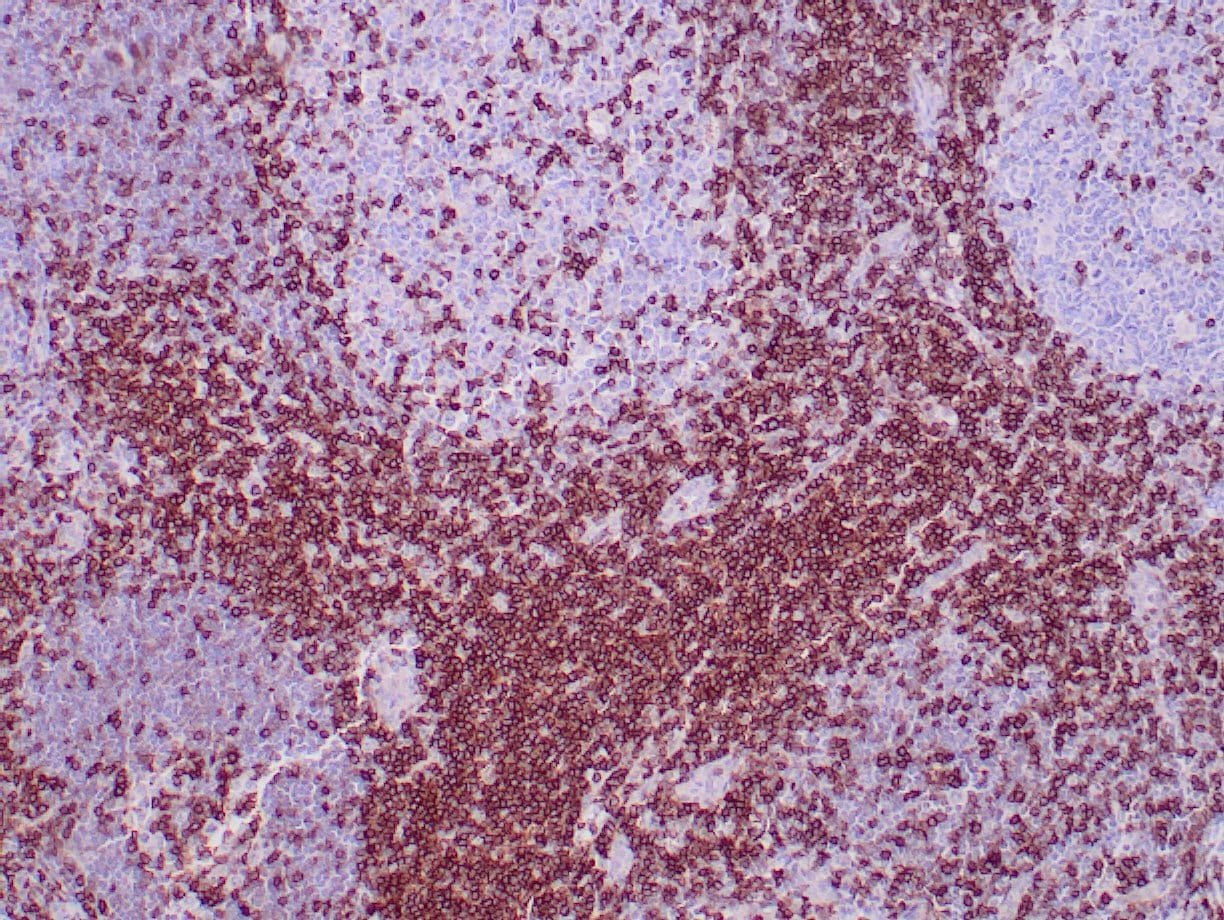 |
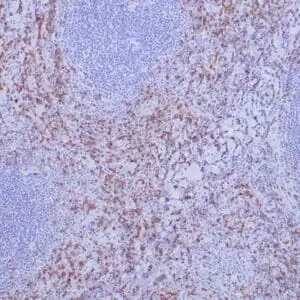
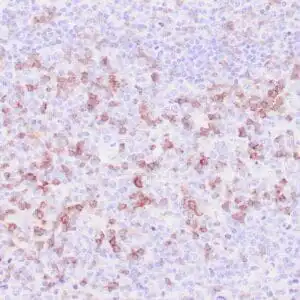
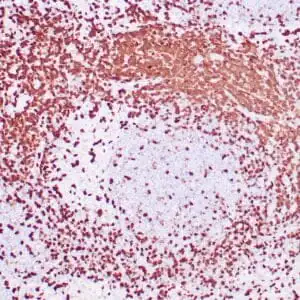
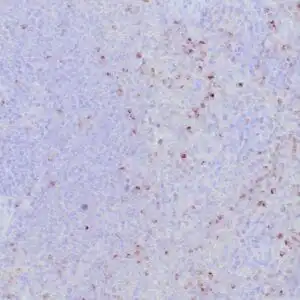
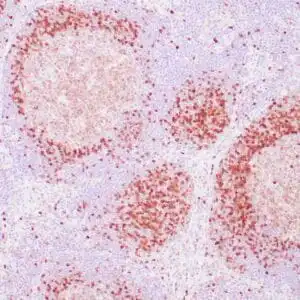
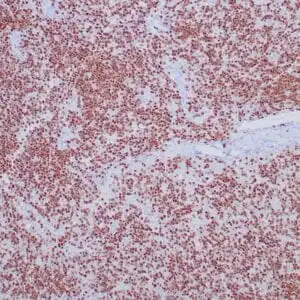
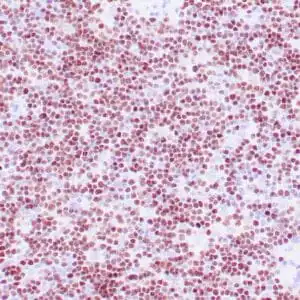
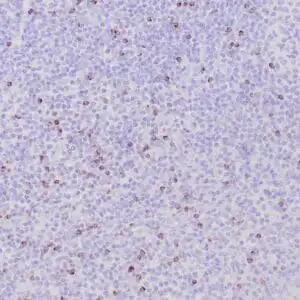
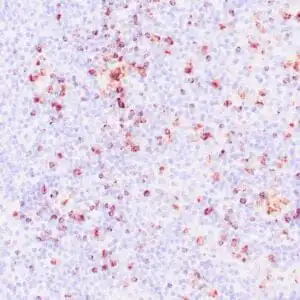
| Human tonsil stained with anti-CD5 antibody using peroxidase-conjugate and DAB chromogen. Note cell membrane staining of T-cells and no stain of B-cells. |
FAQ & Publications
Frequently Asked Questions
What is the recommended application and dilution range for the rabbit anti-CD5 monoclonal antibody (ZR228)?
This antibody is suitable for immunohistochemistry (IHC) on formalin-fixed, paraffin-embedded human tissues. The recommended dilution for the concentrated antibody is between 1:100 and 1:200.
How should the rabbit anti-CD5 monoclonal antibody (ZR228) be stored to maintain its stability?
For short-term storage, keep the antibody at 2-8°C. For longer-term preservation, store it at -20°C and avoid repeated freeze/thaw cycles to maintain antibody integrity.
Publications
| pmid | title | authors | citation |
|---|---|---|---|
| We haven't added any publications to our database yet. | |||
Published literature highly relevant to the biological target of this product and referencing this antibody or clone are retrieved from the PubMed database provided by the United States National Library of Medicine at the National Institutes of Health.
Protocols
| relevant to this product |
|---|
| IHC |
Documents
| Batch Number | QC File | SDS |
|---|---|---|
| To view batch-specific Safety Datasheets and Quality Certificates associated with your account, please Log In. | ||
Only logged in customers who have purchased this product may leave a review.


Reviews
There are no reviews yet.