| Weight | 1 lbs |
|---|---|
| Dimensions | 9 × 5 × 2 in |
| host | mouse |
| isotype | IgG |
| clonality | monoclonal |
| concentration | concentrate, predilute |
| applications | IHC |
| reactivity | human |
| available size | 0.1 mL, 0.5 mL, 1 mL concentrated, 7 mL prediluted |

rabbit anti-CD38 monoclonal antibody (ZR351) 6090
Price range: $160.00 through $528.00
Antibody summary
- Rabbit monoclonal to CD38
- Suitable for: Immunohistochemistry (formalin-fixed, paraffin-embedded tissues)
- Reacts with: Human
- Isotype:IgG
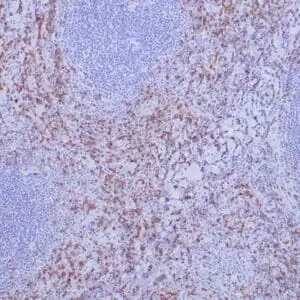
- Control: Tonsil
- Visualization: Cytoplasmic
- 0.1, 0.5, 1.0 mL concentrated, 7 mL prediluted
rabbit anti-CD38 monoclonal antibody ZR351 6090
| target relevance |
|---|
| Homo sapiens CD38 ADP-ribosyl cyclase/cyclic ADP-ribose hydrolase 1 |
| Protein names ADP-ribosyl cyclase/cyclic ADP-ribose hydrolase 1 |
| Alternative names 2'-phospho-ADP-ribosyl cyclase, 2'-phospho-ADP-ribosyl cyclase/2'-phospho-cyclic-ADP-ribose transferase, 2'-phospho-cyclic-ADP-ribose transferase, ADP-ribosyl cyclase 1, Cyclic ADP-ribose hydrolase 1, T10 |
| Gene names CD38 |
| Protein family Belongs to the ADP-ribosyl cyclase family |
| Function Multifunctional transmembrane glycoprotein able to exert enzymatic activities and also to mobilize calcium, to transduce signals, to adhere to hyaluronan and to other ligands. Synthesizes cyclic ADP-ribose (cADPR), a second messenger for glucose-induced insulin secretion (PubMed:7961800, PubMed:8253715). Synthesizes the Ca(2+) mobilizer nicotinate-adenine dinucleotide phosphate, NAADP(+), from 2'-phospho-cADPR and nicotinic acid, as well as from NADP(+) and nicotinic acid. At both pH 5.0 and pH 7.4 preferentially transforms 2'-phospho-cADPR into NAADP(+), while preferentially cleaving NADP(+) to cADPR and ADPRP rather than into NADDP(+) (PubMed:16690024). Has cADPR hydrolase activity (PubMed:7961800, PubMed:8253715). Functions also as a receptor that binds the ligand CD31 on endothelial cells, promoting lymphocyte activation, proliferation, and migration across the endothelial barrier (PubMed:9551996). Involved in the regulation of crucial dendritic cell functions acquired at the mature stage, such as CCL21-driven migration, survival, and Th1-polarizing activity (PubMed:16293598). In lamina propria T lymphocytes, CD38/CD31 cognate interactions initiate a multistep signaling pathway resulting in activation of LCK anf LAT, followed by cytokine release (PubMed:11259373) |
| Catalytic activity 2'-phospho-cyclic ADP-ribose + nicotinate = NAADP(+) NAD(+) = cyclic ADP-beta-D-ribose + nicotinamide + H(+) NAD(+) + H2O = ADP-D-ribose + nicotinamide + H(+) cyclic ADP-beta-D-ribose + H2O = ADP-D-ribose NADP(+) = 2'-phospho-cyclic ADP-ribose + nicotinamide nicotinate + NADP(+) = NAADP(+) + nicotinamide |
| Subcellular location Cell surface, Cell membrane |
| Structure Homodimer |
| Keywords 3D-structure, Alternative splicing, Cell membrane, Diabetes mellitus, Disulfide bond, Glycoprotein, Hydrolase, Membrane, NAD, NADP, Proteomics identification, Receptor, Reference proteome, Signal-anchor, Transferase, Transmembrane, Transmembrane helix |
| Sequence MANCEFSPVSGDKPCCRLSRRAQLCLGVSILVLILVVVLAVVVPRWRQQWSGPGTTKRFP ETVLARCVKYTEIHPEMRHVDCQSVWDAFKGAFISKHPCNITEEDYQPLMKLGTQTVPCN KILLWSRIKDLAHQFTQVQRDMFTLEDTLLGYLADDLTWCGEFNTSKINYQSCPDWRKDC SNNPVSVFWKTVSRRFAEAACDVVHVMLNGSRSKIFDKNSTFGSVEVHNLQPEKVQTLEA WVIHGGREDSRDLCQDPTIKELESIISKRNIQFSCKNIYRPDKFLQCVKNPEDSSCTSEI |
| UniProt accession: P28907 |
Data
 |
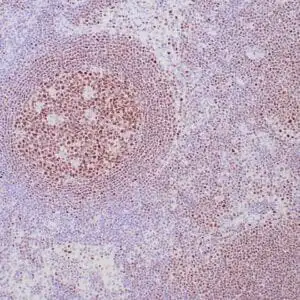
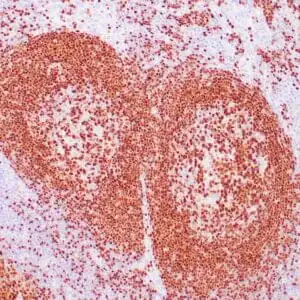
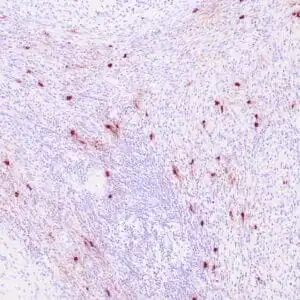
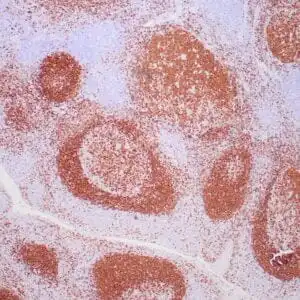
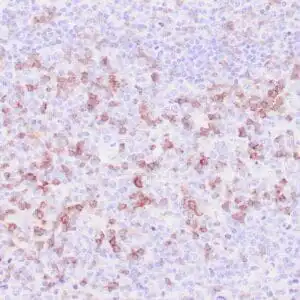
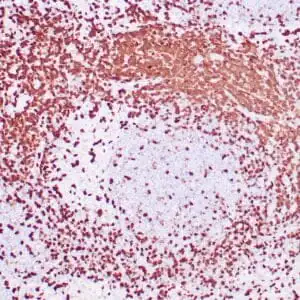
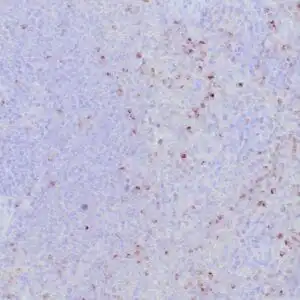
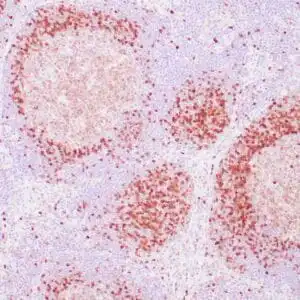
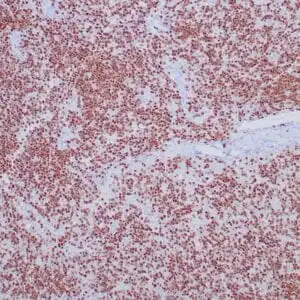
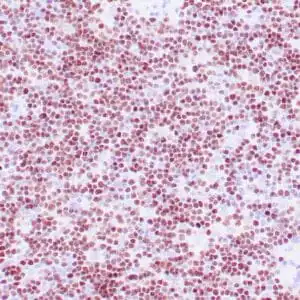
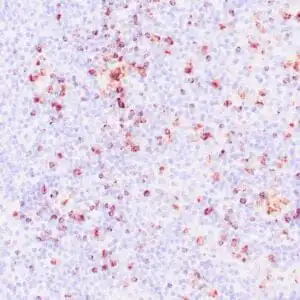
| Human tonsil stained with anti-CD38 antibody using peroxidase-conjugate and DAB chromogen. Note cytoplasmic staining of perifollicular and subepithelial plasma cells. |
FAQ & Publications
Frequently Asked Questions
What species does the rabbit anti-CD38 monoclonal antibody (ZR351) specifically react with?
This antibody specifically reacts with human species.
Which application is the rabbit anti-CD38 monoclonal antibody (ZR351) validated for?
It is validated for immunohistochemistry (IHC) on formalin-fixed, paraffin-embedded tissues.
How should the rabbit anti-CD38 monoclonal antibody (ZR351) be stored for optimal stability?
For short term storage, keep at 2-8°C; for longer term storage, keep at -20°C and avoid freeze/thaw cycles.
What is the recommended dilution range for using the concentrated rabbit anti-CD38 monoclonal antibody (ZR351) in IHC?
The recommended dilution for the concentrated antibody is between 1:100 and 1:200.
What is the immunogen used to generate the rabbit anti-CD38 monoclonal antibody (ZR351)?
The immunogen is a peptide derived from the C-terminus of the human CD38 protein.
Publications
| pmid | title | authors | citation |
|---|---|---|---|
| We haven't added any publications to our database yet. | |||
Published literature highly relevant to the biological target of this product and referencing this antibody or clone are retrieved from the PubMed database provided by the United States National Library of Medicine at the National Institutes of Health.
Protocols
| relevant to this product |
|---|
| IHC |
Documents
| Batch Number | QC File | SDS |
|---|---|---|
| To view batch-specific Safety Datasheets and Quality Certificates associated with your account, please Log In. | ||
Only logged in customers who have purchased this product may leave a review.


Reviews
There are no reviews yet.