| Weight | 1 lbs |
|---|---|
| Dimensions | 9 × 5 × 2 in |
| host | mouse |
| isotype | IgG |
| clonality | monoclonal |
| concentration | concentrate, predilute |
| applications | IHC |
| reactivity | human |
| available size | 0.1 mL, 0.5 mL, 1 mL concentrated, 7 mL prediluted |

rabbit anti-CD27 monoclonal antibody (ZR402) 6080
Price range: $160.00 through $528.00
Antibody summary
- Rabbit monoclonal to CD27
- Suitable for: Immunohistochemistry (formalin-fixed, paraffin-embedded tissues)
- Reacts with: Human
- Isotype:IgG
- Control: Thymus
- Visualization: Cell surface
- 0.1, 0.5, 1.0 mL concentrated, 7 mL prediluted
rabbit anti-CD27 monoclonal antibody ZR402 6080
| target relevance |
|---|
| Protein names CD27 antigen (CD27L receptor) (T-cell activation antigen CD27) (T14) (Tumor necrosis factor receptor superfamily member 7) (CD antigen CD27) |
| Gene names CD27,CD27 TNFRSF7 |
| Mass 29137Da |
| Function FUNCTION: Costimulatory immune-checkpoint receptor expressed at the surface of T-cells, NK-cells and B-cells which binds to and is activated by its ligand CD70/CD27L expressed by B-cells (PubMed:28011863). The CD70-CD27 signaling pathway mediates antigen-specific T-cell activation and expansion which in turn provides immune surveillance of B-cells (PubMed:28011863). Mechanistically, CD70 ligation activates the TRAF2-PTPN6 axis that subsequently inhibits LCK phosphorylation to promote phenotypic and transcriptional adaptations of T-cell memory (PubMed:38354704). In addition, activation by CD70 on early progenitor cells provides a negative feedback signal to leukocyte differentiation during immune activation and thus modulates hematopoiesis (By similarity). Negatively regulates the function of Th2 lymphocytes in the adipose tissue (By similarity). {ECO:0000250|UniProtKB:P41272, ECO:0000269|PubMed:28011863, ECO:0000269|PubMed:38354704}. |
| Subellular location SUBCELLULAR LOCATION: Cell membrane {ECO:0000269|PubMed:28011863}; Single-pass type I membrane protein {ECO:0000255}. |
| Tissues TISSUE SPECIFICITY: Found in most T-lymphocytes. {ECO:0000269|PubMed:1655907}. |
| Structure SUBUNIT: Homodimer (PubMed:1655907, PubMed:34419446). Interacts with SIVA1; may play a role in apoptosis through association with SIVA1 (PubMed:9177220). Interacts with TRAF2 (PubMed:38354704, PubMed:9692890). Interacts ith PTPN6 (PubMed:38354704). {ECO:0000269|PubMed:1655907, ECO:0000269|PubMed:34419446, ECO:0000269|PubMed:38354704, ECO:0000269|PubMed:9177220, ECO:0000269|PubMed:9692890}. |
| Post-translational modification PTM: Phosphorylated. {ECO:0000303|PubMed:1655907}.; PTM: N-glycosylated. {ECO:0000269|PubMed:34419446}.; PTM: O-glycosylated with core 1 or possibly core 8 glycans. {ECO:0000269|PubMed:22171320}. |
| Involvement in disease DISEASE: Lymphoproliferative syndrome 2 (LPFS2) [MIM:615122]: An autosomal recessive immunodeficiency disorder associated with persistent symptomatic EBV viremia, hypogammaglobulinemia, and impaired T-cell-dependent B-cell responses and T-cell dysfunction. The phenotype is highly variable, ranging from asymptomatic borderline-low hypogammaglobulinemia, to a full-blown symptomatic systemic inflammatory response with life-threatening EBV-related complications, including hemophagocytic lymphohistiocytosis, a lymphoproliferative disorder, and malignant lymphoma requiring stem cell transplantation. {ECO:0000269|PubMed:22197273, ECO:0000269|PubMed:22801960}. Note=The disease is caused by variants affecting the gene represented in this entry. |
| Target Relevance information above includes information from UniProt accession: P26842 |
| The UniProt Consortium |
Data
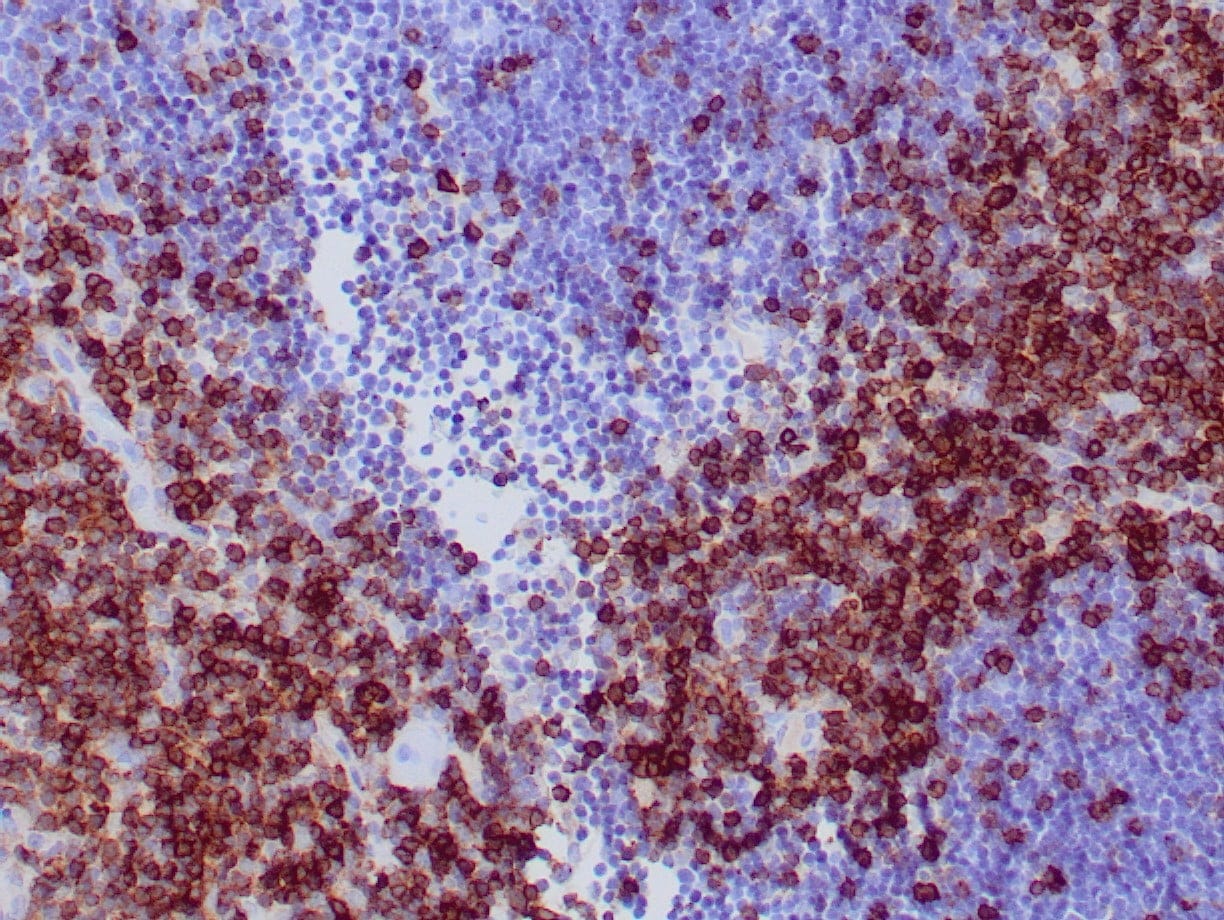 |
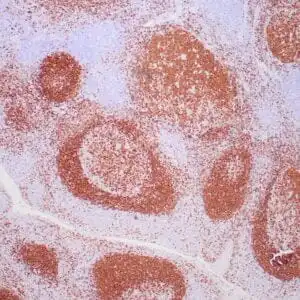
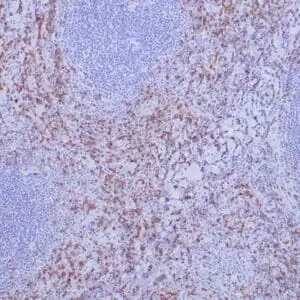
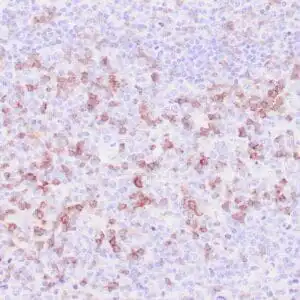
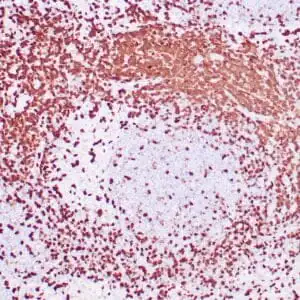
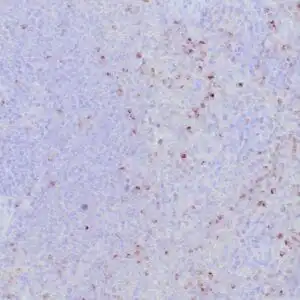
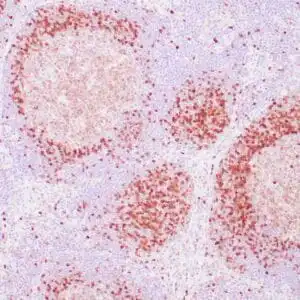
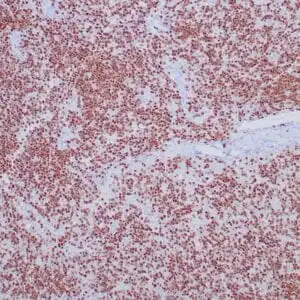
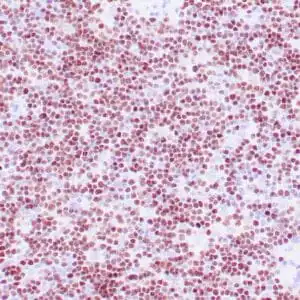
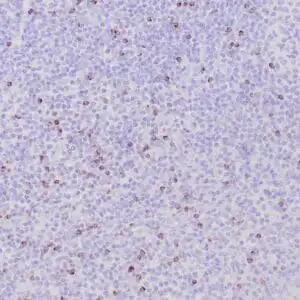
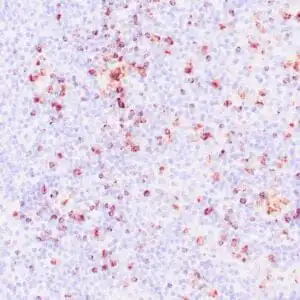
| Formalin-Fixed, paraffin-embedded human thymus stained with anti-CD27 antibody using peroxidase-conjugate and DAB chromogen. Note the cell surface staining of medullary T cells |
FAQ & Publications
Frequently Asked Questions
What species is the rabbit anti-CD27 monoclonal antibody (ZR402) reactive with?
This antibody specifically reacts with human CD27 protein.
What are the recommended storage conditions for maintaining the stability of this anti-CD27 antibody?
For short-term storage, keep the antibody at 2-8°C, and for long-term storage, freeze it at -20°C. Avoid repeated freeze/thaw cycles to preserve antibody integrity.
Which applications has the rabbit anti-CD27 monoclonal antibody (ZR402) been validated for, and what are the suggested dilutions?
This antibody has been tested and validated for Immunohistochemistry (IHC) on formalin-fixed, paraffin-embedded tissues. The recommended dilution for the concentrated antibody is 1:100-200.
Publications
| pmid | title | authors | citation |
|---|---|---|---|
| We haven't added any publications to our database yet. | |||
Published literature highly relevant to the biological target of this product and referencing this antibody or clone are retrieved from the PubMed database provided by the United States National Library of Medicine at the National Institutes of Health.
Protocols
| relevant to this product |
|---|
| IHC |
Documents
| Batch Number | QC File | SDS |
|---|---|---|
| To view batch-specific Safety Datasheets and Quality Certificates associated with your account, please Log In. | ||
Only logged in customers who have purchased this product may leave a review.


Reviews
There are no reviews yet.