| Weight | 1 lbs |
|---|---|
| Dimensions | 9 × 5 × 2 in |
| target | respiraRNA 3 |
| species reactivity | For the detection of Influenza A and B and Respiratory Syncytial Virus (RSV) |
| applications | RT PCR |
| assay type | direct & qualitative |
| available sizes | 96 tests |

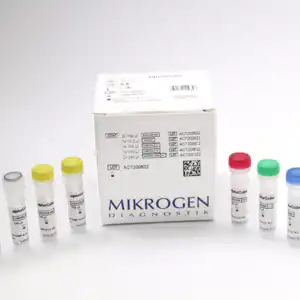
respiraRNA 3 RT-PCR test Mikrogen 830507
$487.00
Summary
- Mikrogen diagnostik RT PCR kit for research use (RUO)
- Direct Respiratory syncytial virus (RSV), Influenza A, Influenza B detection
- High sensitivity and specificity
- Internal control for monitoring nucleic acid extraction
(RNA/DNA) and real-time PCR inhibition in each reaction - Compatible with most common real-time PCR cyclers & RNA/DNA extraction methods
- 96 tests
respiraRNA 3 RT-PCR test Mikrogen 830507
| kit | |||||||||||||||
|---|---|---|---|---|---|---|---|---|---|---|---|---|---|---|---|
| Assay type RT PCR | |||||||||||||||
| Research area Infectious Disease | |||||||||||||||
| Sample type whole blood, serum, plasma, urine, tissue, stool, etc., food and environmental samples or from the carrier material | |||||||||||||||
Notes
| |||||||||||||||
Components
| |||||||||||||||
| Storage Store at -20°C. | |||||||||||||||
| Additional information Highly sensitive and specific direct detection of pathogens that can cause tick-borne infections
Applicable to human starting material as well as RNA/DNA from the tick |
| target relevance |
|---|
| Respiratory Syncytial Virus (RSV) |
| Description Virus that causes respiratory syncytial virus (RSV) infection |
| Structure Respiratory syncytial virus (RSV) is an enveloped, negative-sense, single-stranded RNA virus belonging to the genus Orthopneumovirus within the family Pneumoviridae. The virus possesses a lipid envelope containing fusion (F) and attachment (G) glycoproteins that mediate viral entry into host cells and promote the formation of multinucleated syncytia, a characteristic feature of RSV infection. RSV primarily infects epithelial cells lining the respiratory tract and is one of the leading causes of lower respiratory tract disease in infants and young children worldwide. The virus is highly contagious and spreads through respiratory droplets, direct contact, and contaminated surfaces. Reinfections are common throughout life because immunity following natural infection is incomplete. |
| Diagnosis The diagnosis of RSV infection is performed through the detection of viral antigens, viral RNA, or RSV-specific antibodies. Molecular methods such as reverse transcription polymerase chain reaction (RT-PCR) are considered the most sensitive and specific diagnostic tests and are widely used in clinical laboratories. Rapid antigen detection assays and immunofluorescence tests may provide faster results but generally have lower sensitivity, particularly in adults. Serological assays, including ELISA-based methods, may be used in epidemiological studies or for the assessment of immune responses. Laboratory confirmation is particularly important in infants, elderly individuals, immunocompromised patients, and hospitalized patients with severe respiratory disease. |
| Symptoms Respiratory syncytial virus is a major cause of upper and lower respiratory tract infections. Following an incubation period of approximately two to eight days, infected individuals typically develop symptoms including nasal congestion, runny nose, cough, sneezing, low-grade fever, and reduced appetite. In infants and young children, RSV frequently progresses to bronchiolitis or pneumonia, characterized by wheezing, rapid breathing, respiratory distress, and decreased oxygen saturation. Premature infants, elderly individuals, and immunocompromised patients are at increased risk of severe disease and hospitalization. Although most infections are self-limiting, RSV remains a significant cause of morbidity and mortality worldwide, particularly among vulnerable populations. |
Data
| No results found |
FAQ & Publications
Frequently Asked Questions
Which pathogens can be detected using the respiraRNA 3 RT-PCR test Mikrogen 830507?
The respiraRNA 3 RT-PCR test Mikrogen 830507 is designed for the direct detection of Respiratory Syncytial Virus (RSV), Influenza A, and Influenza B.
Is the respiraRNA 3 RT-PCR test compatible with common real-time PCR cyclers and RNA/DNA extraction methods?
Yes, this test is compatible with most common real-time PCR cyclers, including Roche LightCycler 480 Instrument II, Roche cobas z 480 Analyzer, Qiagen Rotor-Gene Q, Bio-Rad CFX 96, Applied Biosystems QuantStudio 5 Dx, and Stratagene Mx3000P. It also works with various RNA/DNA extraction methods, such as Mikrogen alphaClean Mag RNA/DNA Kits.
Publications
| pmid | title | authors | citation |
|---|---|---|---|
| We haven't added any publications to our database yet. | |||
Published literature highly relevant to the biological target of this product and referencing this antibody or clone are retrieved from the PubMed database provided by the United States National Library of Medicine at the National Institutes of Health.
Protocols
| relevant to this product |
|---|
| This product has moved to a digital protocol. Please use the URL provided on the product packaging to access the electronic Instructions for Use (eIFU). 830507 protocol |
Only logged in customers who have purchased this product may leave a review.
Reviews
There are no reviews yet.