| Weight | 1 lbs |
|---|---|
| Dimensions | 9 × 5 × 2 in |
| target | p. jirovecii quant |
| species reactivity | For the detection of Pneumocystis jirovecii |
| applications | RT PCR |
| assay type | direct & qualitative |
| available sizes | 96 tests |

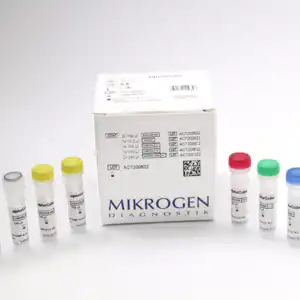
p. jirovecii quant RT-PCR test Mikrogen 830580
$487.00
Summary
- Mikrogen diagnostik RT PCR kit for research use (RUO)
- Direct Pneumocystis jirovecii detection
- High sensitivity and specificity
- Internal control for monitoring nucleic acid extraction
(RNA/DNA) and real-time PCR inhibition in each reaction - Compatible with most common real-time PCR cyclers & RNA/DNA extraction methods
- 96 tests
p. jirovecii quant RT-PCR test Mikrogen 830580
| kit | |||||||||||||||
|---|---|---|---|---|---|---|---|---|---|---|---|---|---|---|---|
| Assay type RT PCR | |||||||||||||||
| Research area Infectious Disease | |||||||||||||||
| Sample type whole blood, serum, plasma, urine, tissue, stool, etc., food and environmental samples or from the carrier material | |||||||||||||||
Notes
| |||||||||||||||
Components
| |||||||||||||||
| Storage Store at -20°C. | |||||||||||||||
| Additional information Highly sensitive and specific direct detection of pathogens that can cause tick-borne infections
Applicable to human starting material as well as RNA/DNA from the tick |
| target relevance |
|---|
| Pneumocystis jirovecii |
| Description Fungus that causes Pneumocystis pneumonia (PCP) |
| Structure Pneumocystis jirovecii is an opportunistic fungal pathogen belonging to the phylum Ascomycota. Formerly classified as a protozoan, molecular studies established its relationship to fungi, although it lacks several characteristics typical of many fungal species. P. jirovecii is highly adapted to the human host and primarily colonizes the alveoli of the lungs. The organism exists in multiple developmental forms, including trophic forms and cysts, and cannot currently be cultured continuously in standard laboratory media. Transmission is believed to occur through airborne spread between individuals. In healthy people, infection is often asymptomatic or rapidly controlled by the immune system, whereas immunocompromised individuals are at risk of severe disease. Pneumocystis jirovecii is the causative agent of Pneumocystis pneumonia (PCP), one of the most important opportunistic infections in patients with impaired cellular immunity. |
| Diagnosis The diagnosis of Pneumocystis jirovecii infection is performed through microscopic, molecular, and immunological methods. Because the organism cannot be readily cultured, diagnosis relies on the detection of organisms or nucleic acids in respiratory specimens such as induced sputum, bronchoalveolar lavage fluid, or lung tissue. Microscopic examination using specialized stains, including Gomori methenamine silver, Giemsa, or immunofluorescent staining, can identify characteristic cysts and trophic forms. Polymerase chain reaction (PCR) assays provide highly sensitive detection of Pneumocystis DNA and are widely used in clinical laboratories. Additional laboratory findings may include elevated serum beta-D-glucan levels, which support the diagnosis but are not specific for Pneumocystis infection. Radiographic imaging typically demonstrates bilateral diffuse interstitial or ground-glass pulmonary infiltrates. |
| Symptoms Pneumocystis pneumonia most commonly occurs in individuals with impaired immune function, including patients with advanced HIV infection, organ transplant recipients, individuals receiving chemotherapy, and those treated with immunosuppressive medications. Symptoms typically develop gradually over days to weeks and include progressive shortness of breath, nonproductive cough, fever, fatigue, and exercise intolerance. As the disease progresses, hypoxemia and respiratory distress may become severe, particularly during physical activity. Chest imaging frequently reveals diffuse bilateral pulmonary infiltrates. Without prompt diagnosis and treatment, Pneumocystis pneumonia can progress to acute respiratory failure and death. The disease remains a significant cause of morbidity and mortality among immunocompromised populations worldwide. |
Data
| No results found |
FAQ & Publications
Frequently Asked Questions
What sample types can be used with the p. jirovecii quant RT-PCR test Mikrogen 830580?
The test is compatible with a variety of sample types including whole blood, serum, plasma, urine, tissue, stool, as well as food and environmental samples or carrier material.
Which real-time PCR cyclers have been validated for use with the p. jirovecii quant RT-PCR test Mikrogen 830580?
This test has been validated for use with several common real-time PCR cyclers, including the Roche LightCycler 480 Instrument II, Roche cobas z 480 Analyzer, Qiagen Rotor-Gene Q, Bio-Rad CFX 96, Applied Biosystems QuantStudio 5 Dx, and Stratagene Mx3000P.
Publications
| pmid | title | authors | citation |
|---|---|---|---|
| We haven't added any publications to our database yet. | |||
Published literature highly relevant to the biological target of this product and referencing this antibody or clone are retrieved from the PubMed database provided by the United States National Library of Medicine at the National Institutes of Health.
Protocols
| relevant to this product |
|---|
| This product has moved to a digital protocol. Please use the URL provided on the product packaging to access the electronic Instructions for Use (eIFU). 830580 protocol |
Documents
| # | ||
|---|---|---|
| Please enter your product and batch number here. | ||
Only logged in customers who have purchased this product may leave a review.
Reviews
There are no reviews yet.