| Weight | 1 lbs |
|---|---|
| Dimensions | 9 × 5 × 2 in |
| host | mouse |
| isotype | IgG |
| clonality | monoclonal |
| concentration | concentrate, predilute |
| applications | IHC |
| reactivity | human |
| available size | 0.1 mL, 0.5 mL, 1 mL concentrated, 7 mL prediluted |

rabbit anti-IgG4 monoclonal antibody (ZR299) 6225
Price range: $160.00 through $528.00
Antibody summary
- Rabbit monoclonal to IgG4
- Suitable for: Immunohistochemistry (formalin-fixed, paraffin-embedded tissues)
- Reacts with: Human
- Isotype:IgG
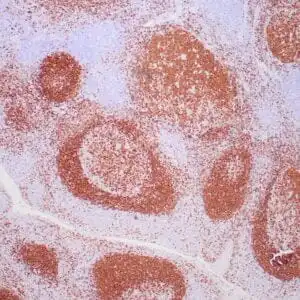
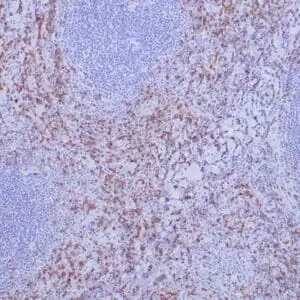
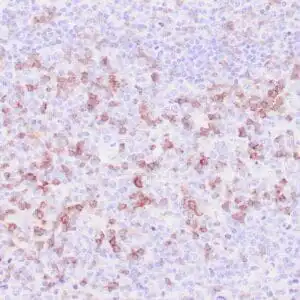
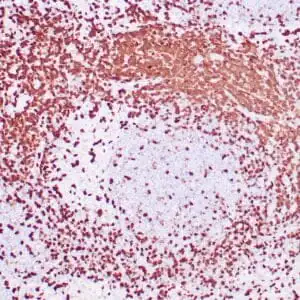
- Control: Tonsil
- Visualization: Cytoplasmic
- 0.1, 0.5, 1.0 mL concentrated, 7 mL prediluted
rabbit anti-IgG4 monoclonal antibody ZR299 6225
| target relevance |
|---|
| Homo sapiens IGHG4 Immunoglobulin heavy constant gamma 4 |
| Protein names Immunoglobulin heavy constant gamma 4 |
| Alternative names Ig gamma-4 chain C region |
| Gene names IGHG4 |
| Function Constant region of immunoglobulin (Ig) heavy chains. Igs are membrane-bound or secreted glycoproteins produced by B lymphocytes. In the recognition phase of humoral immunity, the membrane-bound Igs serve as receptors, which upon binding to a specific antigen trigger the clonal expansion and differentiation of B lymphocytes into Ig-secreting plasma cells. Secreted Igs known as antibodies mediate the effector phase of humoral immunity by blocking the interaction of infectious antigens with cellular receptors (via the antigen-binding region) and eliciting effector mechanisms that lead to pathogen neutralization (via the constant region) (PubMed:17576170, PubMed:20176268, PubMed:22158414). The antigen-binding region is formed by the variable domain of one heavy chain paired with the variable domain of its associated light chain. Each Ig molecule has two antigen-binding sites with remarkable affinity for a particular antigen due to V-(D)-J rearrangement, somatic hypermutations and affinity maturation of the variable domains upon antigen exposure (PubMed:17576170, PubMed:20176268, PubMed:22158414). The constant region defines the Ig isotype that perform distinct sets of effector functions. B cells diversify and rearrange their Ig constant regions through class-switch recombination, a process by which the constant region is switched from one Ig isotype to another, namely from IgM and IgD to IgG, IgA and IgE (PubMed:17576170, PubMed:20176268, PubMed:22158414). The constant region interacts (via the fragment crystallizable, Fc) with the Fc receptors on innate immune cells to mediate humoral effector functions. Ig gamma-4 (IgG4) isotype does not elicit antibody-dependent cellular cytotoxicity (ADDC) or complement-dependent cytotoxicity (CDC). Instead it is likely involved in immune tolerance mechanisms to allergens and parasites either by blocking IgE-antigen complex formation or by directly inhibiting mast cell degranulation through Fc receptor signaling. In the context of tumorigenesis, it may participate in immunosuppressive mechanisms |
| Subcellular location Cell membrane |
| Structure (Microbial infection) Interacts (via Fc region) with S. aureus spa/protein A (via B domain); spa interferes with the formation of IgG:C1q complexes |
| Post-translational modification N-glycosylated. Carries predominantly biantennary complex-type glycans attached at Asn-177 residue on the Fc region of each heavy chain. Unique Fc glycan profiles found in secreted IgGs are induced in an antigen-specific way, likely programmed during B cell priming to mount an appropriate Ig effector response (PubMed:22184099, PubMed:28566370, PubMed:29133956). The core glycan is composed of two sequential N-acetylglucosamine (GlcNAc) moieties followed by a central mannose (Man) from which two additional Man residues branch out (alpha1,3 and alpha1,6 antennae) each capped with a GlcNAc. Additional sugar molecules can be added to generate over 30 possible glycans. Such sugar modifications include the addition of one fucose at the initial GlcNAc, galactose (Gal) and sialic acid (Neu5Ac) residues at antennary GlcNAc or a bisecting GlcNAc to the core Man (PubMed:22184099, PubMed:28566370, PubMed:29133956). Variable addition of sugars account for different IgG functional states associated with antibody-dependent cellular cytotoxicity or phagocytosis and inflammatory responses such as complement activation and cytokine secretion. Fc N-glycan diversity is further enhanced by asymmetric glycan pairing on the heavy chains (PubMed:22184099, PubMed:28566370, PubMed:29133956). Fc N-glycan sialylation is linked to anti-inflammatory effects. It regulates Fc effector functions through conformational changes leading to preferential interaction with type II Fc receptors while reducing binding to type I Fc receptors. During plasmablast response, sialylated Fc domains within immune complexes signal via FCER2/CD23 and drive the selection of B cells with high affinity for antigen (PubMed:22184099). Whereas afucosylated Fc N-glycan preferentially activate FCGR3A, antigen-dependent cellular cytotoxicity and antitumor immunity (PubMed:28566370) (Microbial infection) Deglycosylation on Asn-177 by S.pyogenes EndoS or Endos2 endoglucosidases prevents interaction between immunoglobulin-gamma (IgG) and Fc receptors, impairing ability to activate the complement pathway |
| Keywords 3D-structure, Adaptive immunity, Alternative splicing, Cell membrane, Direct protein sequencing, Disulfide bond, Glycoprotein, Immunity, Immunoglobulin, Immunoglobulin domain, Membrane, Proteomics identification, Reference proteome, Secreted, Transmembrane, Transmembrane helix |
| Sequence ASTKGPSVFPLAPCSRSTSESTAALGCLVKDYFPEPVTVSWNSGALTSGVHTFPAVLQSS GLYSLSSVVTVPSSSLGTKTYTCNVDHKPSNTKVDKRVESKYGPPCPSCPAPEFLGGPSV FLFPPKPKDTLMISRTPEVTCVVVDVSQEDPEVQFNWYVDGVEVHNAKTKPREEQFNSTY RVVSVLTVLHQDWLNGKEYKCKVSNKGLPSSIEKTISKAKGQPREPQVYTLPPSQEEMTK NQVSLTCLVKGFYPSDIAVEWESNGQPENNYKTTPPVLDSDGSFFLYSRLTVDKSRWQEG NVFSCSVMHEALHNHYTQKSLSLSLELQLEESCAEAQDGELDGLWTTITIFITLFLLSVC YSATVTFFKVKWIFSSVVDLKQTIVPDYRNMIRQGA |
| UniProt accession: P01861 |
Data
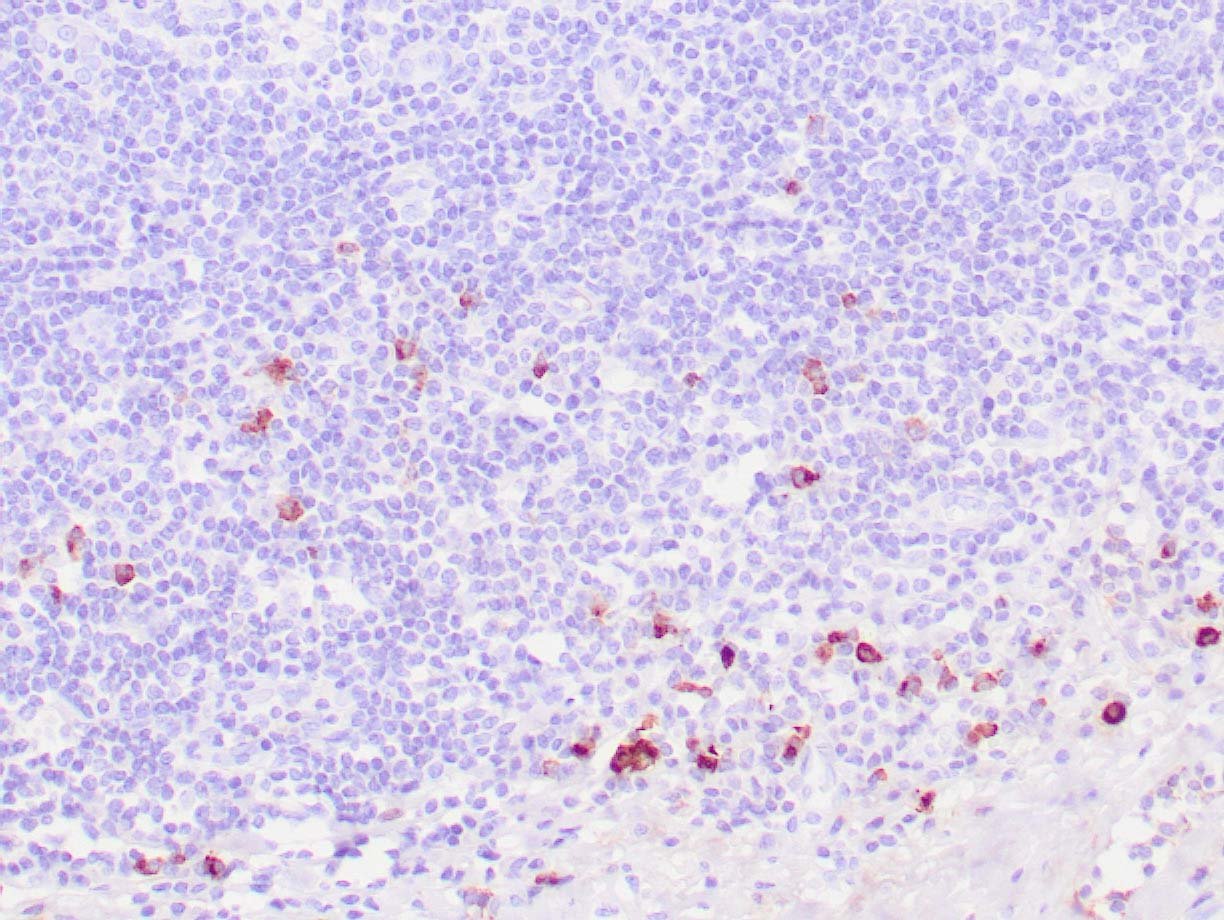 |
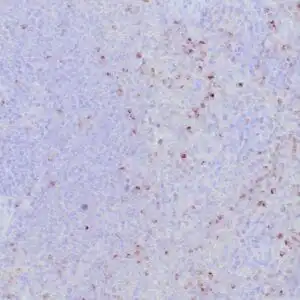
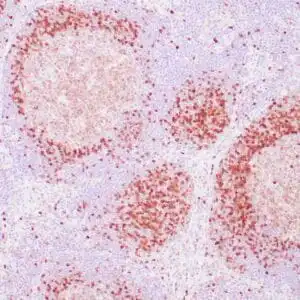
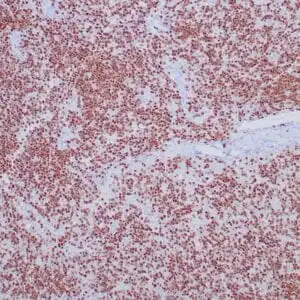
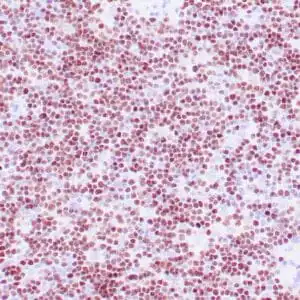
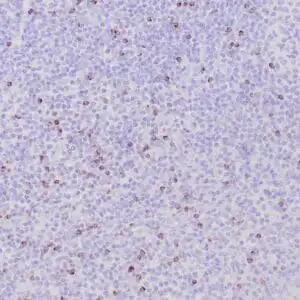
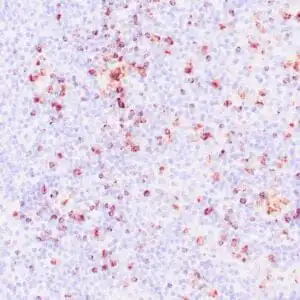
| Human tonsil stained with anti-IgG4 antibody using peroxidase-conjugate and DAB chromogen. Note the cytoplasmic staining of plasma cells. |
FAQ & Publications
Frequently Asked Questions
What species reactivity does the rabbit anti-IgG4 monoclonal antibody (ZR299) exhibit?
This antibody specifically reacts with human IgG4.
For which application has the rabbit anti-IgG4 monoclonal antibody (ZR299) been validated?
It has been validated for use in immunohistochemistry (IHC) on formalin-fixed, paraffin-embedded tissues.
What are the recommended storage conditions for maintaining the stability of this antibody?
For short-term storage, keep the antibody at 2-8°C, and for longer-term storage, freeze at -20°C while avoiding repeated freeze/thaw cycles.
What forms and concentrations are available for the rabbit anti-IgG4 monoclonal antibody (ZR299)?
The antibody is available as concentrated solutions in 0.1 mL, 0.5 mL, and 1.0 mL volumes, as well as a 7 mL prediluted form.
What is the immunogen used to generate the rabbit anti-IgG4 monoclonal antibody (ZR299)?
The immunogen is a recombinant full-length human IGHG4 protein.
Publications
| pmid | title | authors | citation |
|---|---|---|---|
| We haven't added any publications to our database yet. | |||
Published literature highly relevant to the biological target of this product and referencing this antibody or clone are retrieved from the PubMed database provided by the United States National Library of Medicine at the National Institutes of Health.
Protocols
| relevant to this product |
|---|
| IHC |
Documents
| Batch Number | QC File | SDS |
|---|---|---|
| To view batch-specific Safety Datasheets and Quality Certificates associated with your account, please Log In. | ||
Only logged in customers who have purchased this product may leave a review.


Reviews
There are no reviews yet.