| Weight | 1 lbs |
|---|---|
| Dimensions | 9 × 5 × 2 in |
| host | mouse |
| isotype | IgG |
| clonality | monoclonal |
| concentration | concentrate, predilute |
| applications | IHC |
| reactivity | human |
| available size | 0.1 mL, 0.5 mL, 1 mL concentrated, 7 mL prediluted |

rabbit anti-Cyclin D1 monoclonal antibody (ZR197) 6131
Price range: $160.00 through $528.00
Antibody summary
- Rabbit monoclonal to Cyclin D1
- Suitable for: Immunohistochemistry (formalin-fixed, paraffin-embedded tissues)
- Reacts with: Human
- Isotype:IgG
- Control: Mantle cell lymphoma
- Visualization: Nuclear
- 0.1, 0.5, 1.0 mL concentrated, 7 mL prediluted
rabbit anti-Cyclin D1 monoclonal antibody ZR197 6131
| target relevance |
|---|
| Homo sapiens CCND1 G1/S-specific cyclin-D1 |
| Protein names G1/S-specific cyclin-D1 |
| Alternative names B-cell lymphoma 1 protein, BCL-1 oncogene, PRAD1 oncogene |
| Gene names CCND1 |
| Protein family Belongs to the cyclin family. Cyclin D subfamily |
| Function Regulatory component of the cyclin D1-CDK4 (DC) complex that phosphorylates and inhibits members of the retinoblastoma (RB) protein family including RB1 and regulates the cell-cycle during G(1)/S transition (PubMed:1827756, PubMed:1833066, PubMed:19412162, PubMed:33854235, PubMed:8114739, PubMed:8302605). Phosphorylation of RB1 allows dissociation of the transcription factor E2F from the RB/E2F complex and the subsequent transcription of E2F target genes which are responsible for the progression through the G(1) phase (PubMed:1827756, PubMed:1833066, PubMed:19412162, PubMed:8114739, PubMed:8302605). Hypophosphorylates RB1 in early G(1) phase (PubMed:1827756, PubMed:1833066, PubMed:19412162, PubMed:8114739, PubMed:8302605). Cyclin D-CDK4 complexes are major integrators of various mitogenenic and antimitogenic signals (PubMed:1827756, PubMed:1833066, PubMed:19412162, PubMed:8302605). Also a substrate for SMAD3, phosphorylating SMAD3 in a cell-cycle-dependent manner and repressing its transcriptional activity (PubMed:15241418). Component of the ternary complex, cyclin D1/CDK4/CDKN1B, required for nuclear translocation and activity of the cyclin D-CDK4 complex (PubMed:9106657). Exhibits transcriptional corepressor activity with INSM1 on the NEUROD1 and INS promoters in a cell cycle-independent manner (PubMed:16569215, PubMed:18417529) |
| Subcellular location Nucleus, Cytoplasm, Nucleus membrane |
| Structure Interacts with either CDK4 or CDK6 protein kinase to form a serine/threonine kinase holoenzyme complex (PubMed:19237565, PubMed:8114739). The cyclin subunit imparts substrate specificity to the complex (PubMed:19237565, PubMed:20399237, PubMed:8302605, PubMed:9106657). Component of the ternary complex CCND1/CDK4/CDKN1B required for nuclear translocation and modulation of CDK4-mediated kinase activity (PubMed:9106657). Interacts directly with CDKN1B (By similarity). Can form similar complexes with either CDKN1A or CDKN2A (By similarity). Interacts with UHRF2; the interaction ubiquitinates CCND1 and appears to occur independently of phosphorylation (PubMed:21952639). Interacts with USP2 (PubMed:19917254). Interacts (via cyclin N-terminal domain) with INSM1 (via N-terminal region); the interaction competes with the binding of CCND1 to CDK4 during cell cycle progression and inhibits CDK4 activity (PubMed:16569215, PubMed:18417529, PubMed:19124461). Interacts with CDK4; the interaction is prevented with the binding of CCND1 to INSM1 during cell cycle progression (PubMed:19124461). Interacts with FBXO32; this interaction mediates CCND1 stabilization via 'Lys-27'-linked polyubiquitination (PubMed:40307251) |
| Post-translational modification Phosphorylation at Thr-286 by MAP kinases is required for ubiquitination and degradation by the DCX(AMBRA1) complex (PubMed:10766840, PubMed:17205132, PubMed:33854232, PubMed:33854235, PubMed:33854239). It also plays an essential role for recognition by the FBXO31 component of SCF (SKP1-cullin-F-box) protein ligase complex following DNA damage (PubMed:19412162) Ubiquitinated at Lys-269 by the DCX(AMBRA1) complex during the transition from G1 to S cell phase, leading to its degradation: ubiquitination is dependent on Thr-286 phosphorylation (PubMed:33854232, PubMed:33854235, PubMed:33854239). The DCX(AMBRA1) complex represents the major regulator of CCND1 stability during the G1/S transition (PubMed:33854232, PubMed:33854235, PubMed:33854239). Also ubiquitinated by the SCF(FBXO4) and Cul7-RING(FBXW8) ubiquitin-protein ligase complexes (PubMed:17205132). Following DNA damage it is ubiquitinated by the SCF(FBXO31) protein ligase complex (PubMed:19412162, PubMed:29279382). SCF(FBXO31) ubiquitination is dependent on Thr-286 phosphorylation (PubMed:10766840, PubMed:19412162, PubMed:29279382). Ubiquitinated also by UHRF2 apparently in a phosphorylation-independent manner (PubMed:21952639). Ubiquitination leads to its degradation and G1 arrest. Deubiquitinated by USP2; leading to its stabilization (PubMed:19917254). Ubiquitinated by FBXO32 at Lys-58 via 'Lys27'-linked polyubiquitination; leading to its stabilization (PubMed:40307251) |
| Involvement in disease Multiple myeloma A malignant tumor of plasma cells usually arising in the bone marrow and characterized by diffuse involvement of the skeletal system, hyperglobulinemia, Bence-Jones proteinuria and anemia. Complications of multiple myeloma are bone pain, hypercalcemia, renal failure and spinal cord compression. The aberrant antibodies that are produced lead to impaired humoral immunity and patients have a high prevalence of infection. Amyloidosis may develop in some patients. Multiple myeloma is part of a spectrum of diseases ranging from monoclonal gammopathy of unknown significance (MGUS) to plasma cell leukemia. |
| Keywords 3D-structure, Cell cycle, Cell division, Chromosomal rearrangement, Cyclin, Cytoplasm, DNA damage, Isopeptide bond, Membrane, Nucleus, Phosphoprotein, Proteomics identification, Proto-oncogene, Reference proteome, Repressor, Transcription, Transcription regulation, Ubl conjugation |
| Sequence MEHQLLCCEVETIRRAYPDANLLNDRVLRAMLKAEETCAPSVSYFKCVQKEVLPSMRKIV ATWMLEVCEEQKCEEEVFPLAMNYLDRFLSLEPVKKSRLQLLGATCMFVASKMKETIPLT AEKLCIYTDNSIRPEELLQMELLLVNKLKWNLAAMTPHDFIEHFLSKMPEAEENKQIIRK HAQTFVALCATDVKFISNPPSMVAAGSVVAAVQGLNLRSPNNFLSYYRLTRFLSRVIKCD PDCLRACQEQIEALLESSLRQAQQNMDPKAAEEEEEEEEEVDLACTPTDVRDVDI |
| UniProt accession: P24385 |
Data
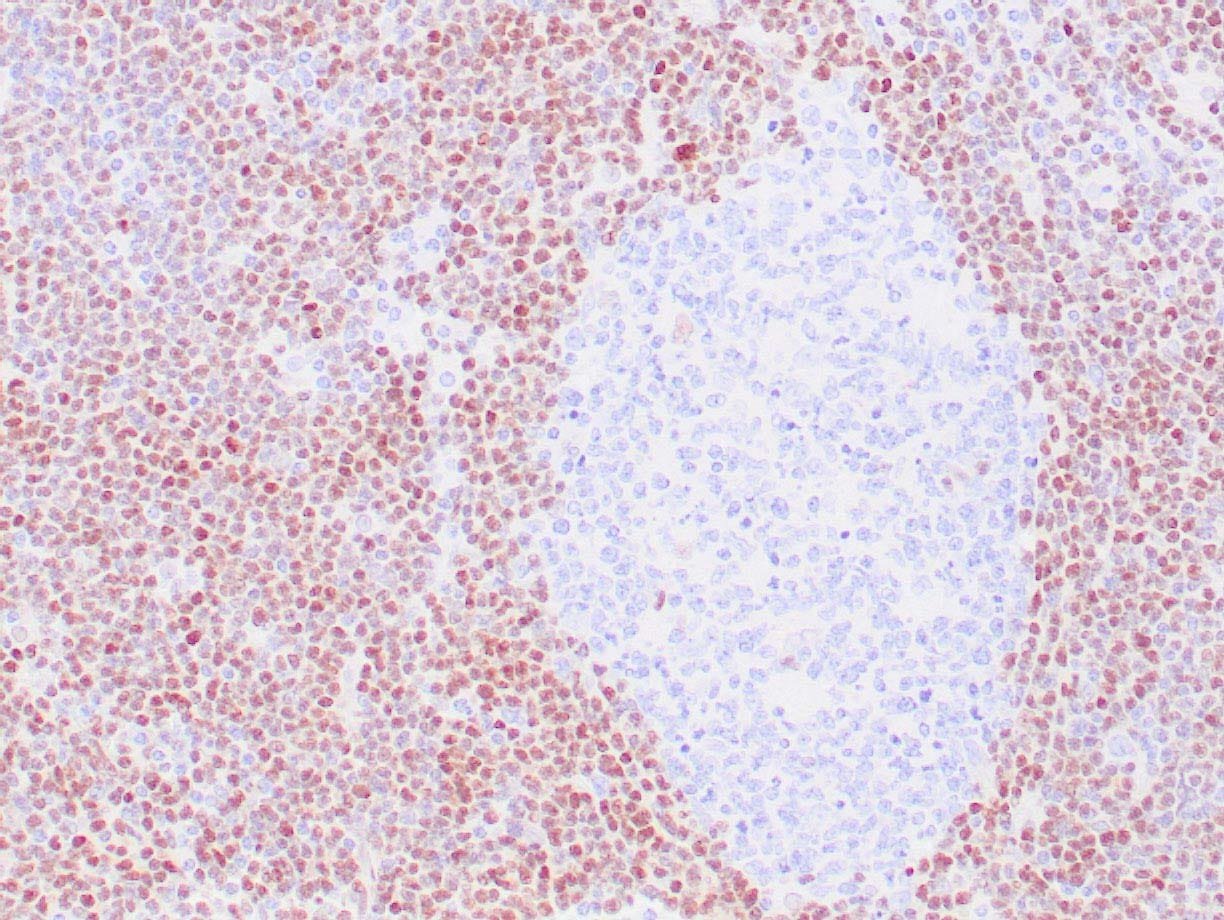 |
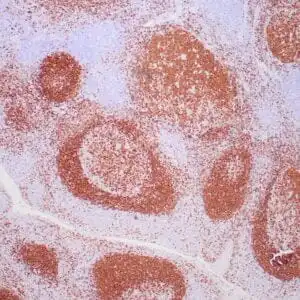
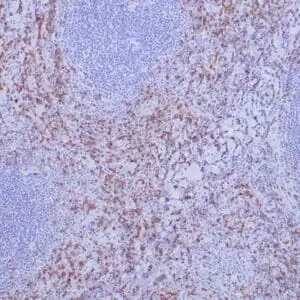
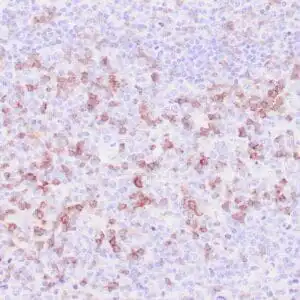
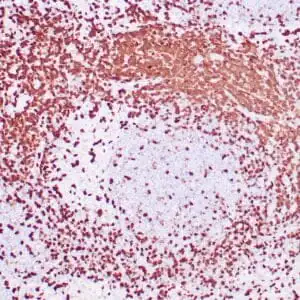
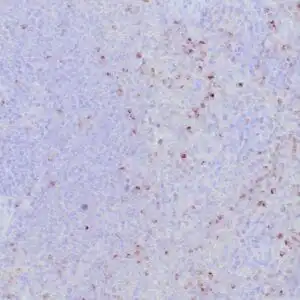
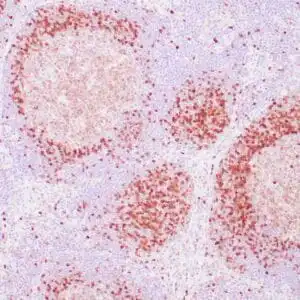
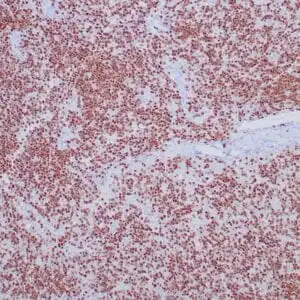
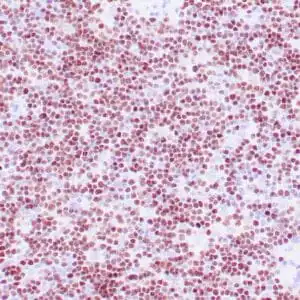
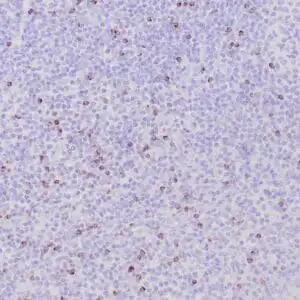
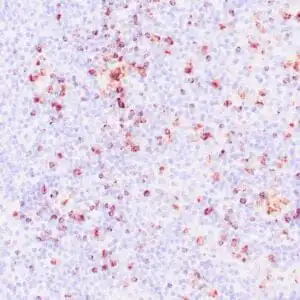
| Human mantle cell lymphoma stained with anti-Cyclin D1 antibody using peroxidase-conjugate and DAB chromogen. Note the nuclear staining of lymphoma cells. |
FAQ & Publications
Frequently Asked Questions
What species does the rabbit anti-Cyclin D1 monoclonal antibody (ZR197) specifically react with?
This antibody specifically reacts with human Cyclin D1 protein.
Which control tissue is recommended when using this antibody for immunohistochemistry?
Mantle cell lymphoma is recommended as a positive control for immunohistochemistry applications using this antibody.
What are the storage conditions for maintaining the stability of this Cyclin D1 antibody?
For short-term storage, keep the antibody at 2-8°C; for long-term storage, store at -20°C and avoid repeated freeze/thaw cycles.
Publications
| pmid | title | authors | citation |
|---|---|---|---|
| We haven't added any publications to our database yet. | |||
Published literature highly relevant to the biological target of this product and referencing this antibody or clone are retrieved from the PubMed database provided by the United States National Library of Medicine at the National Institutes of Health.
Protocols
| relevant to this product |
|---|
| IHC |
Documents
| Batch Number | QC File | SDS |
|---|---|---|
| To view batch-specific Safety Datasheets and Quality Certificates associated with your account, please Log In. | ||
Only logged in customers who have purchased this product may leave a review.


Reviews
There are no reviews yet.