| Weight | 1 lbs |
|---|---|
| Dimensions | 9 × 5 × 2 in |
| host | mouse |
| isotype | IgG |
| clonality | monoclonal |
| concentration | concentrate, predilute |
| applications | IHC |
| reactivity | human |
| available size | 0.1 mL, 0.5 mL, 1 mL concentrated, 7 mL prediluted |

rabbit anti-BCL-6 monoclonal antibody (ZR380) 6031
Price range: $160.00 through $528.00
Antibody summary
- Rabbit monoclonal to BCL-6
- Suitable for: Immunohistochemistry (formalin-fixed, paraffin-embedded tissues)
- Reacts with: Human
- Isotype:IgG
- Control: Tonsil or diffuse large B-cell lymphoma
- Visualization: Nuclear
- 0.1, 0.5, 1.0 mL concentrated, 7 mL prediluted
rabbit anti-BCL-6 monoclonal antibody ZR380 6031
| target relevance |
|---|
| Homo sapiens BCL6 B-cell lymphoma 6 protein |
| Protein names B-cell lymphoma 6 protein |
| Alternative names B-cell lymphoma 5 protein, Protein LAZ-3, Zinc finger and BTB domain-containing protein 27, Zinc finger protein 51 |
| Gene names BCL6 |
| Function Transcriptional repressor mainly required for germinal center (GC) formation and antibody affinity maturation which has different mechanisms of action specific to the lineage and biological functions. Forms complexes with different corepressors and histone deacetylases to repress the transcriptional expression of different subsets of target genes. Represses its target genes by binding directly to the DNA sequence 5'-TTCCTAGAA-3' (BCL6-binding site) or indirectly by repressing the transcriptional activity of transcription factors. In GC B-cells, represses genes that function in differentiation, inflammation, apoptosis and cell cycle control, also autoregulates its transcriptional expression and up-regulates, indirectly, the expression of some genes important for GC reactions, such as AICDA, through the repression of microRNAs expression, like miR155. An important function is to allow GC B-cells to proliferate very rapidly in response to T-cell dependent antigens and tolerate the physiological DNA breaks required for immunoglobulin class switch recombination and somatic hypermutation without inducing a p53/TP53-dependent apoptotic response. In follicular helper CD4(+) T-cells (T(FH) cells), promotes the expression of T(FH)-related genes but inhibits the differentiation of T(H)1, T(H)2 and T(H)17 cells. Also required for the establishment and maintenance of immunological memory for both T- and B-cells. Suppresses macrophage proliferation through competition with STAT5 for STAT-binding motifs binding on certain target genes, such as CCL2 and CCND2. In response to genotoxic stress, controls cell cycle arrest in GC B-cells in both p53/TP53-dependedent and -independent manners. Besides, also controls neurogenesis through the alteration of the composition of NOTCH-dependent transcriptional complexes at selective NOTCH targets, such as HES5, including the recruitment of the deacetylase SIRT1 and resulting in an epigenetic silencing leading to neuronal differentiation |
| Subcellular location Nucleus |
| Structure Homodimer. Interacts (via BTB domain) with the corepressors BCOR, NCOR1 and SMRT/NCOR2; the interactions are direct. Forms preferably ternary complexes with BCOR and SMRT/NCOR2 on target gene promoters but, on enhancer elements, interacts with SMRT/NCOR2 and HDAC3 to repress proximal gene expression. Interacts with histone deacetylases HDAC2, HDAC5 and HDAC9 (via the catalytic domain). Interacts with ZBTB7 and BCL6B. Interacts with SCF(FBXO11) complex; the interaction is independent of phosphorylation and promotes ubiquitination. Interacts (when phosphorylated) with PIN1; the interaction is required for BCL6 degradation upon genotoxic stress. Interacts with ZBTB17; inhibits ZBTB17 transcriptional activity. Interacts with CTBP1, autoinhibits its transcriptional expression. Interacts with NOTCH1 NCID and SIRT1; leads to a epigenetic repression of selective NOTCH1-target genes. Interacts (nor via BTB domain neither acetylated) with the NuRD complex components CHD4, HDAC1, MBD3 and MTA3; the interaction with MTA3 inhibits BCL6 acetylation and is required for BCL6 transpriptional repression |
| Post-translational modification Phosphorylated by MAPK1 in response to antigen receptor activation at Ser-333 and Ser-343. Phosphorylated by ATM in response to genotoxic stress. Phosphorylation induces its degradation by ubiquitin/proteasome pathway Polyubiquitinated (PubMed:22113614, PubMed:30190310, PubMed:9649500). Polyubiquitinated by SCF(FBXO11), leading to its degradation by the proteasome (PubMed:22113614). Ubiquitinated by the SCF(FBXL17) complex, leading to its degradation by the proteasome: ubiquitination by the SCF(FBXL17) complex takes place when aberrant BTB domain dimers are formed (PubMed:30190310) Acetylated at Lys-379 by EP300 which inhibits the interaction with NuRD complex and the transcriptional repressor function. Deacetylated by HDAC- and SIR2-dependent pathways |
| Keywords 3D-structure, Acetylation, Activator, Alternative splicing, Chromosomal rearrangement, DNA-binding, Immunity, Inflammatory response, Metal-binding, Nucleus, Phosphoprotein, Proteomics identification, Proto-oncogene, Reference proteome, Repeat, Repressor, Transcription, Transcription regulation, Ubl conjugation, Zinc, Zinc-finger |
| Sequence MASPADSCIQFTRHASDVLLNLNRLRSRDILTDVVIVVSREQFRAHKTVLMACSGLFYSI FTDQLKCNLSVINLDPEINPEGFCILLDFMYTSRLNLREGNIMAVMATAMYLQMEHVVDT CRKFIKASEAEMVSAIKPPREEFLNSRMLMPQDIMAYRGREVVENNLPLRSAPGCESRAF APSLYSGLSTPPASYSMYSHLPVSSLLFSDEEFRDVRMPVANPFPKERALPCDSARPVPG EYSRPTLEVSPNVCHSNIYSPKETIPEEARSDMHYSVAEGLKPAAPSARNAPYFPCDKAS KEEERPSSEDEIALHFEPPNAPLNRKGLVSPQSPQKSDCQPNSPTESCSSKNACILQASG SPPAKSPTDPKACNWKKYKFIVLNSLNQNAKPEGPEQAELGRLSPRAYTAPPACQPPMEP ENLDLQSPTKLSASGEDSTIPQASRLNNIVNRSMTGSPRSSSESHSPLYMHPPKCTSCGS QSPQHAEMCLHTAGPTFPEEMGETQSEYSDSSCENGAFFCNECDCRFSEEASLKRHTLQT HSDKPYKCDRCQASFRYKGNLASHKTVHTGEKPYRCNICGAQFNRPANLKTHTRIHSGEK PYKCETCGARFVQVAHLRAHVLIHTGEKPYPCEICGTRFRHLQTLKSHLRIHTGEKPYHC EKCNLHFRHKSQLRLHLRQKHGAITNTKVQYRVSATDLPPELPKAC |
| UniProt accession: P41182 |
Data
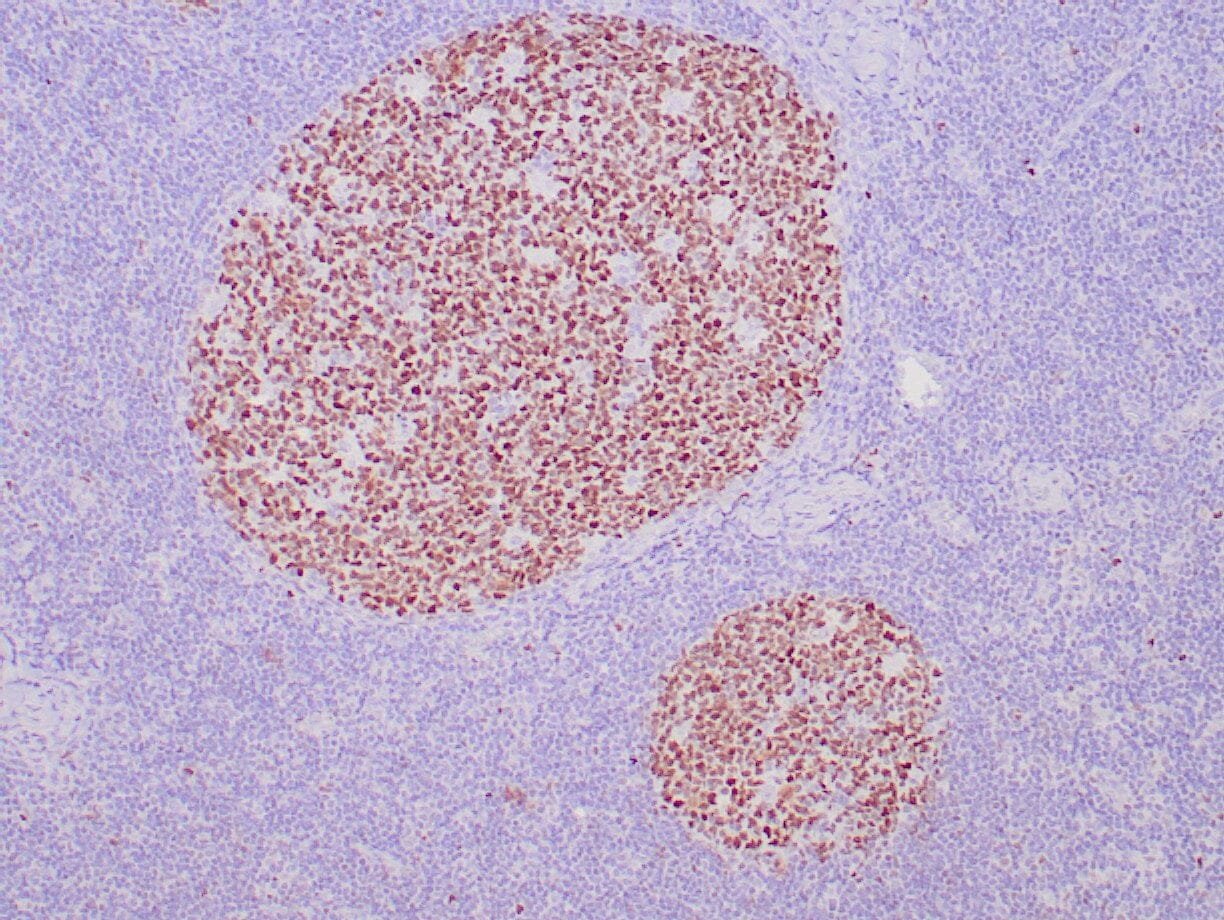 |
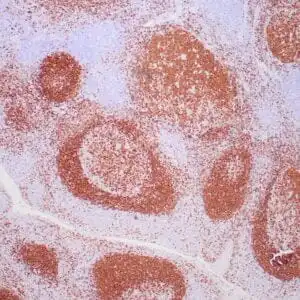
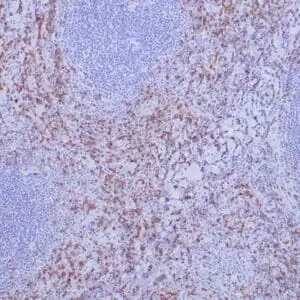
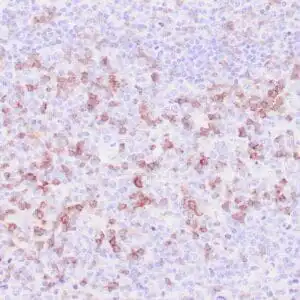
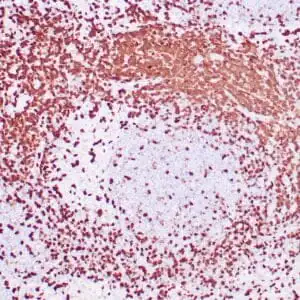
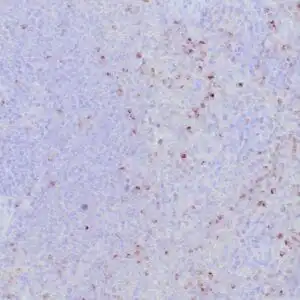
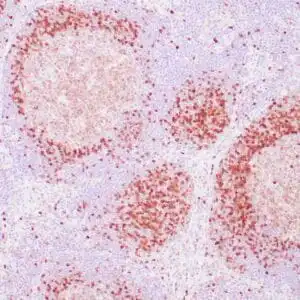
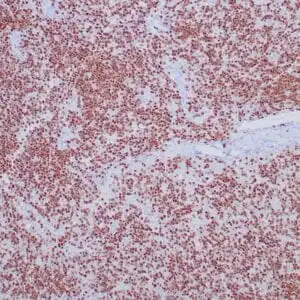
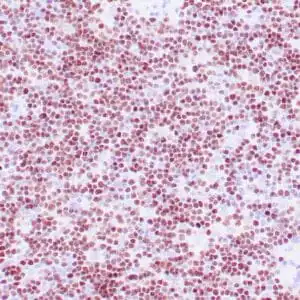
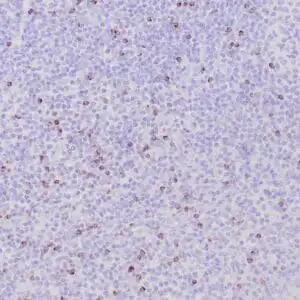
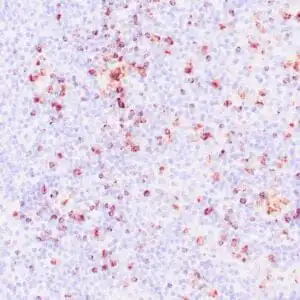
| Human reactive lymph node stained with anti-BCL-6 antibody using peroxidase-conjugate and DAB chromogen. Note nuclear staining of follicular center B-cells. |
FAQ & Publications
Frequently Asked Questions
What is the recommended application and dilution for the rabbit anti-BCL-6 monoclonal antibody (ZR380)?
This antibody is suitable for immunohistochemistry (IHC) on formalin-fixed, paraffin-embedded human tissues. The recommended dilution for the concentrated antibody is between 1:100 and 1:200.
How should the rabbit anti-BCL-6 monoclonal antibody be stored to maintain stability?
For short-term storage, keep the antibody at 2-8°C. For longer-term storage, it should be kept at -20°C. Avoid repeated freeze/thaw cycles to preserve antibody integrity.
What species does the rabbit anti-BCL-6 monoclonal antibody specifically react with, and what is its host and clonality?
This antibody is reactive with human tissues. It is a rabbit monoclonal antibody with an IgG isotype.
Publications
| pmid | title | authors | citation |
|---|---|---|---|
| We haven't added any publications to our database yet. | |||
Published literature highly relevant to the biological target of this product and referencing this antibody or clone are retrieved from the PubMed database provided by the United States National Library of Medicine at the National Institutes of Health.
Protocols
| relevant to this product |
|---|
| IHC |
Documents
| Batch Number | QC File | SDS |
|---|---|---|
| To view batch-specific Safety Datasheets and Quality Certificates associated with your account, please Log In. | ||
Only logged in customers who have purchased this product may leave a review.


Reviews
There are no reviews yet.