| Weight | 1 lbs |
|---|---|
| Dimensions | 9 × 5 × 2 in |
| host | mouse |
| isotype | IgG |
| clonality | monoclonal |
| concentration | concentrate, predilute |
| applications | IHC |
| reactivity | human |
| available size | 0.1 mL, 0.5 mL, 1 mL concentrated, 7 mL prediluted |

rabbit anti-ALK monoclonal antibody (ZR305) 6016
Price range: $160.00 through $528.00
Antibody summary
- Rabbit monoclonal to ALK
- Suitable for: Immunohistochemistry (formalin-fixed, paraffin-embedded tissues)
- Reacts with: Human
- Isotype:IgG
- Control: Anaplastic large cell lymphoma or Lung adenocarcinoma with ALK translocation
- Visualization: Cytoplasmic and nuclear
- 0.1, 0.5, 1.0 mL concentrated, 7 mL prediluted
rabbit anti-ALK monoclonal antibody ZR305 6016
| antibody |
|---|
| Database link: human Q9UM73 |
| Tested applications IHC |
| Recommended dilutions Concentrated 1:50-1 |
| Application Notes Positive control: Anaplastic large cell lymphoma or Lung adenocarcinoma with ALK translocation |
| Immunogen Human ALK-1 protein fragment around aa 1058-1620 |
| Size and concentration 7 mL prediluted or 0.1, 0.5, 1.0 mL and concentrated |
| Form liquid |
| Storage Instructions 2-8°C for short term, for longer term at -20°C. Avoid freeze / thaw cycles. |
| Purity affinity purified |
| Clonality monoclonal |
| Isotype IgG |
| Compatible secondaries goat anti-rabbit IgG, H&L chain specific, peroxidase conjugated, conjugated polyclonal antibody 9512 goat anti-rabbit IgG, H&L chain specific, biotin conjugated polyclonal antibody 2079 goat anti-rabbit IgG, H&L chain specific, FITC conjugated polyclonal antibody 7863 goat anti-rabbit IgG, H&L chain specific, Cross Absorbed polyclonal antibody 2371 goat anti-rabbit IgG, H&L chain specific, biotin conjugated polyclonal antibody, crossabsorbed 1715 goat anti-rabbit IgG, H&L chain specific, FITC conjugated polyclonal antibody, crossabsorbed 1720 |
| Isotype control Rabbit polyclonal - Isotype Control |
| target relevance |
|---|
| Homo sapiens ALK ALK tyrosine kinase receptor |
| Protein names ALK tyrosine kinase receptor |
| Alternative names Anaplastic lymphoma kinase |
| Gene names ALK |
| Protein family Belongs to the protein kinase superfamily. Tyr protein kinase family. Insulin receptor subfamily |
| Function Neuronal receptor tyrosine kinase that is essentially and transiently expressed in specific regions of the central and peripheral nervous systems and plays an important role in the genesis and differentiation of the nervous system (PubMed:11121404, PubMed:11387242, PubMed:16317043, PubMed:17274988, PubMed:30061385, PubMed:34646012, PubMed:34819673). Also acts as a key thinness protein involved in the resistance to weight gain: in hypothalamic neurons, controls energy expenditure acting as a negative regulator of white adipose tissue lipolysis and sympathetic tone to fine-tune energy homeostasis (By similarity). Following activation by ALKAL2 ligand at the cell surface, transduces an extracellular signal into an intracellular response (PubMed:30061385, PubMed:33411331, PubMed:34646012, PubMed:34819673). In contrast, ALKAL1 is not a potent physiological ligand for ALK (PubMed:34646012). Ligand-binding to the extracellular domain induces tyrosine kinase activation, leading to activation of the mitogen-activated protein kinase (MAPK) pathway (PubMed:34819673). Phosphorylates almost exclusively at the first tyrosine of the Y-x-x-x-Y-Y motif (PubMed:15226403, PubMed:16878150). Induces tyrosine phosphorylation of CBL, FRS2, IRS1 and SHC1, as well as of the MAP kinases MAPK1/ERK2 and MAPK3/ERK1 (PubMed:15226403, PubMed:16878150). ALK activation may also be regulated by pleiotrophin (PTN) and midkine (MDK) (PubMed:11278720, PubMed:11809760, PubMed:12107166, PubMed:12122009). PTN-binding induces MAPK pathway activation, which is important for the anti-apoptotic signaling of PTN and regulation of cell proliferation (PubMed:11278720, PubMed:11809760, PubMed:12107166). MDK-binding induces phosphorylation of the ALK target insulin receptor substrate (IRS1), activates mitogen-activated protein kinases (MAPKs) and PI3-kinase, resulting also in cell proliferation induction (PubMed:12122009). Drives NF-kappa-B activation, probably through IRS1 and the activation of the AKT serine/threonine kinase (PubMed:15226403, PubMed:16878150). Recruitment of IRS1 to activated ALK and the activation of NF-kappa-B are essential for the autocrine growth and survival signaling of MDK (PubMed:15226403, PubMed:16878150). May function as regulator of gastric epithelial differentiation (By similarity) |
| Catalytic activity L-tyrosyl-[protein] + ATP = O-phospho-L-tyrosyl-[protein] + ADP + H(+) |
| Subcellular location Cell membrane |
| Structure Homodimer; homodimerizes following heparin- and ligand-binding (PubMed:16317043, PubMed:25605972, PubMed:34646012, PubMed:34819673). Interacts with CBL, IRS1, PIK3R1 and PLCG1 (PubMed:15226403). Interacts with FRS2 and SHC1 (PubMed:15226403, PubMed:16878150, PubMed:17274988). Interacts with PTN and MDK (PubMed:11278720, PubMed:12122009) |
| Post-translational modification Phosphorylated at tyrosine residues by autocatalysis, which activates kinase activity (PubMed:11121404, PubMed:15938644, PubMed:16878150, PubMed:34819673). In cells not stimulated by a ligand, receptor protein tyrosine phosphatase beta and zeta complex (PTPRB/PTPRZ1) dephosphorylates ALK at the sites in ALK that are undergoing autophosphorylation through autoactivation (PubMed:17681947). Phosphorylation at Tyr-1507 is critical for SHC1 association (PubMed:17274988) N-glycosylated |
| Involvement in disease Neuroblastoma 3 A common neoplasm of early childhood arising from embryonic cells that form the primitive neural crest and give rise to the adrenal medulla and the sympathetic nervous system. |
| Keywords 3D-structure, ATP-binding, Cell membrane, Chromosomal rearrangement, Disease variant, Disulfide bond, Glycoprotein, Kinase, Membrane, Nucleotide-binding, Phosphoprotein, Proteomics identification, Proto-oncogene, Receptor, Reference proteome, Repeat, Signal, Transferase, Transmembrane, Transmembrane helix, Tyrosine-protein kinase |
| Sequence MGAIGLLWLLPLLLSTAAVGSGMGTGQRAGSPAAGPPLQPREPLSYSRLQRKSLAVDFVV PSLFRVYARDLLLPPSSSELKAGRPEARGSLALDCAPLLRLLGPAPGVSWTAGSPAPAEA RTLSRVLKGGSVRKLRRAKQLVLELGEEAILEGCVGPPGEAAVGLLQFNLSELFSWWIRQ GEGRLRIRLMPEKKASEVGREGRLSAAIRASQPRLLFQIFGTGHSSLESPTNMPSPSPDY FTWNLTWIMKDSFPFLSHRSRYGLECSFDFPCELEYSPPLHDLRNQSWSWRRIPSEEASQ MDLLDGPGAERSKEMPRGSFLLLNTSADSKHTILSPWMRSSSEHCTLAVSVHRHLQPSGR YIAQLLPHNEAAREILLMPTPGKHGWTVLQGRIGRPDNPFRVALEYISSGNRSLSAVDFF ALKNCSEGTSPGSKMALQSSFTCWNGTVLQLGQACDFHQDCAQGEDESQMCRKLPVGFYC NFEDGFCGWTQGTLSPHTPQWQVRTLKDARFQDHQDHALLLSTTDVPASESATVTSATFP APIKSSPCELRMSWLIRGVLRGNVSLVLVENKTGKEQGRMVWHVAAYEGLSLWQWMVLPL LDVSDRFWLQMVAWWGQGSRAIVAFDNISISLDCYLTISGEDKILQNTAPKSRNLFERNP NKELKPGENSPRQTPIFDPTVHWLFTTCGASGPHGPTQAQCNNAYQNSNLSVEVGSEGPL KGIQIWKVPATDTYSISGYGAAGGKGGKNTMMRSHGVSVLGIFNLEKDDMLYILVGQQGE DACPSTNQLIQKVCIGENNVIEEEIRVNRSVHEWAGGGGGGGGATYVFKMKDGVPVPLII AAGGGGRAYGAKTDTFHPERLENNSSVLGLNGNSGAAGGGGGWNDNTSLLWAGKSLQEGA TGGHSCPQAMKKWGWETRGGFGGGGGGCSSGGGGGGYIGGNAASNNDPEMDGEDGVSFIS PLGILYTPALKVMEGHGEVNIKHYLNCSHCEVDECHMDPESHKVICFCDHGTVLAEDGVS CIVSPTPEPHLPLSLILSVVTSALVAALVLAFSGIMIVYRRKHQELQAMQMELQSPEYKL SKLRTSTIMTDYNPNYCFAGKTSSISDLKEVPRKNITLIRGLGHGAFGEVYEGQVSGMPN DPSPLQVAVKTLPEVCSEQDELDFLMEALIISKFNHQNIVRCIGVSLQSLPRFILLELMA GGDLKSFLRETRPRPSQPSSLAMLDLLHVARDIACGCQYLEENHFIHRDIAARNCLLTCP GPGRVAKIGDFGMARDIYRASYYRKGGCAMLPVKWMPPEAFMEGIFTSKTDTWSFGVLLW EIFSLGYMPYPSKSNQEVLEFVTSGGRMDPPKNCPGPVYRIMTQCWQHQPEDRPNFAIIL ERIEYCTQDPDVINTALPIEYGPLVEEEEKVPVRPKDPEGVPPLLVSQQAKREEERSPAA PPPLPTTSSGKAAKKPTAAEISVRVPRGPAVEGGHVNMAFSQSNPPSELHKVHGSRNKPT SLWNPTYGSWFTEKPTKKNNPIAKKEPHDRGNLGLEGSCTVPPNVATGRLPGASLLLEPS SLTANMKEVPLFRLRHFPCGNVNYGYQQQGLPLEAATAPGAGHYEDTILKSKNSMNQPGP |
| UniProt accession: Q9UM73 |
Data
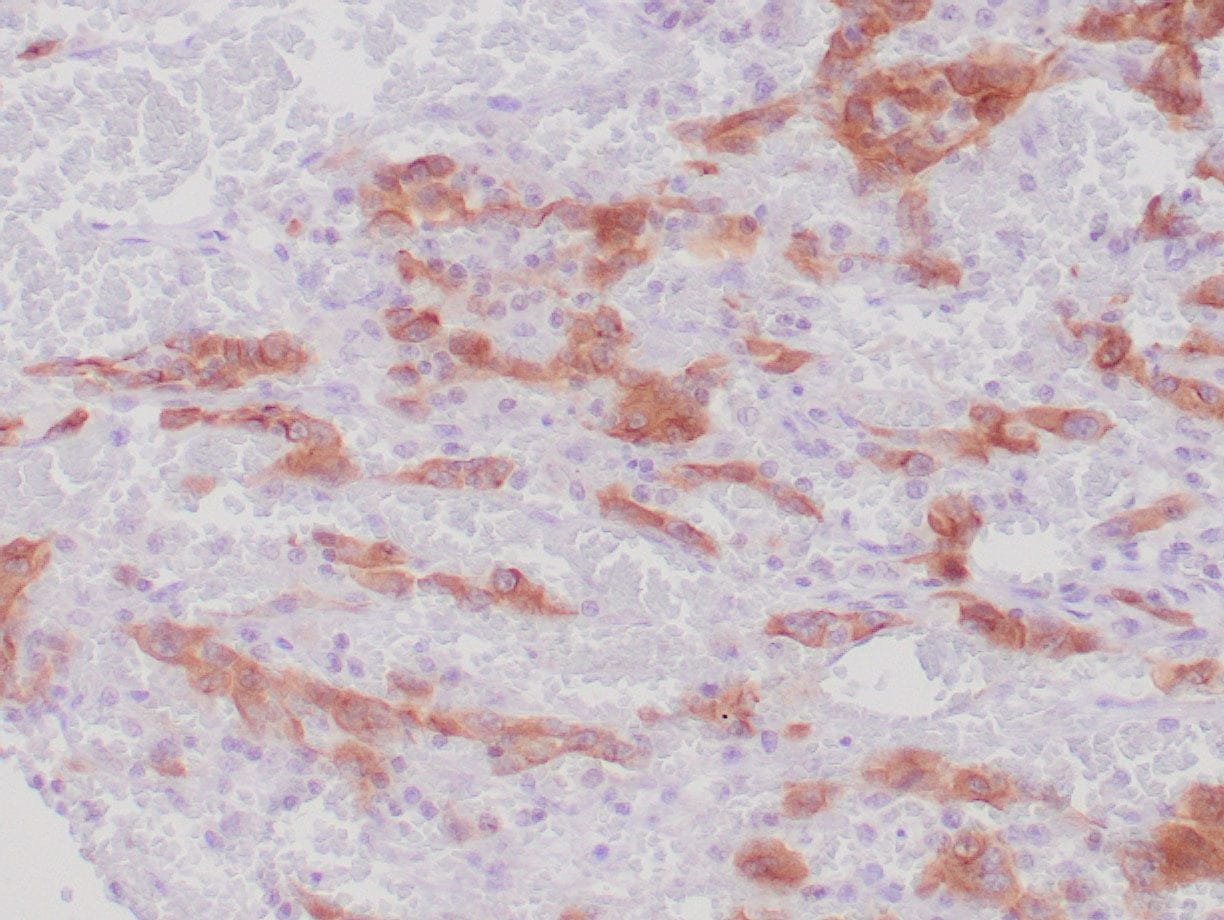 |
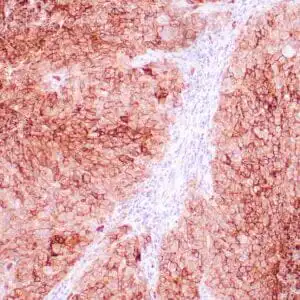
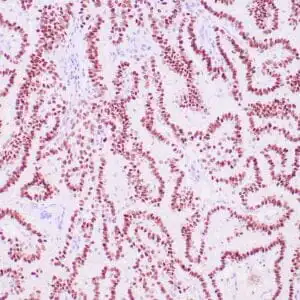
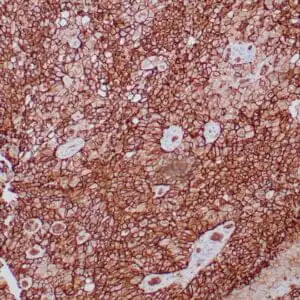
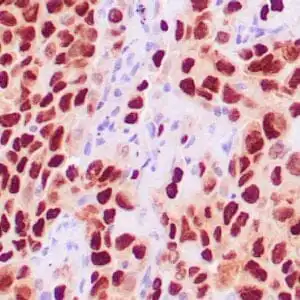
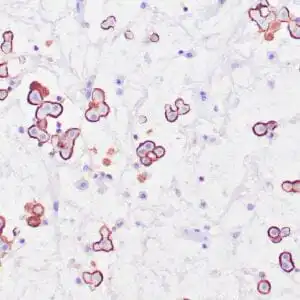
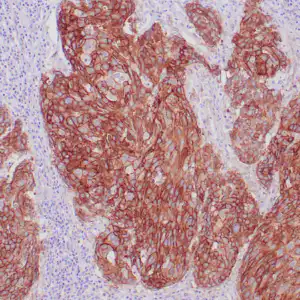
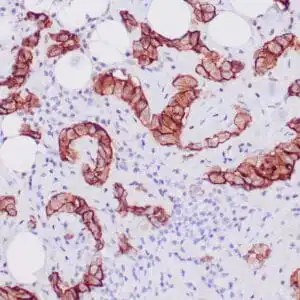
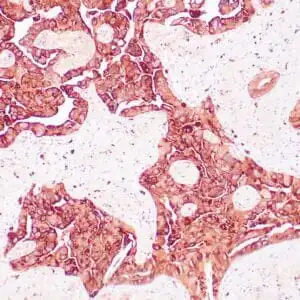
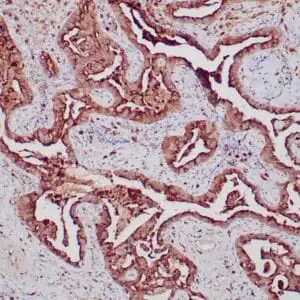
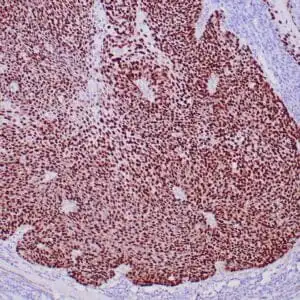
| Human lung adenocarcinoma stained with anti-ALK-1 antibody using peroxidase-conjugate and DAB chromogen. Note cytoplasmic stain of adenocarcinoma cells. |
FAQ & Publications
Frequently Asked Questions
What species does the rabbit anti-ALK monoclonal antibody (ZR305) specifically react with?
This antibody specifically reacts with human ALK protein.
For which applications is the rabbit anti-ALK monoclonal antibody (ZR305) validated and recommended?
It is validated and recommended for Immunohistochemistry (IHC) on formalin-fixed, paraffin-embedded tissues.
How should the rabbit anti-ALK monoclonal antibody (ZR305) be stored to maintain its stability?
Store the antibody at 2-8°C for short term use and at -20°C for long term storage. Avoid repeated freeze/thaw cycles to preserve antibody integrity.
What is the host species and clonality of the anti-ALK monoclonal antibody ZR305?
The antibody is a rabbit monoclonal antibody with IgG isotype.
What positive controls are recommended when using the rabbit anti-ALK monoclonal antibody (ZR305) in immunohistochemistry?
Anaplastic large cell lymphoma or lung adenocarcinoma tissues with ALK translocation are recommended as positive controls.
Publications
| pmid | title | authors | citation |
|---|---|---|---|
| We haven't added any publications to our database yet. | |||
Published literature highly relevant to the biological target of this product and referencing this antibody or clone are retrieved from the PubMed database provided by the United States National Library of Medicine at the National Institutes of Health.
Protocols
| relevant to this product |
|---|
| IHC |
Documents
| Batch Number | QC File | SDS |
|---|---|---|
| To view batch-specific Safety Datasheets and Quality Certificates associated with your account, please Log In. | ||
Only logged in customers who have purchased this product may leave a review.
Reviews
There are no reviews yet.