| Weight | 1 lbs |
|---|---|
| Dimensions | 9 × 5 × 2 in |
| host | mouse |
| isotype | IgG1 |
| clonality | monoclonal |
| concentration | concentrate, predilute |
| applications | IHC |
| reactivity | human |
| available size | 0.1 mL, 0.5 mL, 1 mL concentrated, 7 mL prediluted |

mouse anti-ZAP-70 monoclonal antibody (ZM97) 6406
Price range: $160.00 through $528.00
Antibody summary
- Mouse monoclonal to ZAP-70
- Suitable for: Immunohistochemistry (formalin-fixed, paraffin-embedded tissues)
- Reacts with: Human
- Isotype:IgG1
- Control: Tonsil, CLL/SLL
- Visualization: Cytoplasmic
- 0.1, 0.5, 1.0 mL concentrated, 7 mL prediluted
mouse anti-ZAP-70 monoclonal antibody ZM97 6406
| target relevance |
|---|
| Homo sapiens ZAP70 Tyrosine-protein kinase ZAP-70 |
| Protein names Tyrosine-protein kinase ZAP-70 |
| Alternative names 70 kDa zeta-chain associated protein, Syk-related tyrosine kinase |
| Gene names ZAP70 |
| Protein family Belongs to the protein kinase superfamily. Tyr protein kinase family. SYK/ZAP-70 subfamily |
| Function Tyrosine kinase that plays an essential role in regulation of the adaptive immune response. Regulates motility, adhesion and cytokine expression of mature T-cells, as well as thymocyte development. Also contributes to the development and activation of primary B-lymphocytes. When antigen presenting cells (APC) activate T-cell receptor (TCR), a serie of phosphorylations lead to the recruitment of ZAP70 to the phosphorylated TCR components CD3E and CD247/CD3Z through ITAM motif at the plasma membrane (PubMed:7509083). This recruitment serves to localization to the stimulated TCR and to relieve its autoinhibited conformation. Release of ZAP70 active conformation is further stabilized by phosphorylation mediated by LCK. Subsequently, ZAP70 phosphorylates at least 2 essential adapter proteins: LAT and LCP2. In turn, a large number of signaling molecules are recruited and ultimately lead to lymphokine production, T-cell proliferation and differentiation. Furthermore, ZAP70 controls cytoskeleton modifications, adhesion and mobility of T-lymphocytes, thus ensuring correct delivery of effectors to the APC. ZAP70 is also required for TCR-CD247/CD3Z internalization and degradation through interaction with the E3 ubiquitin-protein ligase CBL and adapter proteins SLA and SLA2. Thus, ZAP70 regulates both T-cell activation switch on and switch off by modulating TCR expression at the T-cell surface. During thymocyte development, ZAP70 promotes survival and cell-cycle progression of developing thymocytes before positive selection (when cells are still CD4/CD8 double negative). Additionally, ZAP70-dependent signaling pathway may also contribute to primary B-cells formation and activation through B-cell receptor (BCR) |
| Catalytic activity L-tyrosyl-[protein] + ATP = O-phospho-L-tyrosyl-[protein] + ADP + H(+) |
| Subcellular location Cytoplasm, Cell membrane |
| Structure Interacts with CD247/CD3Z; this interaction docks ZAP70 at the stimulated TCR (PubMed:1423621, PubMed:26783323, PubMed:7659156). Interacts with NFAM1 (PubMed:15143214). Interacts with adapter protein SLA; this interaction negatively regulates T-cell receptor signaling (PubMed:10449770). Interacts with FCRL3 (PubMed:12051764, PubMed:19843936). Interacts with VAV1 (PubMed:9151714). Interacts with CBL; this interaction promotes ubiquitination, internalization and subsequent degradation of CD247/CD3Z (PubMed:10078535, PubMed:10449770). Identified in a complex with CBL and UBE2L3 (PubMed:10966114). Interacts with SHB (PubMed:12084069). Interacts with adapter protein SLA2; this interaction negatively regulates T-cell receptor signaling. Interacts with CBLB. Interacts (via SH2 domains) with RHOH; this interaction regulates ZAP70 subcellular localization. Interacts with DEF6 (By similarity). Interacts (ubiquitinated form) with OTUD7B and UBASH3B (PubMed:26903241) |
| Post-translational modification Phosphorylated on tyrosine residues upon T-cell antigen receptor (TCR) stimulation. Phosphorylation of Tyr-315 and Tyr-319 are essential for ZAP70 positive function on T-lymphocyte activation whereas Tyr-292 has a negative regulatory role. Within the C-terminal kinase domain, Tyr-492 and Tyr-493 are phosphorylated after TCR induction, Tyr-492 playing a negative regulatory role and Tyr-493 a positive. Tyr-493 is dephosphorylated by PTN22 Ubiquitinated in response to T cell activation. Deubiquitinated by OTUD7B |
| Involvement in disease Immunodeficiency 48 A form of severe immunodeficiency characterized by a selective absence of CD8+ T-cells. Autoimmune disease, multisystem, infantile-onset, 2 An autosomal recessive, autoimmune disorder characterized by systemic manifestations including blistering skin disease, uncontrollable bullous pemphigoid, inflammatory colitis, autoimmune hypothyroidism, proteinuria and nephrotic syndrome. |
| Keywords 3D-structure, Acetylation, Adaptive immunity, Alternative splicing, ATP-binding, Cell membrane, Cytoplasm, Disease variant, Immunity, Isopeptide bond, Kinase, Membrane, Nucleotide-binding, Phosphoprotein, Proteomics identification, Reference proteome, Repeat, SCID, SH2 domain, Transferase, Tyrosine-protein kinase, Ubl conjugation |
| Sequence MPDPAAHLPFFYGSISRAEAEEHLKLAGMADGLFLLRQCLRSLGGYVLSLVHDVRFHHFP IERQLNGTYAIAGGKAHCGPAELCEFYSRDPDGLPCNLRKPCNRPSGLEPQPGVFDCLRD AMVRDYVRQTWKLEGEALEQAIISQAPQVEKLIATTAHERMPWYHSSLTREEAERKLYSG AQTDGKFLLRPRKEQGTYALSLIYGKTVYHYLISQDKAGKYCIPEGTKFDTLWQLVEYLK LKADGLIYCLKEACPNSSASNASGAAAPTLPAHPSTLTHPQRRIDTLNSDGYTPEPARIT SPDKPRPMPMDTSVYESPYSDPEELKDKKLFLKRDNLLIADIELGCGNFGSVRQGVYRMR KKQIDVAIKVLKQGTEKADTEEMMREAQIMHQLDNPYIVRLIGVCQAEALMLVMEMAGGG PLHKFLVGKREEIPVSNVAELLHQVSMGMKYLEEKNFVHRDLAARNVLLVNRHYAKISDF GLSKALGADDSYYTARSAGKWPLKWYAPECINFRKFSSRSDVWSYGVTMWEALSYGQKPY KKMKGPEVMAFIEQGKRMECPPECPPELYALMSDCWIYKWEDRPDFLTVEQRMRACYYSL ASKVEGPPGSTQKAEAACA |
| UniProt accession: P43403 |
Data
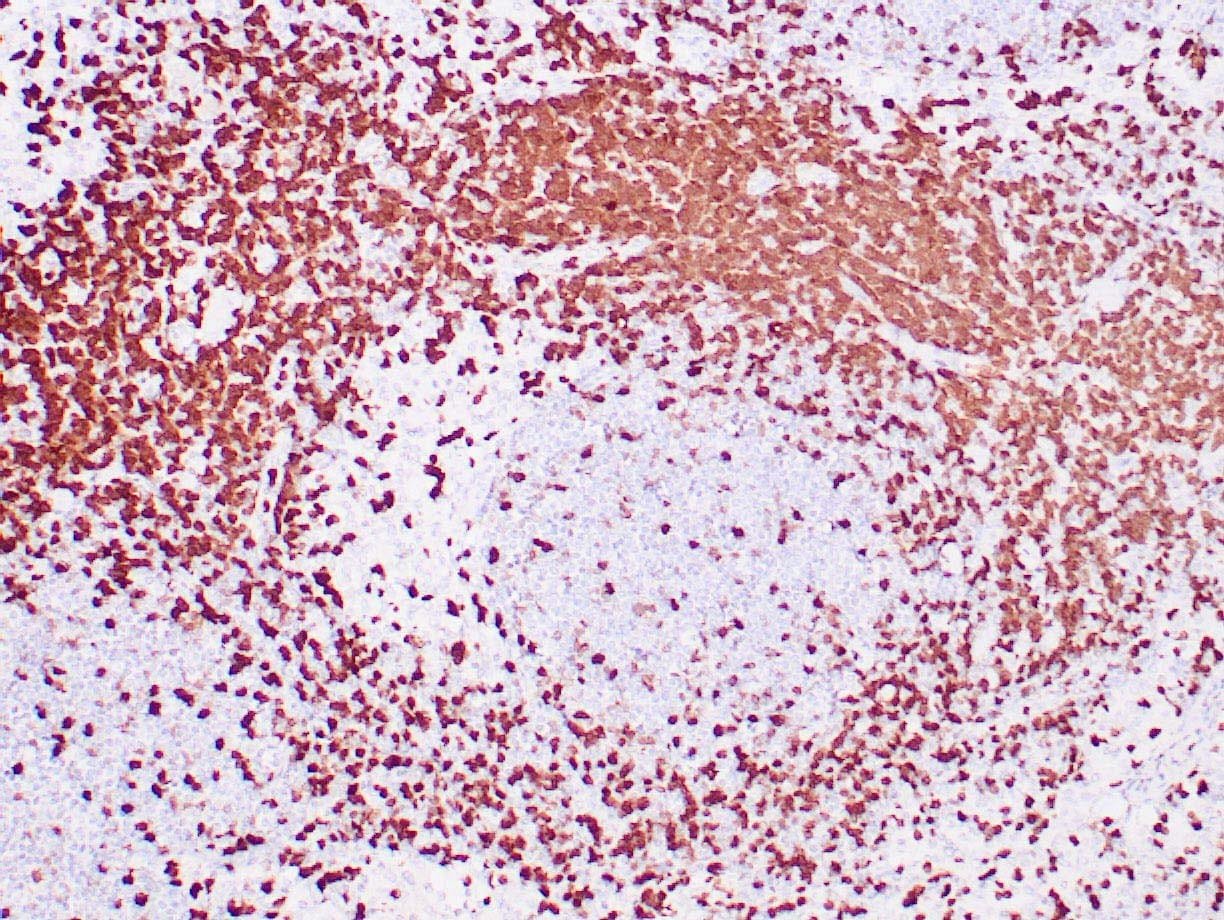 |
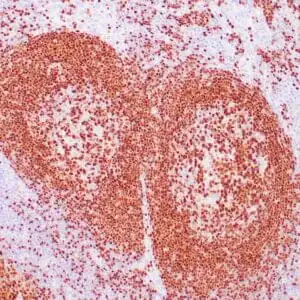
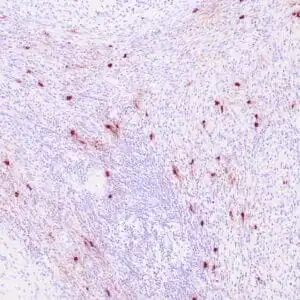
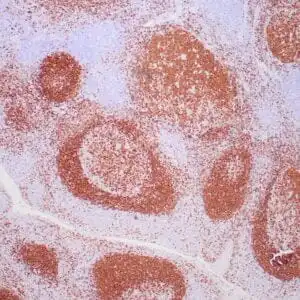
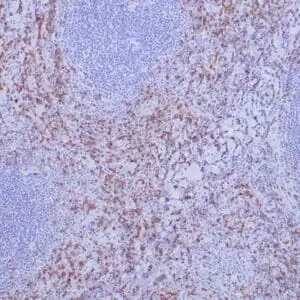
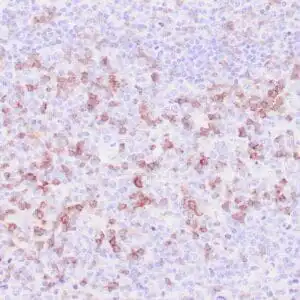
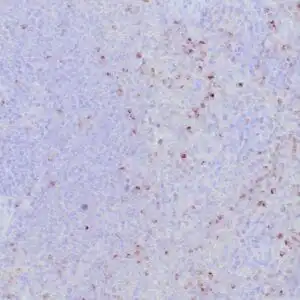
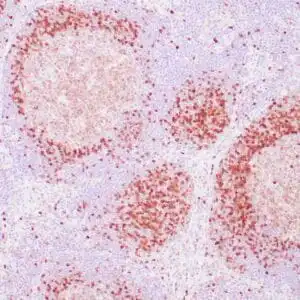
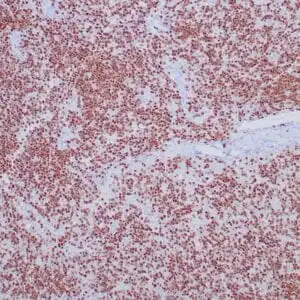
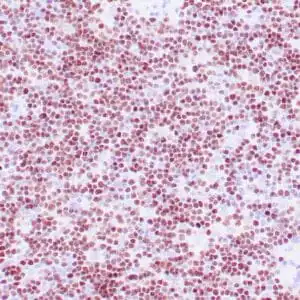
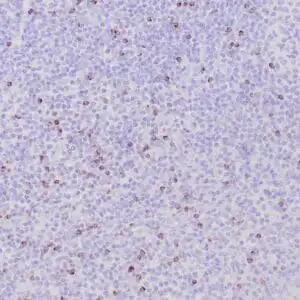
| Human tonsil stained with anti-ZAP-70 antibodies using peroxidase-conjugate and DAB chromogen. Note the positive staining of perifollicular B-cells |
FAQ & Publications
Frequently Asked Questions
What species does the mouse anti-ZAP-70 monoclonal antibody (ZM97) specifically react with?
This antibody specifically reacts with human ZAP-70 protein.
Which applications is the mouse anti-ZAP-70 monoclonal antibody (ZM97) validated for?
It is validated for Immunohistochemistry (IHC) on formalin-fixed, paraffin-embedded tissues.
How should the mouse anti-ZAP-70 monoclonal antibody (ZM97) be stored to maintain its stability?
For short-term storage, keep the antibody at 2-8°C. For long-term storage, store at -20°C and avoid repeated freeze/thaw cycles.
What is the recommended dilution for using the concentrated mouse anti-ZAP-70 monoclonal antibody (ZM97) in IHC?
The recommended dilution range for the concentrated antibody in IHC is 1:100 to 1:200.
Publications
| pmid | title | authors | citation |
|---|---|---|---|
| We haven't added any publications to our database yet. | |||
Published literature highly relevant to the biological target of this product and referencing this antibody or clone are retrieved from the PubMed database provided by the United States National Library of Medicine at the National Institutes of Health.
Protocols
| relevant to this product |
|---|
| IHC |
Documents
| Batch Number | QC File | SDS |
|---|---|---|
| To view batch-specific Safety Datasheets and Quality Certificates associated with your account, please Log In. | ||
Only logged in customers who have purchased this product may leave a review.


Reviews
There are no reviews yet.