| Weight | 1 lbs |
|---|---|
| Dimensions | 9 × 5 × 2 in |
| host | mouse |
| isotype | IgG2b |
| clonality | monoclonal |
| concentration | concentrate, predilute |
| applications | IHC |
| reactivity | human |
| available size | 0.1 mL, 0.5 mL, 1 mL concentrated, 7 mL prediluted |

mouse anti-OCT-4 monoclonal antibody (C-10) 6300
Price range: $160.00 through $528.00
Antibody summary
- Mouse monoclonal to OCT-4
- Suitable for: Immunohistochemistry (formalin-fixed, paraffin-embedded tissues)
- Reacts with: Human
- Isotype:IgG2b
- Control: Seminoma
- Visualization: Nuclear
- 0.1, 0.5, 1.0 mL concentrated, 7 mL prediluted
mouse anti-OCT-4 monoclonal antibody C-10 6300
| target relevance |
|---|
| Homo sapiens POU5F1 POU domain, class 5, transcription factor 1 |
| Protein names POU domain, class 5, transcription factor 1 |
| Alternative names Octamer-binding protein 3, Octamer-binding protein 4, Octamer-binding transcription factor 3 |
| Gene names POU5F1 |
| Protein family Belongs to the POU transcription factor family. Class-5 subfamily |
| Function Transcription factor that binds to the octamer motif (5'-ATTTGCAT-3'). Forms a trimeric complex with SOX2 or SOX15 on DNA and controls the expression of a number of genes involved in embryonic development such as YES1, FGF4, UTF1 and ZFP206. Critical for early embryogenesis and for embryonic stem cell pluripotency |
| Subcellular location Cytoplasm, Nucleus |
| Structure Interacts with PKM (PubMed:18191611). Interacts with WWP2 (PubMed:19274063). Interacts with UBE2I and ZSCAN10 (By similarity). Interacts with PCGF1 (PubMed:26687479). Interacts with ESRRB; recruits ESRRB near the POU5F1-SOX2 element in the NANOG proximal promoter; the interaction is DNA independent (By similarity). Interacts with ZNF322 (By similarity). Interacts with MAPK8 and MAPK9; the interaction allows MAPK8 and MAPK9 to phosphorylate POU5F1 on Ser-355 (By similarity). Interacts (when phosphorylated on Ser-355) with FBXW8 (By similarity). Interacts with FBXW4 (By similarity). Interacts with SOX2 and SOX15; binds synergistically with either SOX2 or SOX15 to DNA (By similarity). Interacts with DDX56 (By similarity). Interacts with ZNF143; promoting POU5F1/OCT4 association with promoters (By similarity) |
| Post-translational modification Sumoylation enhances the protein stability, DNA binding and transactivation activity. Sumoylation is required for enhanced YES1 expression Ubiquitinated; undergoes 'Lys-63'-linked polyubiquitination by WWP2 leading to proteasomal degradation ERK1/2-mediated phosphorylation at Ser-111 promotes nuclear exclusion and proteasomal degradation. Phosphorylation at Thr-235 and Ser-236 decrease DNA-binding and alters ability to activate transcription |
| Keywords 3D-structure, Alternative splicing, Cytoplasm, Developmental protein, DNA-binding, Homeobox, Isopeptide bond, Nucleus, Phosphoprotein, Proteomics identification, Reference proteome, Transcription, Transcription regulation, Ubl conjugation |
| Sequence MAGHLASDFAFSPPPGGGGDGPGGPEPGWVDPRTWLSFQGPPGGPGIGPGVGPGSEVWGI PPCPPPYEFCGGMAYCGPQVGVGLVPQGGLETSQPEGEAGVGVESNSDGASPEPCTVTPG AVKLEKEKLEQNPEESQDIKALQKELEQFAKLLKQKRITLGYTQADVGLTLGVLFGKVFS QTTICRFEALQLSFKNMCKLRPLLQKWVEEADNNENLQEICKAETLVQARKRKRTSIENR VRGNLENLFLQCPKPTLQQISHIAQQLGLEKDVVRVWFCNRRQKGKRSSSDYAQREDFEA AGSPFSGGPVSFPLAPGPHFGTPGYGSPHFTALYSSVPFPEGEAFPPVSVTTLGSPMHSN |
| UniProt accession: Q01860 |
Data
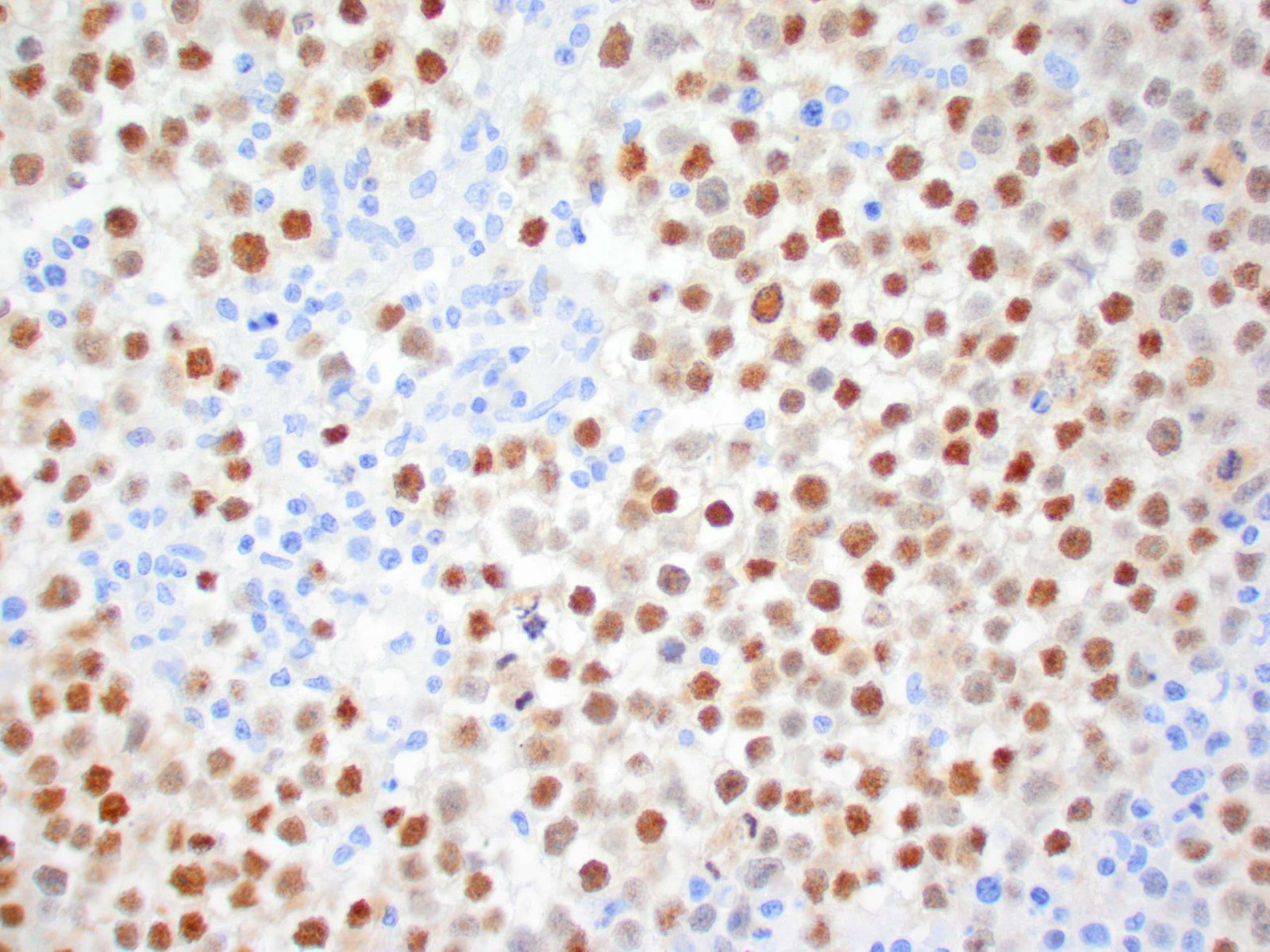 |
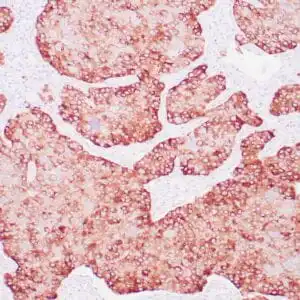
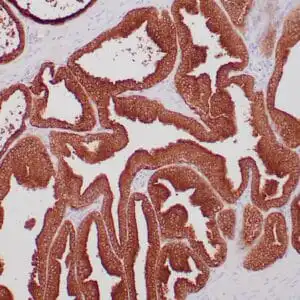
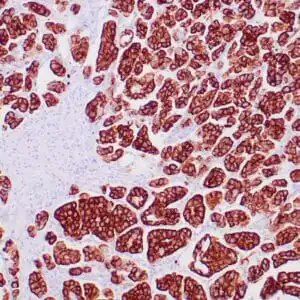
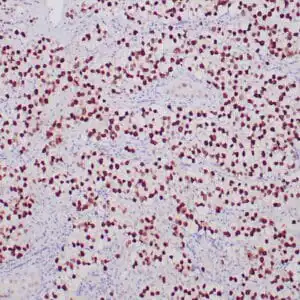
| Human seminoma stained with anti-OCT-4 antibody using peroxidase-conjugate and DAB chromogen. Note the nuclear staining of seminoma cells. |
FAQ & Publications
Frequently Asked Questions
What is the recommended dilution range for using the mouse anti-OCT-4 monoclonal antibody (C-10) in immunohistochemistry?
For immunohistochemistry applications, the recommended dilution range for the concentrated mouse anti-OCT-4 monoclonal antibody (C-10) is between 1:50 and 1:100.
How should the mouse anti-OCT-4 monoclonal antibody (C-10) be stored to maintain its stability?
The antibody should be stored at 2-8°C for short-term use. For long-term storage, it should be kept at -20°C, and freeze/thaw cycles should be avoided to preserve antibody stability.
Publications
| pmid | title | authors | citation |
|---|---|---|---|
| We haven't added any publications to our database yet. | |||
Published literature highly relevant to the biological target of this product and referencing this antibody or clone are retrieved from the PubMed database provided by the United States National Library of Medicine at the National Institutes of Health.
Protocols
| relevant to this product |
|---|
| IHC |
Documents
| Batch Number | QC File | SDS |
|---|---|---|
| To view batch-specific Safety Datasheets and Quality Certificates associated with your account, please Log In. | ||
Only logged in customers who have purchased this product may leave a review.
Reviews
There are no reviews yet.