| Weight | 1 lbs |
|---|---|
| Dimensions | 9 × 5 × 2 in |
| host | mouse |
| isotype | IgG2b |
| clonality | monoclonal |
| concentration | concentrate, predilute |
| applications | IHC |
| reactivity | human |
| available size | 0.1 mL, 0.5 mL, 1 mL concentrated, 7 mL prediluted |

mouse anti-Lysozyme monoclonal antibody (ZM120) 6244
Price range: $160.00 through $528.00
Antibody summary
- Mouse monoclonal to Lysozyme
- Suitable for: Immunohistochemistry (formalin-fixed, paraffin-embedded tissues)
- Reacts with: Human
- Isotype:IgG2b
- Control: Myeloid leukemia
- Visualization: Cytoplasmic
- 0.1, 0.5, 1.0 mL concentrated, 7 mL prediluted
mouse anti-Lysozyme monoclonal antibody ZM120 6244
| target relevance |
|---|
| Homo sapiens LYZ Lysozyme C |
| Protein names Lysozyme C |
| Alternative names 1,4-beta-N-acetylmuramidase C |
| Gene names LYZ |
| Protein family Belongs to the glycosyl hydrolase 22 family |
| Function Lysozymes have primarily a bacteriolytic function; those in tissues and body fluids are associated with the monocyte-macrophage system and enhance the activity of immunoagents |
| Catalytic activity Hydrolysis of (1->4)-beta-linkages between N-acetylmuramic acid and N-acetyl-D-glucosamine residues in a peptidoglycan and between N-acetyl-D-glucosamine residues in chitodextrins. |
| Subcellular location Secreted |
| Structure Monomer |
| Involvement in disease Amyloidosis, hereditary systemic 5 A form of hereditary systemic amyloidosis, a disorder characterized by amyloid deposition in multiple tissues resulting in a wide clinical spectrum. AMYLD5 primarily affects the viscera, and the predominant clinical features are renal dysfunction of varying severity, and intra-abdominal bleeding. Inheritance is autosomal dominant. |
| Keywords 3D-structure, Amyloid, Amyloidosis, Antimicrobial, Bacteriolytic enzyme, Direct protein sequencing, Disease variant, Disulfide bond, Glycosidase, Hydrolase, Proteomics identification, Reference proteome, Secreted, Signal |
| Sequence MKALIVLGLVLLSVTVQGKVFERCELARTLKRLGMDGYRGISLANWMCLAKWESGYNTRA TNYNAGDRSTDYGIFQINSRYWCNDGKTPGAVNACHLSCSALLQDNIADAVACAKRVVRD PQGIRAWVAWRNRCQNRDVRQYVQGCGV |
| UniProt accession: P61626 |
Data
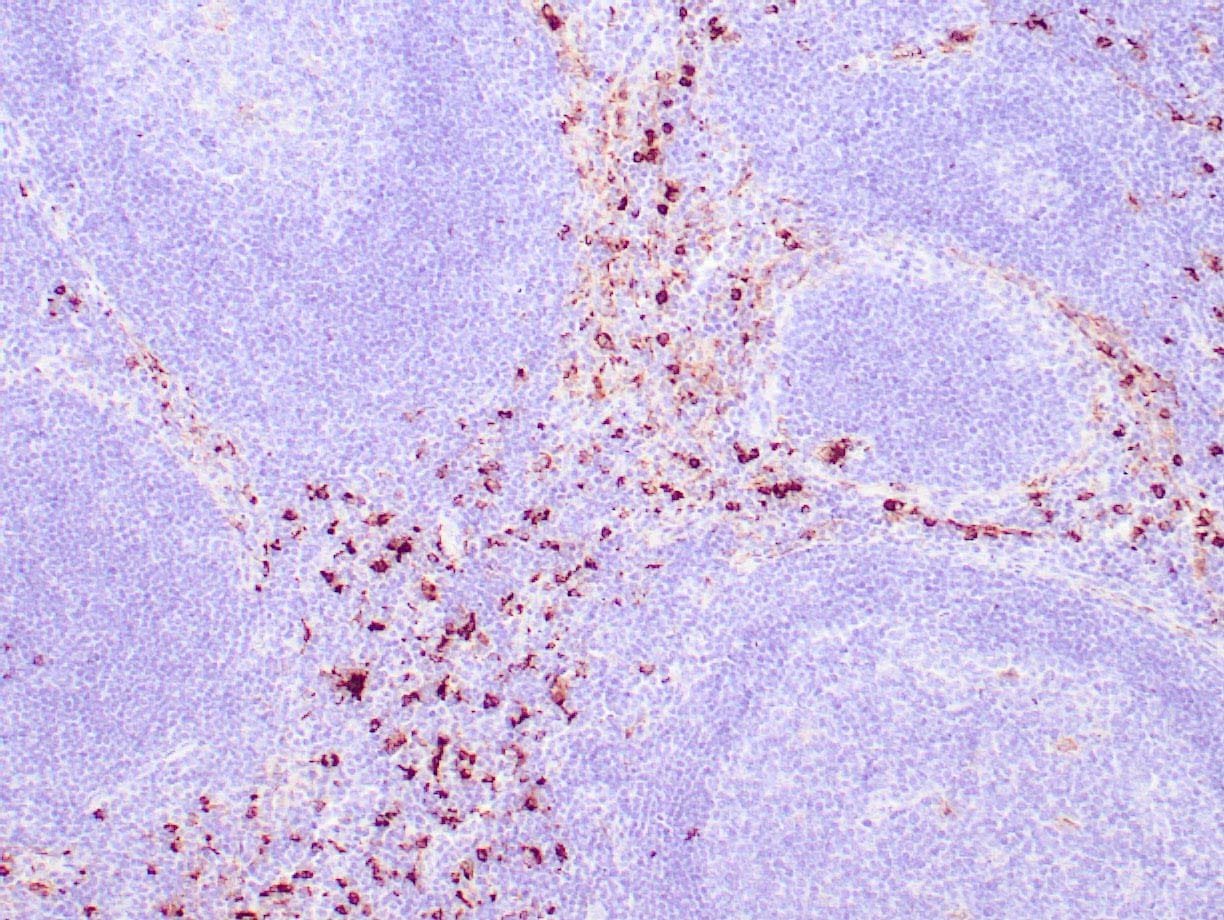 |
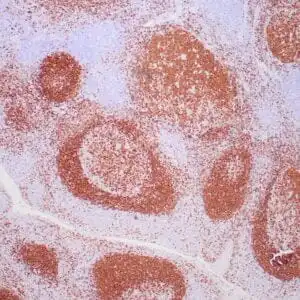
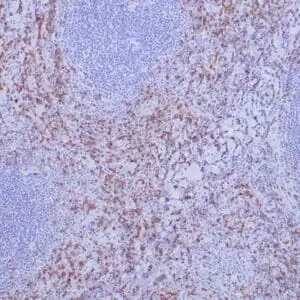
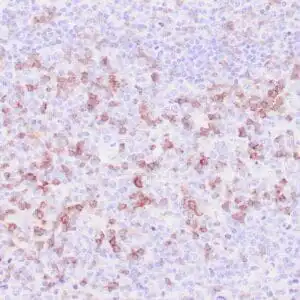
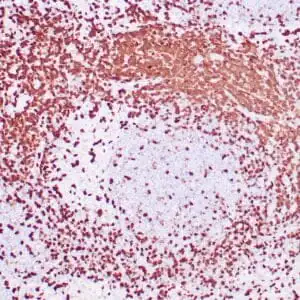
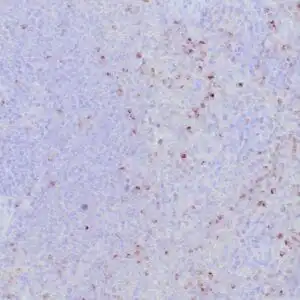
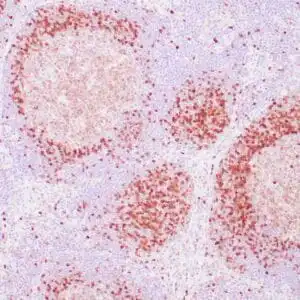
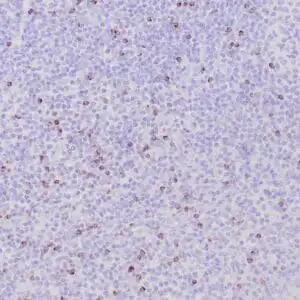
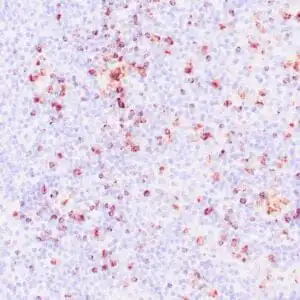
| Human lymph node stained with anti-Lysozyme antibody using peroxidase-conjugate and DAB chromogen. Note the cytoplasmic staining of perifollicular neutrophils and histiocytes.. |
FAQ & Publications
Frequently Asked Questions
What is the recommended application for the mouse anti-Lysozyme monoclonal antibody (ZM120)?
This antibody is suitable for immunohistochemistry (IHC) on formalin-fixed, paraffin-embedded tissues.
Which species does the mouse anti-Lysozyme monoclonal antibody (ZM120) react with?
The antibody reacts specifically with human Lysozyme.
What are the storage conditions for the mouse anti-Lysozyme monoclonal antibody (ZM120)?
For short-term storage, keep the antibody at 2-8°C. For long-term storage, it should be kept at -20°C, and freeze/thaw cycles should be avoided.
What is the host and isotype of the mouse anti-Lysozyme monoclonal antibody (ZM120)?
The antibody is a mouse monoclonal of the IgG2b isotype.
What immunogen was used to generate the mouse anti-Lysozyme monoclonal antibody (ZM120)?
The immunogen was a recombinant fragment of human Lysozyme protein, approximately amino acids 18-147.
Publications
| pmid | title | authors | citation |
|---|---|---|---|
| We haven't added any publications to our database yet. | |||
Published literature highly relevant to the biological target of this product and referencing this antibody or clone are retrieved from the PubMed database provided by the United States National Library of Medicine at the National Institutes of Health.
Protocols
| relevant to this product |
|---|
| IHC |
Documents
| Batch Number | QC File | SDS |
|---|---|---|
| To view batch-specific Safety Datasheets and Quality Certificates associated with your account, please Log In. | ||
Only logged in customers who have purchased this product may leave a review.


Reviews
There are no reviews yet.