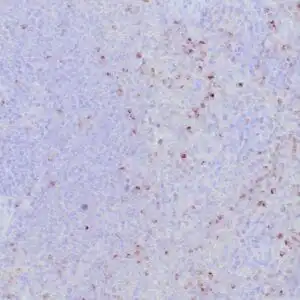
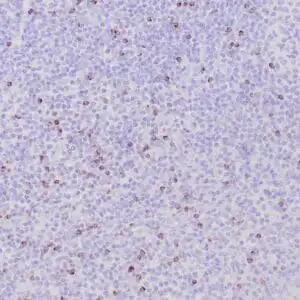
Isotype control Mouse monoclonal IgG2b - Isotype Control
target relevance
Homo sapiens ITGB3 Integrin beta-3
Protein names Integrin beta-3
Alternative names Platelet membrane glycoprotein IIIa
Gene names ITGB3
Protein family Belongs to the integrin beta chain family
Function Integrin alpha-V/beta-3 (ITGAV:ITGB3) is a receptor for cytotactin, fibronectin, laminin, matrix metalloproteinase-2, osteopontin, osteomodulin, prothrombin, thrombospondin, vitronectin and von Willebrand factor. Integrin alpha-IIb/beta-3 (ITGA2B:ITGB3) is a receptor for fibronectin, fibrinogen, plasminogen, prothrombin, thrombospondin and vitronectin. Integrins alpha-IIb/beta-3 and alpha-V/beta-3 recognize the sequence R-G-D in a wide array of ligands. Integrin alpha-IIb/beta-3 recognizes the sequence H-H-L-G-G-G-A-K-Q-A-G-D-V in fibrinogen gamma chain (By similarity). Following activation integrin alpha-IIb/beta-3 brings about platelet/platelet interaction through binding of soluble fibrinogen (PubMed:9111081). This step leads to rapid platelet aggregation which physically plugs ruptured endothelial surface. Fibrinogen binding enhances SELP expression in activated platelets (By similarity). ITGAV:ITGB3 binds to fractalkine (CX3CL1) and acts as its coreceptor in CX3CR1-dependent fractalkine signaling (PubMed:23125415, PubMed:24789099). ITGAV:ITGB3 binds to NRG1 (via EGF domain) and this binding is essential for NRG1-ERBB signaling (PubMed:20682778). ITGAV:ITGB3 binds to FGF1 and this binding is essential for FGF1 signaling (PubMed:18441324). ITGAV:ITGB3 binds to FGF2 and this binding is essential for FGF2 signaling (PubMed:28302677). ITGAV:ITGB3 binds to IGF1 and this binding is essential for IGF1 signaling (PubMed:19578119). ITGAV:ITGB3 binds to IGF2 and this binding is essential for IGF2 signaling (PubMed:28873464). ITGAV:ITGB3 binds to IL1B and this binding is essential for IL1B signaling (PubMed:29030430). ITGAV:ITGB3 binds to PLA2G2A via a site (site 2) which is distinct from the classical ligand-binding site (site 1) and this induces integrin conformational changes and enhanced ligand binding to site 1 (PubMed:18635536, PubMed:25398877). ITGAV:ITGB3 acts as a receptor for fibrillin-1 (FBN1) and mediates R-G-D-dependent cell adhesion to FBN1 (PubMed:12807887). In brain, plays a role in synaptic transmission and plasticity. Involved in the regulation of the serotonin neurotransmission, is required to localize to specific compartments within the synapse the serotonin receptor SLC6A4 and for an appropriate reuptake of serotonin. Controls excitatory synaptic strength by regulating GRIA2-containing AMPAR endocytosis, which affects AMPAR abundance and composition (By similarity). ITGAV:ITGB3 act as a receptor for CD40LG (PubMed:31331973). ITGAV:ITGB3 acts as a receptor for IBSP and promotes cell adhesion and migration to IBSP (PubMed:10640428). Integrin ITGA2B:ITGB3 is also the receptor of the erythrocyte-specific ICAM4 ligand involved in heterotypic cell-cell adhesion between erythrocytes and activated platelets (PubMed:12477717)
Structure (Microbial infection) Interacts with HIV-1 Tat (PubMed:10397733). ITGAV:ITGB3 interacts with AGRA2 (PubMed:16982628)
Post-translational modification Phosphorylated on tyrosine residues in response to thrombin-induced platelet aggregation. Probably involved in outside-in signaling. A peptide (AA 740-762) is capable of binding GRB2 only when both Tyr-773 and Tyr-785 are phosphorylated. Phosphorylation of Thr-779 inhibits SHC binding
Involvement in disease Fetomaternal alloimmune thrombocytopenia 1 A form of fetomaternal alloimmune thrombocytopenia, a bleeding disorder caused by maternal/fetal incompatibility for platelet alloantigens and arising when a fetus inherits a paternal platelet alloantigen that the mother does not possess. During pregnancy, as well as parturition, maternal alloantibodies against paternally-inherited platelet antigens cause destruction of fetal platelets and fetal/neonatal thrombocytopenia. Disease severity and clinical features in the fetus or neonate are heterogeneous. While most fetuses remain asymptomatic, others develop skin bleedings (petechiae) or internal organ bleedings. The most severe symptom is intracranial hemorrhage that is mostly discovered postnatally and can result in neurological complications or even death. Mothers with circulating platelet alloantibodies may experience miscarriage. FMAIT1 transmission pattern is consistent with autosomal dominant paternal inheritance.
Glanzmann thrombasthenia 2 A form of Glanzmann thrombasthenia, a disorder characterized by failure of platelet aggregation, absent or diminished clot retraction, and mucocutaneous bleeding of mild-to-moderate severity. Glanzmann thrombasthenia has been classified into clinical types I and II. In type I, platelets show absence of glycoprotein IIb-IIIa complexes at their surface and lack fibrinogen and clot retraction capability. In type II, the platelets express glycoprotein IIb-IIIa complexes at reduced levels, have detectable amounts of fibrinogen, and have low or moderate clot retraction capability.
Bleeding disorder, platelet-type, 24 An autosomal dominant disorder of platelet production characterized by congenital macrothrombocytopenia and platelet anisocytosis. Affected individuals may have no or only mildly increased bleeding tendency.
Alternative names GPalpha IIb, Platelet membrane glycoprotein IIb
Gene names ITGA2B
Protein family Belongs to the integrin alpha chain family
Function Integrin alpha-IIb/beta-3 (ITGA2B:ITGB3) is a receptor for fibronectin, fibrinogen, plasminogen, prothrombin, thrombospondin and vitronectin. It recognizes the sequence R-G-D in a wide array of ligands. It recognizes the sequence H-H-L-G-G-G-A-K-Q-A-G-D-V in fibrinogen gamma chain (By similarity). Following activation integrin alpha-IIb/beta-3 brings about platelet/platelet interaction through binding of soluble fibrinogen (PubMed:9111081). This step leads to rapid platelet aggregation which physically plugs ruptured endothelial cell surface (By similarity). Integrin ITGA2B:ITGB3 is also the receptor of erythrocyte-specific ICAM4 ligand involved in heterotypic cell-cell adhesion between erythrocytes and activated platelets (PubMed:12477717)
Subcellular location Cell membrane
Structure Heterodimer of an alpha and a beta subunit. The alpha subunit is composed of a heavy and a light chain linked by a disulfide bond. Alpha-IIb associates with beta-3. Directly interacts with RNF181. Interacts (via C-terminus cytoplasmic tail region) with CIB1; the interaction is direct and calcium-dependent. Interacts (via C-terminus cytoplasmic tail region) with CIB2, CIB3 and CIB4; the interactions are stabilized/increased in a calcium and magnesium-dependent manner. ITGA2B:ITGB3 interacts with PPIA/CYPA; the interaction is ROS and PPIase activity-dependent and is increased in the presence of thrombin (By similarity). ITGA2B:ITGB3 interacts with SELP (via C-type lectin domain); the interaction mediates cell-cell interaction and adhesion (PubMed:37184585)
Post-translational modification Cleaved by ELANE; the cleavage promotes activation of platelet fibrinogen receptor integrin alpha-IIb/beta-3
Involvement in disease Fetomaternal alloimmune thrombocytopenia 2 A form of fetomaternal alloimmune thrombocytopenia, a bleeding disorder caused by maternal/fetal incompatibility for platelet alloantigens and arising when a fetus inherits a paternal platelet alloantigen that the mother does not possess. During pregnancy, as well as parturition, maternal alloantibodies against paternally-inherited platelet antigens cause destruction of fetal platelets and fetal/neonatal thrombocytopenia. Disease severity and clinical features in the fetus or neonate are heterogeneous. While most fetuses remain asymptomatic, others develop skin bleedings (petechiae) or internal organ bleedings. The most severe symptom is intracranial hemorrhage that is mostly discovered postnatally and can result in neurological complications or even death. Mothers with circulating platelet alloantibodies may experience miscarriage. FMAIT2 transmission pattern is consistent with autosomal dominant paternal inheritance.
Glanzmann thrombasthenia 1 A form of Glanzmann thrombasthenia, a disorder characterized by failure of platelet aggregation, absent or diminished clot retraction, and mucocutaneous bleeding of mild-to-moderate severity. Glanzmann thrombasthenia has been classified into clinical types I and II. In type I, platelets show absence of glycoprotein IIb-IIIa complexes at their surface and lack fibrinogen and clot retraction capability. In type II, the platelets express glycoprotein IIb-IIIa complexes at reduced levels, have detectable amounts of fibrinogen, and have low or moderate clot retraction capability. GT1 inheritance is autosomal recessive.
Bleeding disorder, platelet-type, 16 An autosomal dominant form of congenital macrothrombocytopenia associated with platelet anisocytosis. It is a disorder of platelet production. Affected individuals may have no or only mildly increased bleeding tendency. In vitro studies show mild platelet functional abnormalities.
Keywords 3D-structure, Alternative splicing, Calcium, Cell adhesion, Cell membrane, Cleavage on pair of basic residues, Direct protein sequencing, Disease variant, Disulfide bond, Glycoprotein, Integrin, Membrane, Metal-binding, Proteomics identification, Pyrrolidone carboxylic acid, Receptor, Reference proteome, Repeat, Signal, Transmembrane, Transmembrane helix
Homo sapiens LFA-1 ITGB2 (CD18) + ITGAL (CD11a) integrin heterodimer
Homo sapiens ITGA2 Integrin alpha-2
Protein names Integrin alpha-2
Alternative names CD49 antigen-like family member B, Collagen receptor, Platelet membrane glycoprotein Ia, VLA-2 subunit alpha
Gene names ITGA2
Protein family Belongs to the integrin alpha chain family
Function Integrin alpha-2/beta-1 is a receptor for laminin, collagen, collagen C-propeptides, fibronectin and E-cadherin. It recognizes the proline-hydroxylated sequence G-F-P-G-E-R in collagen. It is responsible for adhesion of platelets and other cells to collagens, modulation of collagen and collagenase gene expression, force generation and organization of newly synthesized extracellular matrix
Subcellular location Membrane
Structure (Microbial infection) Integrin ITGA2:ITGB1 interacts with human echoviruses 1 and 8 capsid proteins
Involvement in disease Fetomaternal alloimmune thrombocytopenia 3 A form of fetomaternal alloimmune thrombocytopenia, a bleeding disorder caused by maternal/fetal incompatibility for platelet alloantigens and arising when a fetus inherits a paternal platelet alloantigen that the mother does not possess. During pregnancy, as well as parturition, maternal alloantibodies against paternally-inherited platelet antigens cause destruction of fetal platelets and fetal/neonatal thrombocytopenia. Disease severity and clinical features in the fetus or neonate are heterogeneous. While most fetuses remain asymptomatic, others develop skin bleedings (petechiae) or internal organ bleedings. The most severe symptom is intracranial hemorrhage that is mostly discovered postnatally and can result in neurological complications or even death. Mothers with circulating platelet alloantibodies may experience miscarriage. FMAIT3 transmission pattern is consistent with autosomal dominant paternal inheritance.
Homo sapiens CR4 ITGB2 (CD18) + ITGAX (CD11c) integrin heterodimer
Homo sapiens ITGAV Integrin alpha-V
Protein names Integrin alpha-V
Alternative names Vitronectin receptor, Vitronectin receptor subunit alpha
Gene names ITGAV
Protein family Belongs to the integrin alpha chain family
Function The alpha-V (ITGAV) integrins are receptors for vitronectin, cytotactin, fibronectin, fibrinogen, laminin, matrix metalloproteinase-2, osteopontin, osteomodulin, prothrombin, thrombospondin and vWF. They recognize the sequence R-G-D in a wide array of ligands. ITGAV:ITGB3 binds to fractalkine (CX3CL1) and may act as its coreceptor in CX3CR1-dependent fractalkine signaling (PubMed:23125415). ITGAV:ITGB3 binds to NRG1 (via EGF domain) and this binding is essential for NRG1-ERBB signaling (PubMed:20682778). ITGAV:ITGB3 binds to FGF1 and this binding is essential for FGF1 signaling (PubMed:18441324). ITGAV:ITGB3 binds to FGF2 and this binding is essential for FGF2 signaling (PubMed:28302677). ITGAV:ITGB3 binds to IGF1 and this binding is essential for IGF1 signaling (PubMed:19578119). ITGAV:ITGB3 binds to IGF2 and this binding is essential for IGF2 signaling (PubMed:28873464). ITGAV:ITGB3 binds to IL1B and this binding is essential for IL1B signaling (PubMed:29030430). ITGAV:ITGB3 binds to PLA2G2A via a site (site 2) which is distinct from the classical ligand-binding site (site 1) and this induces integrin conformational changes and enhanced ligand binding to site 1 (PubMed:18635536, PubMed:25398877). ITGAV:ITGB3 and ITGAV:ITGB6 act as receptors for fibrillin-1 (FBN1) and mediate R-G-D-dependent cell adhesion to FBN1 (PubMed:12807887, PubMed:17158881). Integrin alpha-V/beta-6 or alpha-V/beta-8 (ITGAV:ITGB6 or ITGAV:ITGB8) mediates R-G-D-dependent release of transforming growth factor beta-1 (TGF-beta-1) from regulatory Latency-associated peptide (LAP), thereby playing a key role in TGF-beta-1 activation (PubMed:15184403, PubMed:22278742, PubMed:28117447). ITGAV:ITGB3 acts as a receptor for CD40LG (PubMed:31331973). ITGAV:ITGB3 acts as a receptor for IBSP and promotes cell adhesion and migration to IBSP (PubMed:10640428)
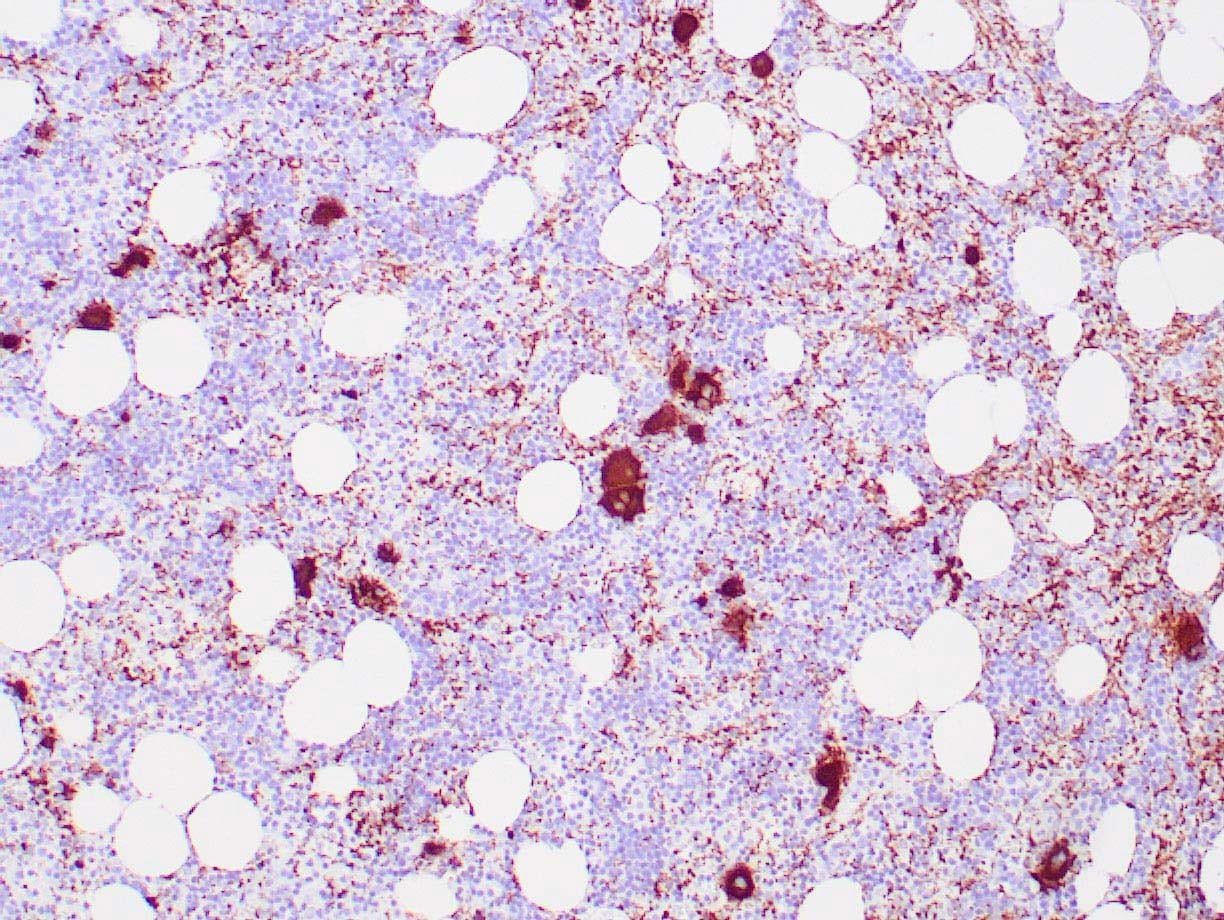
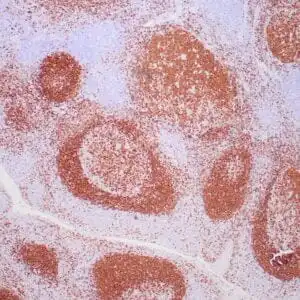
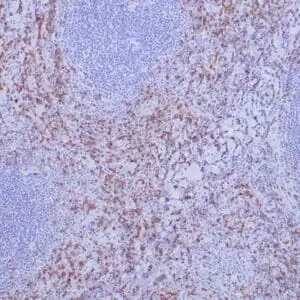
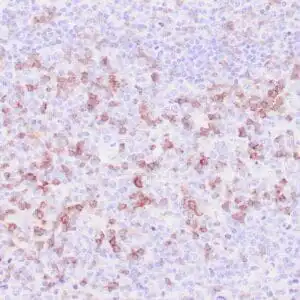
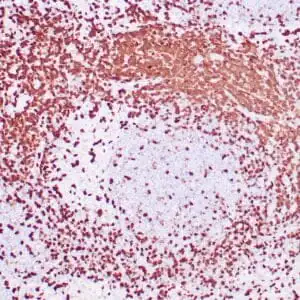
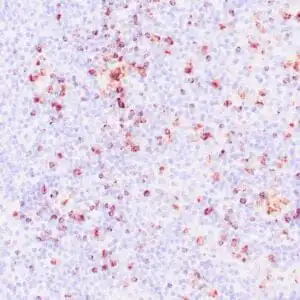
Human bone marrow stained with anti-CD61 antibody using peroxidase-conjugate and DAB chromogen. Note the cytoplasmic staining of megakaryocytes.
FAQ & Publications
Frequently Asked Questions
What species reactivity does the mouse anti-CD61 monoclonal antibody (ZM33) 6105 exhibit?
The mouse anti-CD61 monoclonal antibody (ZM33) 6105 specifically reacts with human CD61 protein.
How should the mouse anti-CD61 monoclonal antibody (ZM33) 6105 be stored for optimal preservation?
For short-term storage, keep the antibody at 2-8°C, and for long-term storage, store it at -20°C. Avoid repeated freeze/thaw cycles to maintain antibody integrity.
Publications
pmid
title
authors
citation
We haven't added any publications to our database yet.
Published literature highly relevant to the biological target of this product and referencing this antibody or clone are retrieved from the PubMed database provided by the United States National Library of Medicine at the National Institutes of Health.



Reviews
There are no reviews yet.