| Weight | 1 lbs |
|---|---|
| Dimensions | 9 × 5 × 2 in |
| host | mouse |
| isotype | IgG2b |
| clonality | monoclonal |
| concentration | concentrate, predilute |
| applications | IHC |
| reactivity | human |
| available size | 0.1 mL, 0.5 mL, 1 mL concentrated, 7 mL prediluted |

mouse anti-CD33 monoclonal antibody (PWS44) 6087
Price range: $160.00 through $528.00
Antibody summary
- Mouse monoclonal to CD33
- Suitable for: Immunohistochemistry (formalin-fixed, paraffin-embedded tissues)
- Reacts with: Human
- Isotype:IgG2b
- Control: Spleen
- Visualization: Cytoplasmic
- 0.1, 0.5, 1.0 mL concentrated, 7 mL prediluted
mouse anti-CD33 monoclonal antibody PWS44 6087
| target relevance |
|---|
| Homo sapiens CD33 Myeloid cell surface antigen CD33 |
| Protein names Myeloid cell surface antigen CD33 |
| Alternative names Sialic acid-binding Ig-like lectin 3, gp67 |
| Gene names CD33 |
| Protein family Belongs to the immunoglobulin superfamily. SIGLEC (sialic acid binding Ig-like lectin) family |
| Function Sialic-acid-binding immunoglobulin-like lectin (Siglec) that plays a role in mediating cell-cell interactions and in maintaining immune cells in a resting state (PubMed:10611343, PubMed:11320212, PubMed:15597323). Preferentially recognizes and binds alpha-2,3- and more avidly alpha-2,6-linked sialic acid-bearing glycans (PubMed:7718872). Upon engagement of ligands such as C1q or syalylated glycoproteins, two immunoreceptor tyrosine-based inhibitory motifs (ITIMs) located in CD33 cytoplasmic tail are phosphorylated by Src-like kinases such as LCK (PubMed:10887109, PubMed:28325905). These phosphorylations provide docking sites for the recruitment and activation of protein-tyrosine phosphatases PTPN6/SHP-1 and PTPN11/SHP-2 (PubMed:10206955, PubMed:10556798, PubMed:10887109). In turn, these phosphatases regulate downstream pathways through dephosphorylation of signaling molecules (PubMed:10206955, PubMed:10887109). One of the repressive effect of CD33 on monocyte activation requires phosphoinositide 3-kinase/PI3K (PubMed:15597323) |
| Subcellular location Peroxisome |
| Structure Homodimer; disulfide-linked (PubMed:10887109). Interacts with PTPN6/SHP-1 and PTPN11/SHP-2 upon phosphorylation (PubMed:10206955, PubMed:10556798). Interacts with C1QA (via C-terminus); this interaction activates CD33 inhibitory motifs (PubMed:28325905) |
| Post-translational modification Glycosylated. Glycosylation at Asn-100 is critical for regulating ligand recognition Phosphorylation of Tyr-340 is involved in binding to PTPN6 and PTPN11. Phosphorylation of Tyr-358 is involved in binding to PTPN6. LCK phosphorylates Tyr-340 efficiently and Tyr-358 to a lesser extent |
| Keywords 3D-structure, Alternative splicing, Cell adhesion, Cell membrane, Disulfide bond, Glycoprotein, Immunoglobulin domain, Lectin, Membrane, Peroxisome, Phosphoprotein, Proteomics identification, Reference proteome, Repeat, Signal, Transmembrane, Transmembrane helix |
| Sequence MPLLLLLPLLWAGALAMDPNFWLQVQESVTVQEGLCVLVPCTFFHPIPYYDKNSPVHGYW FREGAIISRDSPVATNKLDQEVQEETQGRFRLLGDPSRNNCSLSIVDARRRDNGSYFFRM ERGSTKYSYKSPQLSVHVTDLTHRPKILIPGTLEPGHSKNLTCSVSWACEQGTPPIFSWL SAAPTSLGPRTTHSSVLIITPRPQDHGTNLTCQVKFAGAGVTTERTIQLNVTYVPQNPTT GIFPGDGSGKQETRAGVVHGAIGGAGVTALLALCLCLIFFIVKTHRRKAARTAVGRNDTH PTTGSASPKHQKKSKLHGPTETSSCSGAAPTVEMDEELHYASLNFHGMNPSKDTSTEYSE VRTQ |
| UniProt accession: P20138 |
Data
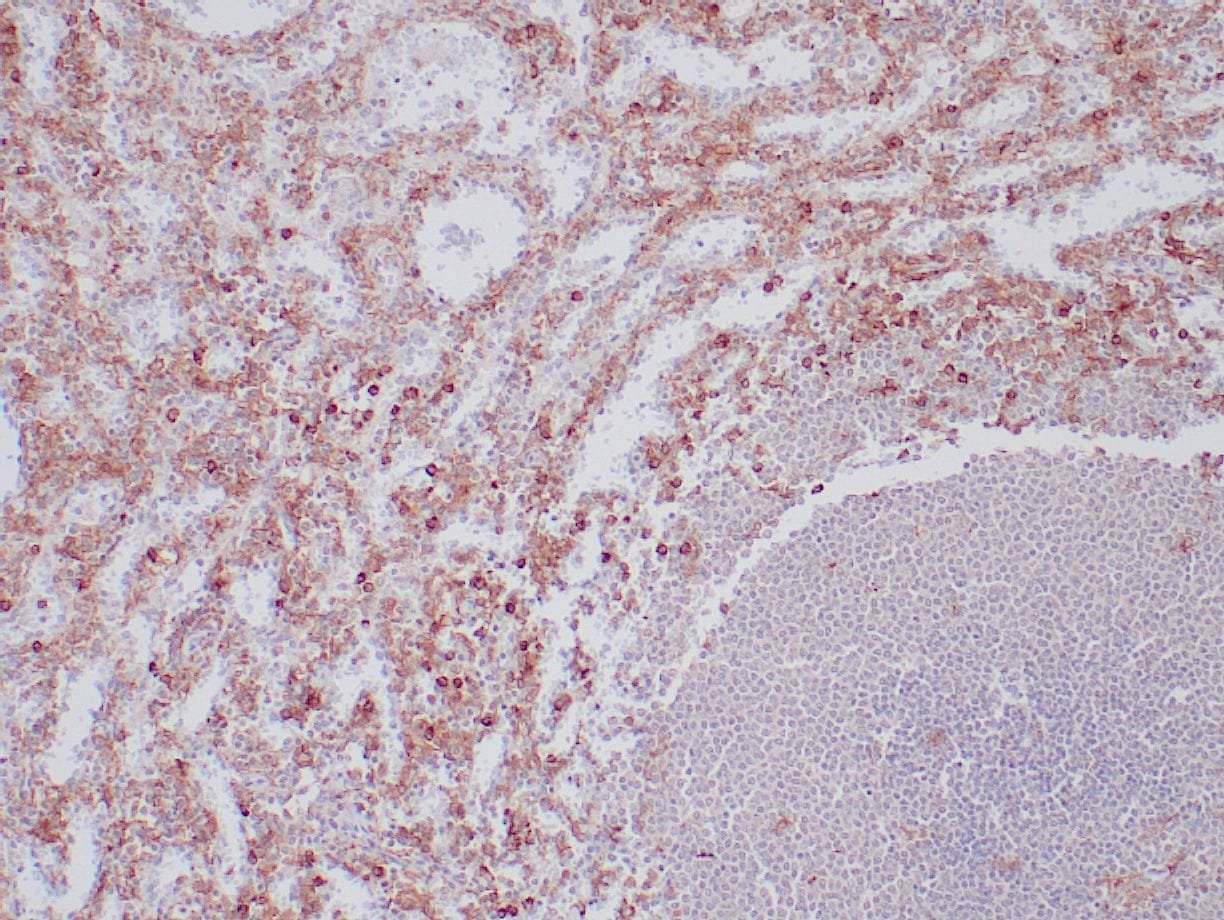 |
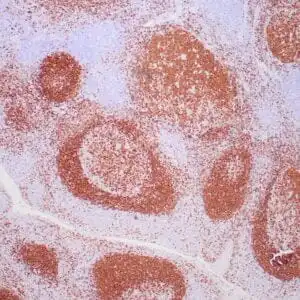
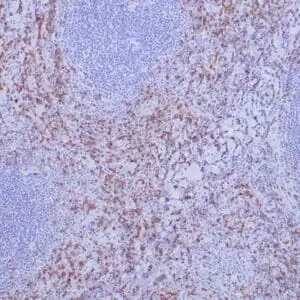
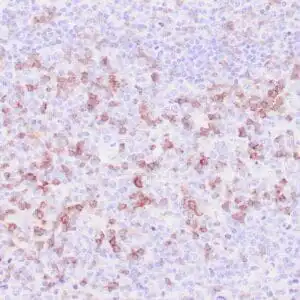
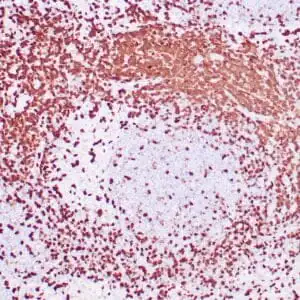
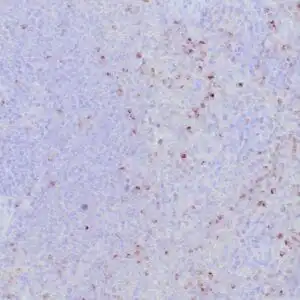
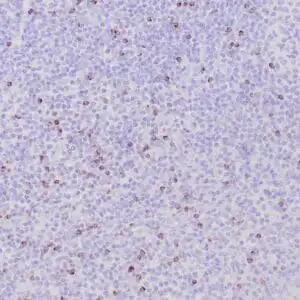
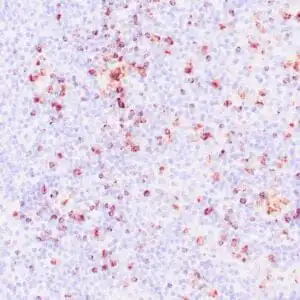
| Formalin-fixed, paraffin-embedded human spleen stained with anti-CD33 antibody using peroxidase-conjugate and DAB chromogen. Note cytoplasmic staining of myeloid cells |
FAQ & Publications
Frequently Asked Questions
What species does the mouse anti-CD33 monoclonal antibody (PWS44) 6087 specifically react with?
This antibody specifically reacts with human CD33 protein.
Which application is this mouse anti-CD33 monoclonal antibody validated for and what is the recommended dilution?
The antibody is validated for immunohistochemistry (IHC) on formalin-fixed, paraffin-embedded tissues, with a recommended dilution of 1:50 to 1:100 for the concentrated form.
How should the mouse anti-CD33 monoclonal antibody be stored to maintain stability?
For short-term storage, keep the antibody at 2-8°C, and for long-term storage, freeze it at -20°C while avoiding freeze/thaw cycles.
What is the immunogen used to generate the mouse anti-CD33 monoclonal antibody (PWS44) 6087?
The immunogen is a prokaryotic recombinant protein corresponding to a region of the C2 domain of the human CD33 molecule.
Publications
| pmid | title | authors | citation |
|---|---|---|---|
| We haven't added any publications to our database yet. | |||
Published literature highly relevant to the biological target of this product and referencing this antibody or clone are retrieved from the PubMed database provided by the United States National Library of Medicine at the National Institutes of Health.
Protocols
| relevant to this product |
|---|
| IHC |
Documents
| Batch Number | QC File | SDS |
|---|---|---|
| To view batch-specific Safety Datasheets and Quality Certificates associated with your account, please Log In. | ||
Only logged in customers who have purchased this product may leave a review.


Reviews
There are no reviews yet.