| Weight | 1 lbs |
|---|---|
| Dimensions | 9 × 5 × 2 in |
| host | mouse |
| isotype | IgG1 |
| clonality | monoclonal |
| concentration | concentrate, predilute |
| applications | IHC |
| reactivity | human |
| available size | 0.1 mL, 0.5 mL, 1 mL concentrated, 7 mL prediluted |

mouse anti-CD22 monoclonal antibody (ZM183) 6077
Price range: $160.00 through $528.00
Antibody summary
- Mouse monoclonal to CD22
- Suitable for: Immunohistochemistry (formalin-fixed, paraffin-embedded tissues)
- Reacts with: Human
- Isotype:IgG1
- Control: Lymph node
- Visualization: Cytoplasmic
- 0.1, 0.5, 1.0 mL concentrated, 7 mL prediluted
mouse anti-CD22 monoclonal antibody ZM183 6077
| target relevance |
|---|
| Homo sapiens CD22 B-cell receptor CD22 |
| Protein names B-cell receptor CD22 |
| Alternative names B-lymphocyte cell adhesion molecule, Sialic acid-binding Ig-like lectin 2, T-cell surface antigen Leu-14 |
| Gene names CD22 |
| Protein family Belongs to the immunoglobulin superfamily. SIGLEC (sialic acid binding Ig-like lectin) family |
| Function Most highly expressed siglec (sialic acid-binding immunoglobulin-like lectin) on B-cells that plays a role in various aspects of B-cell biology including differentiation, antigen presentation, and trafficking to bone marrow (PubMed:34330755, PubMed:8627166). Binds to alpha 2,6-linked sialic acid residues of surface molecules such as CD22 itself, CD45 and IgM in a cis configuration. Can also bind to ligands on other cells as an adhesion molecule in a trans configuration (PubMed:20172905). Acts as an inhibitory coreceptor on the surface of B-cells and inhibits B-cell receptor induced signaling, characterized by inhibition of the calcium mobilization and cellular activation. Mechanistically, the immunoreceptor tyrosine-based inhibitory motif domain is phosphorylated by the Src kinase LYN, which in turn leads to the recruitment of the protein tyrosine phosphatase 1/PTPN6, leading to the negative regulation of BCR signaling (PubMed:8627166). If this negative signaling from is of sufficient strength, apoptosis of the B-cell can be induced (PubMed:20516366) |
| Subcellular location Cell membrane |
| Structure Predominantly monomer of isoform CD22-beta. Also found as heterodimer of isoform CD22-beta and a shorter isoform. Interacts with PTPN6/SHP-1, LYN, SYK, PIK3R1/PIK3R2 and PLCG1 upon phosphorylation. Interacts with GRB2, INPP5D and SHC1 upon phosphorylation (By similarity). May form a complex with INPP5D/SHIP, GRB2 and SHC1 |
| Post-translational modification Phosphorylation of Tyr-762, Tyr-807 and Tyr-822 are involved in binding to SYK, GRB2 and SYK, respectively. Phosphorylation of Tyr-842 is involved in binding to SYK, PLCG2 and PIK3R1/PIK3R2 Phosphorylated on tyrosine residues by LYN |
| Keywords 3D-structure, Alternative splicing, Cell adhesion, Cell membrane, Disulfide bond, Glycoprotein, Immunoglobulin domain, Isopeptide bond, Lectin, Membrane, Phosphoprotein, Proteomics identification, Reference proteome, Repeat, Signal, Transmembrane, Transmembrane helix |
| Sequence MHLLGPWLLLLVLEYLAFSDSSKWVFEHPETLYAWEGACVWIPCTYRALDGDLESFILFH NPEYNKNTSKFDGTRLYESTKDGKVPSEQKRVQFLGDKNKNCTLSIHPVHLNDSGQLGLR MESKTEKWMERIHLNVSERPFPPHIQLPPEIQESQEVTLTCLLNFSCYGYPIQLQWLLEG VPMRQAAVTSTSLTIKSVFTRSELKFSPQWSHHGKIVTCQLQDADGKFLSNDTVQLNVKH TPKLEIKVTPSDAIVREGDSVTMTCEVSSSNPEYTTVSWLKDGTSLKKQNTFTLNLREVT KDQSGKYCCQVSNDVGPGRSEEVFLQVQYAPEPSTVQILHSPAVEGSQVEFLCMSLANPL PTNYTWYHNGKEMQGRTEEKVHIPKILPWHAGTYSCVAENILGTGQRGPGAELDVQYPPK KVTTVIQNPMPIREGDTVTLSCNYNSSNPSVTRYEWKPHGAWEEPSLGVLKIQNVGWDNT TIACAACNSWCSWASPVALNVQYAPRDVRVRKIKPLSEIHSGNSVSLQCDFSSSHPKEVQ FFWEKNGRLLGKESQLNFDSISPEDAGSYSCWVNNSIGQTASKAWTLEVLYAPRRLRVSM SPGDQVMEGKSATLTCESDANPPVSHYTWFDWNNQSLPYHSQKLRLEPVKVQHSGAYWCQ GTNSVGKGRSPLSTLTVYYSPETIGRRVAVGLGSCLAILILAICGLKLQRRWKRTQSQQG LQENSSGQSFFVRNKKVRRAPLSEGPHSLGCYNPMMEDGISYTTLRFPEMNIPRTGDAES SEMQRPPPDCDDTVTYSALHKRQVGDYENVIPDFPEDEGIHYSELIQFGVGERPQAQENV DYVILKH |
| UniProt accession: P20273 |
Data
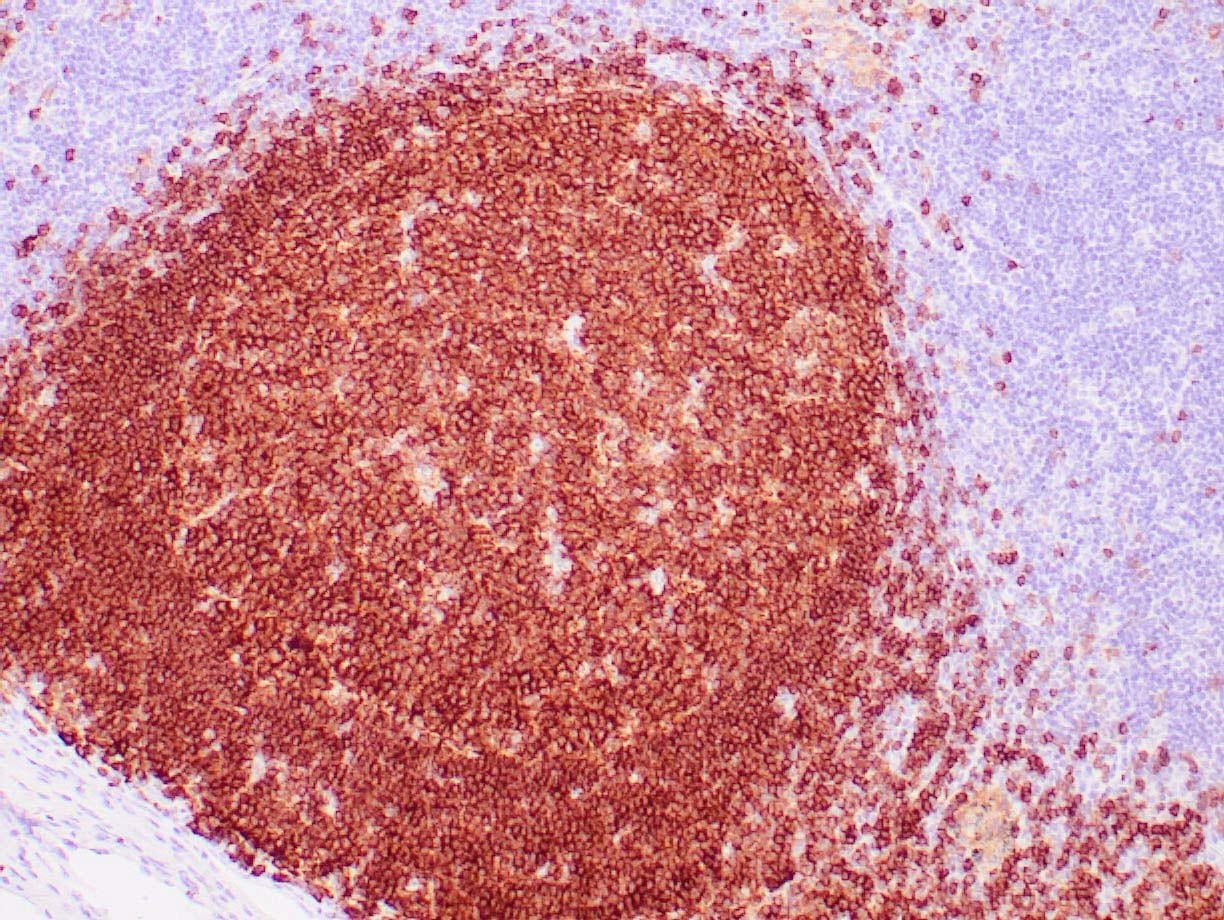 |
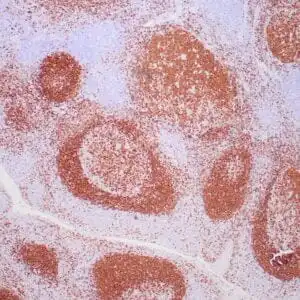
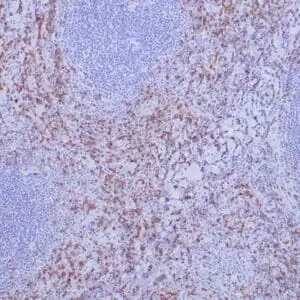
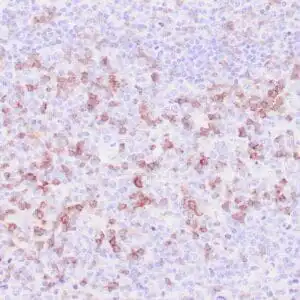
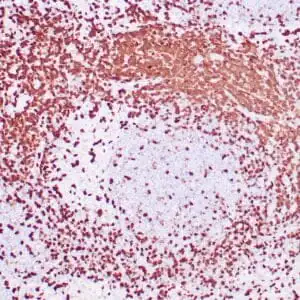
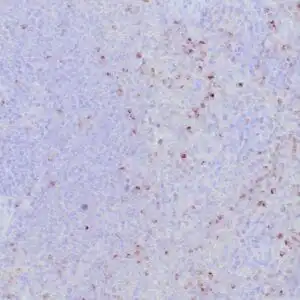
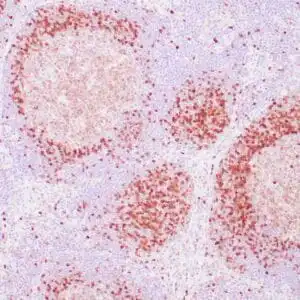
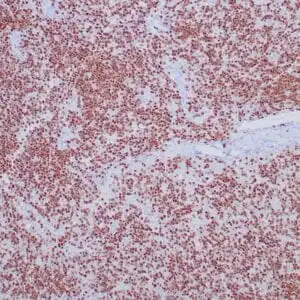
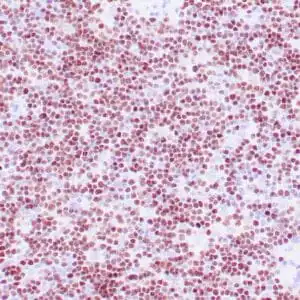
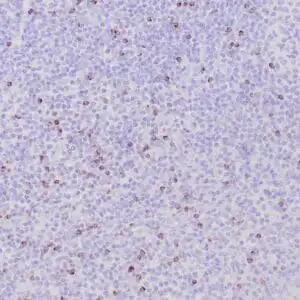
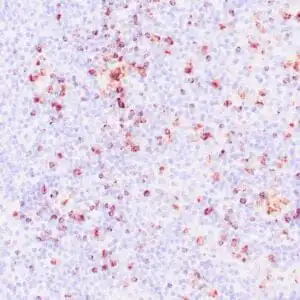
| Human spleen stained with anti-CD22 antibody using peroxidase-conjugate and DAB chromogen. Note cytoplasmic staining of B-lymphocytes. |
FAQ & Publications
Frequently Asked Questions
What species does the mouse anti-CD22 monoclonal antibody (ZM183) react with?
This antibody is reactive with human species.
Which applications is the mouse anti-CD22 monoclonal antibody (ZM183) validated for?
It is suitable for immunohistochemistry (IHC) on formalin-fixed, paraffin-embedded human tissues.
How should the mouse anti-CD22 monoclonal antibody (ZM183) be stored to maintain stability?
For short term storage, keep the antibody at 2-8°C. For longer term preservation, store at -20°C and avoid freeze/thaw cycles.
What are the available sizes and concentrations for the mouse anti-CD22 monoclonal antibody (ZM183)?
The antibody is available in 0.1 mL, 0.5 mL, and 1.0 mL concentrated formats, as well as a 7 mL prediluted format.
Publications
| pmid | title | authors | citation |
|---|---|---|---|
| We haven't added any publications to our database yet. | |||
Published literature highly relevant to the biological target of this product and referencing this antibody or clone are retrieved from the PubMed database provided by the United States National Library of Medicine at the National Institutes of Health.
Protocols
| relevant to this product |
|---|
| IHC |
Documents
| Batch Number | QC File | SDS |
|---|---|---|
| To view batch-specific Safety Datasheets and Quality Certificates associated with your account, please Log In. | ||
Only logged in customers who have purchased this product may leave a review.


Reviews
There are no reviews yet.