| Weight | 1 lbs |
|---|---|
| Dimensions | 9 × 5 × 2 in |
| host | mouse |
| isotype | IgG1/ Kappa |
| clonality | monoclonal |
| concentration | concentrate, predilute |
| applications | IHC |
| reactivity | human |
| available size | 0.1 mL, 0.5 mL, 1 mL concentrated, 7 mL prediluted |

mouse anti-CD14 monoclonal antibody (ZM104) 6419
Price range: $160.00 through $528.00
Antibody summary
- Mouse monoclonal to CD14
- Suitable for: Immunohistochemistry (formalin-fixed, paraffin-embedded tissues)
- Reacts with: Human
- Isotype:IgG1/ Kappa
- Control: Tonsil or lymph node
- Visualization: Membrane and cytoplasmic
- 0.1, 0.5, 1.0 mL concentrated, 7 mL prediluted
mouse anti-CD14 monoclonal antibody ZM104 6419
| target relevance |
|---|
| Protein names Monocyte differentiation antigen CD14 (My23 antigen) (Myeloid cell-specific leucine-rich glycoprotein) (CD antigen CD14) [Cleaved into: Monocyte differentiation antigen CD14, urinary form; Monocyte differentiation antigen CD14, membrane-bound form] |
| Gene names CD14,CD14 |
| Mass 40076Da |
| Function FUNCTION: Coreceptor for bacterial lipopolysaccharide (PubMed:1698311, PubMed:23264655). In concert with LBP, binds to monomeric lipopolysaccharide and delivers it to the LY96/TLR4 complex, thereby mediating the innate immune response to bacterial lipopolysaccharide (LPS) (PubMed:20133493, PubMed:22265692, PubMed:23264655). Acts via MyD88, TIRAP and TRAF6, leading to NF-kappa-B activation, cytokine secretion and the inflammatory response (PubMed:8612135). Acts as a coreceptor for TLR2:TLR6 heterodimer in response to diacylated lipopeptides and for TLR2:TLR1 heterodimer in response to triacylated lipopeptides, these clusters trigger signaling from the cell surface and subsequently are targeted to the Golgi in a lipid-raft dependent pathway (PubMed:16880211). Binds electronegative LDL (LDL(-)) and mediates the cytokine release induced by LDL(-) (PubMed:23880187). {ECO:0000269|PubMed:16880211, ECO:0000269|PubMed:1698311, ECO:0000269|PubMed:20133493, ECO:0000269|PubMed:22265692, ECO:0000269|PubMed:23264655, ECO:0000269|PubMed:23880187, ECO:0000269|PubMed:8612135}. |
| Subellular location SUBCELLULAR LOCATION: Cell membrane {ECO:0000269|PubMed:1698311, ECO:0000269|PubMed:2462937, ECO:0000269|PubMed:3385210}; Lipid-anchor, GPI-anchor {ECO:0000269|PubMed:1698311, ECO:0000269|PubMed:2462937, ECO:0000269|PubMed:3385210}. Secreted {ECO:0000269|PubMed:25497142, ECO:0000269|PubMed:2779588}. Membrane raft {ECO:0000269|PubMed:16880211}. Golgi apparatus {ECO:0000269|PubMed:16880211}. Note=Secreted forms may arise by cleavage of the GPI anchor. {ECO:0000269|PubMed:2462937, ECO:0000269|PubMed:2779588, ECO:0000269|PubMed:3385210}. |
| Tissues TISSUE SPECIFICITY: Detected on macrophages (at protein level) (PubMed:1698311). Expressed strongly on the surface of monocytes and weakly on the surface of granulocytes; also expressed by most tissue macrophages. {ECO:0000269|PubMed:1698311, ECO:0000269|PubMed:25497142}. |
| Structure SUBUNIT: Interacts with LPS-bound LPB (PubMed:1698311, PubMed:23264655). Belongs to the lipopolysaccharide (LPS) receptor, a multi-protein complex containing at least CD14, LY96 and TLR4 (PubMed:11274165). Interacts with LPAR1 (By similarity). Interacts with the TLR2:TLR6 or TLR2:TLR1 heterodimers; upon interaction with ligands such as diacylated lipopeptides and triacylated lipopeptides, respectively (PubMed:16880211). Interacts with MYO18A (PubMed:25965346). Interacts with FSTL1 (PubMed:22265692). {ECO:0000250|UniProtKB:P10810, ECO:0000269|PubMed:11274165, ECO:0000269|PubMed:16880211, ECO:0000269|PubMed:1698311, ECO:0000269|PubMed:22265692, ECO:0000269|PubMed:23264655, ECO:0000269|PubMed:25965346}. |
| Post-translational modification PTM: N- and O- glycosylated. O-glycosylated with a core 1 or possibly core 8 glycan. {ECO:0000269|PubMed:16335952, ECO:0000269|PubMed:19159218, ECO:0000269|PubMed:19838169}. |
| Domain DOMAIN: The C-terminal leucine-rich repeat (LRR) region is required for responses to smooth LPS. {ECO:0000250|UniProtKB:P10810}. |
| Target Relevance information above includes information from UniProt accession: P08571 |
| The UniProt Consortium |
Data
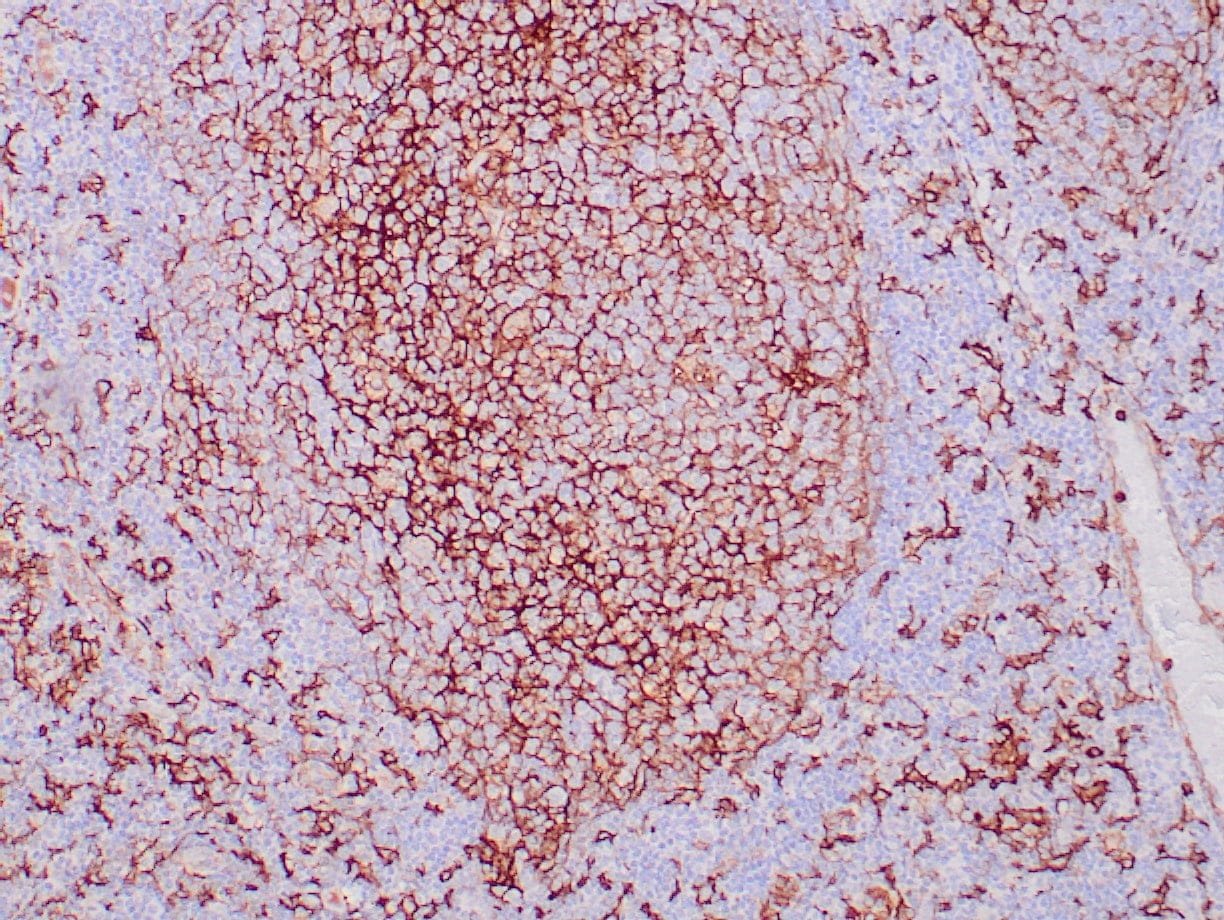 |
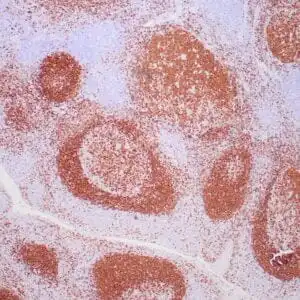
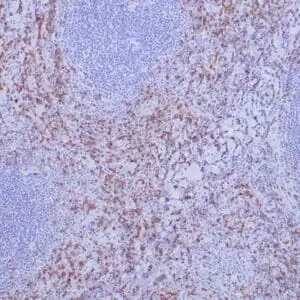
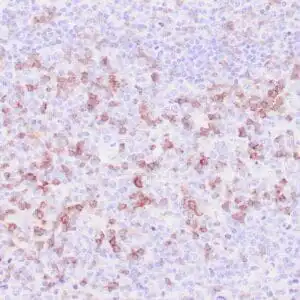
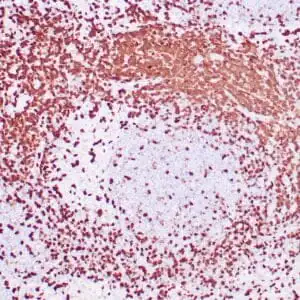
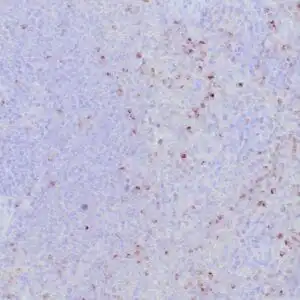
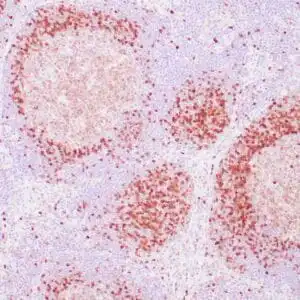
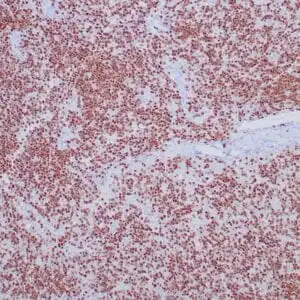
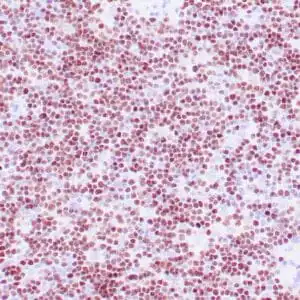
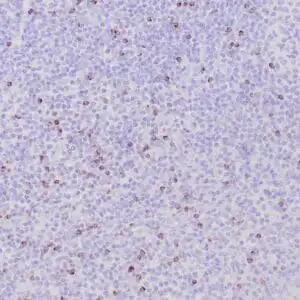
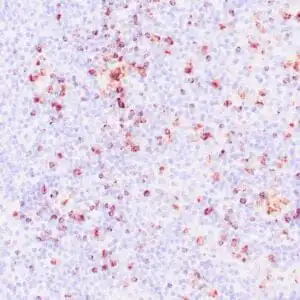
| Formalin-fixed, paraffin-embedded human tonsil stained with anti-CD14 antibody using peroxidase-conjugate and DAB chromogen. Note cytoplasmic and membrane staining of Langerhans cells (in follicle) and histiocytes in the perifollicular region |
FAQ & Publications
Frequently Asked Questions
What species does the mouse anti-CD14 monoclonal antibody (ZM104) react with?
This antibody is reactive with human CD14.
Which applications is the mouse anti-CD14 monoclonal antibody (ZM104) suitable for?
It is suitable for immunohistochemistry (IHC) on formalin-fixed, paraffin-embedded tissues.
How should the mouse anti-CD14 monoclonal antibody (ZM104) be stored for optimal stability?
Store the antibody at 2-8°C for short-term use, and for longer-term storage keep at -20°C while avoiding repeated freeze/thaw cycles.
What is the recommended dilution range for using the concentrated mouse anti-CD14 monoclonal antibody (ZM104) in IHC?
The recommended dilution for the concentrated antibody is between 1:100 and 1:200 for immunohistochemistry applications.
Publications
| pmid | title | authors | citation |
|---|---|---|---|
| We haven't added any publications to our database yet. | |||
Published literature highly relevant to the biological target of this product and referencing this antibody or clone are retrieved from the PubMed database provided by the United States National Library of Medicine at the National Institutes of Health.
Protocols
| relevant to this product |
|---|
| IHC |
Documents
| Batch Number | QC File | SDS |
|---|---|---|
| To view batch-specific Safety Datasheets and Quality Certificates associated with your account, please Log In. | ||
Only logged in customers who have purchased this product may leave a review.


Reviews
There are no reviews yet.