| Weight | 1 lbs |
|---|---|
| Dimensions | 9 × 5 × 2 in |
| host | rabbit |
| isotype | IgG |
| clonality | polyclonal |
| concentration | 1 mg/mL |
| applications | ICC/IF, IHC, WB |
| available sizes | 100 µg |


rabbit anti-Ubiquitin polyclonal antibody 9044
$409.00
Antibody summary
- Rabbit polyclonal to Ubiquitin
- Suitable for: WB, ICC/IF, IHC
- Reacts with: all
- Isotype: IgG
- 100 µg
rabbit anti-Ubiquitin polyclonal antibody 9044
| antibody |
|---|
| Database link: Ubiquitin Sequence - MQIFVKTLTGKTITLEVEPSDTIENVKAKIQDKEGIPPDQQRLIFAGKQLEDGRTLSDYNIQKESTLHLVLRLRGG |
| Tested applications WB,IHC,IHC,ICC/IF |
| Recommended dilutions WB: 1:5000-1:10000 IF/ICC and IHC: 1:500-1:1000 |
| Immunogen Purified ubiquitin conjugated with glutaraldehyde to KLH |
| Size and concentration 100µg and 1 mg/mL |
| Form liquid |
| Storage Instructions 2-8°C for short term, for longer term at -20°C. Avoid freeze / thaw cycles. |
| Storage buffer PBS, 50% glycerol, 0.04% NaN3 |
| Purity affinity purified |
| Clonality polyclonal |
| Isotype IgG |
| Compatible secondaries goat anti-rabbit IgG, H&L chain specific, peroxidase conjugated, conjugated polyclonal antibody 9512 goat anti-rabbit IgG, H&L chain specific, biotin conjugated polyclonal antibody 2079 goat anti-rabbit IgG, H&L chain specific, FITC conjugated polyclonal antibody 7863 goat anti-rabbit IgG, H&L chain specific, Cross Absorbed polyclonal antibody 2371 goat anti-rabbit IgG, H&L chain specific, biotin conjugated polyclonal antibody, crossabsorbed 1715 goat anti-rabbit IgG, H&L chain specific, FITC conjugated polyclonal antibody, crossabsorbed 1720 |
| Isotype control Rabbit polyclonal - Isotype Control |
| target relevance |
|---|
| ubiquitin |
| Alternative names Ub, Polyubiquitin, Monoubiquitin |
| Function Ubiquitin is covalently attached to lysine residues of target proteins through an enzymatic cascade involving E1 activating enzymes, E2 conjugating enzymes, and E3 ligases. Ubiquitination regulates protein degradation by the proteasome, intracellular trafficking, signaling pathways, DNA repair, autophagy, and immune responses. |
| Subcellular location Ubiquitin is distributed throughout the cytoplasm and nucleus and can be covalently attached to proteins in virtually all cellular compartments. |
| Involvement in disease Defects in ubiquitin-mediated pathways have been implicated in cancer, neurodegenerative disorders, inflammatory diseases, autoimmune diseases, and infectious diseases. |
| Description Ubiquitin is a highly conserved 76-amino acid protein that functions as a post-translational modifier of proteins. Covalent attachment of ubiquitin regulates protein degradation, signaling, trafficking, DNA repair, and numerous other cellular processes. |
| Biological role Protein degradation Proteasome targeting Cell signaling DNA damage response Autophagy Protein quality control Immune regulation |
| Pathways Ubiquitin-proteasome system Protein degradation Autophagy DNA repair pathways NF-kB signaling Cell cycle regulation |
| Research relevance Ubiquitin is one of the most widely studied post-translational modifiers. Antibodies may recognize total ubiquitin, monoubiquitinated proteins, polyubiquitin chains, or specific chain linkages such as K48, K63, or M1-linked ubiquitin. |
| Related entities relationship: modified_form_of; entity: K48-linked polyubiquitin relationship: modified_form_of; entity: K63-linked polyubiquitin relationship: modified_form_of; entity: Linear ubiquitin |
| Keywords Protein degradation, Ubiquitination, Polyubiquitination, Proteasome, Autophagy, DNA repair |
| Structure Ubiquitin is a highly conserved 76-amino acid protein found in all eukaryotic cells. It can be attached to target proteins either as a single molecule or as polyubiquitin chains. |
| Function Ubiquitin regulates protein degradation, trafficking, signaling, DNA repair, autophagy, and immune responses through reversible covalent modification of target proteins. |
| Ubiquitination Protein ubiquitination occurs through E1 activating enzymes, E2 conjugating enzymes, and E3 ligases, resulting in attachment of ubiquitin to lysine residues on substrate proteins. |
| Polyubiquitin Chains Different ubiquitin chain linkages encode distinct biological signals. K48 chains generally target proteins for degradation, whereas K63 and M1 chains frequently regulate signaling pathways. |
| Research relevance Ubiquitin is a major target in studies of proteostasis, cancer biology, neurodegeneration, autophagy, cell signaling, and post-translational modification analysis. |
Data
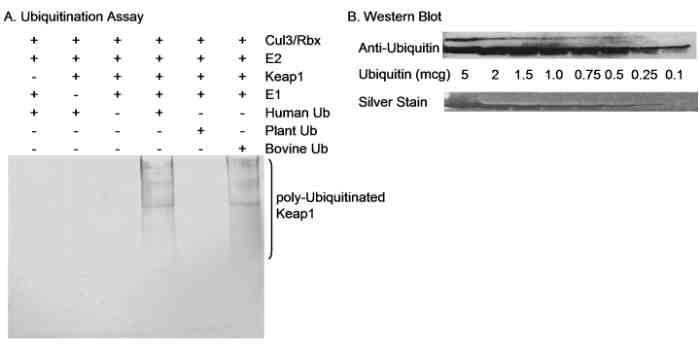 |
| Detection of Ubiquitin by western blotting of Products from an Ubiquitination Assay and Purified Ubiquitin. Samples: A) Ubiquitination assay was performed as described in Zhang et al., 2004, Mol. Cell. Biol. 24(24):10941-10953. B) Purified ubiquitin applied in decreasing amounts from 5 to 0.1 µg. Antibody: Affinity purified rabbit anti-Ubiquitin antibody used at 0.4 µg/ml for western blot. Detection: Alkaline phosphatase conjugated secondary antibody and development with NBT/BCIP for 10 minutes (A and B). |
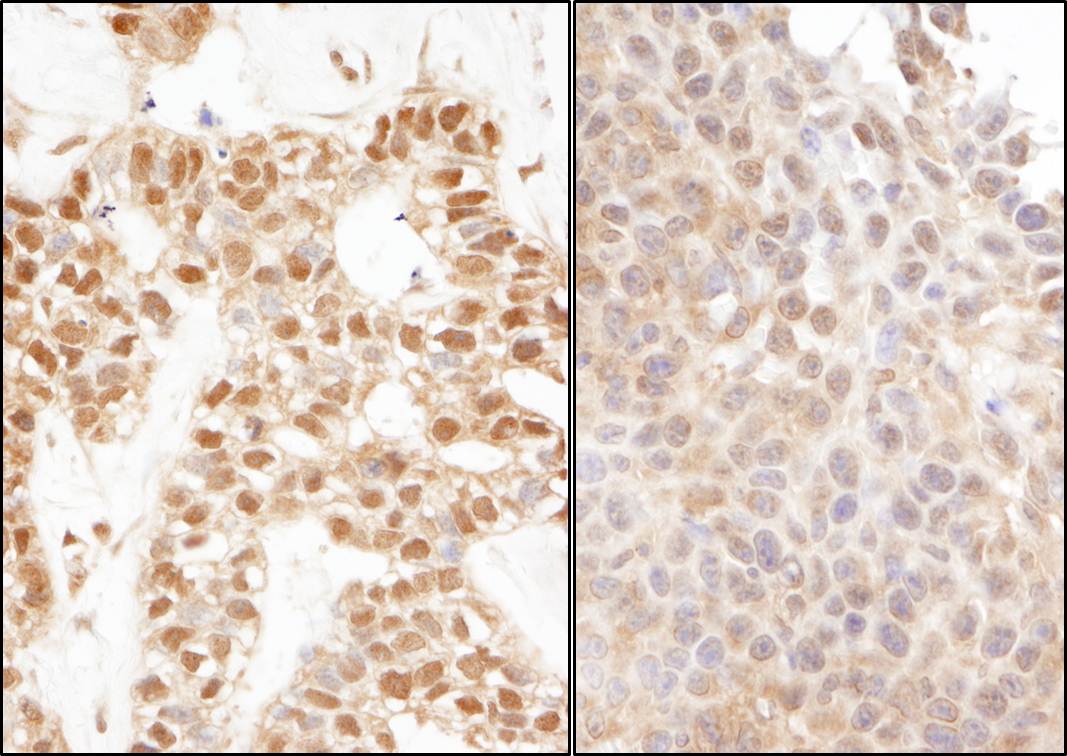 |
| Detection of human and mouse Ubiquitin by immunohistochemistry. Sample: FFPE sections of human breast carcinoma (left) and mouse teratoma (right). Antibody: Affinity purified rabbit anti-Ubiquitin used at a dilution of 1:1,000 (1µg/ml). Detection: DAB |
FAQ & Publications
Frequently Asked Questions
What applications is the rabbit anti-Ubiquitin polyclonal antibody 9044 validated for, and what are the recommended dilution ranges?
The rabbit anti-Ubiquitin polyclonal antibody 9044 is validated for use in Western blotting (WB), immunocytochemistry/immunofluorescence (ICC/IF), and immunohistochemistry (IHC). The recommended dilution ranges are 1:5000 to 1:10000 for WB, and 1:500 to 1:1000 for ICC/IF and IHC.
How should the rabbit anti-Ubiquitin polyclonal antibody 9044 be stored to maintain stability and activity?
For short-term storage, keep the antibody at 2-8°C. For long-term storage, it should be kept at -20°C. It is important to avoid freeze-thaw cycles to preserve antibody stability and activity.
Publications
| pmid | title | authors | citation |
|---|---|---|---|
| We haven't added any publications to our database yet. | |||
Published literature highly relevant to the biological target of this product and referencing this antibody or clone are retrieved from the PubMed database provided by the United States National Library of Medicine at the National Institutes of Health.
Protocols
| relevant to this product |
|---|
| Western blot IHC ICC |
Documents
| Batch Number | QC File | SDS |
|---|---|---|
| To view batch-specific Safety Datasheets and Quality Certificates associated with your account, please Log In. | ||
Only logged in customers who have purchased this product may leave a review.

Reviews
There are no reviews yet.