| Weight | 1 lbs |
|---|---|
| Dimensions | 9 × 5 × 2 in |
| host | rabbit |
| isotype | IgG |
| clonality | polyclonal |
| concentration | 1 mg/mL |
| applications | IP, WB |
| reactivity | polyclonal, rabbit, TRX1 |
| available sizes | 10 µL, 100 µL |


rabbit anti-thioredoxin (TRX1) polyclonal antibody 1004
Price range: $121.00 through $2,600.00
Antibody summary
- Rabbit polyclonal to Thioredoxin (Trx1)
- Suitable for: IP,WB
- Reacts with: Hu
- Isotype: IgG
- 100 µL, 10 µL
rabbit anti-TRX1 polyclonal antibody 1004
| target relevance |
|---|
| Homo sapiens TXN Thioredoxin |
| Protein names Thioredoxin |
| Alternative names ATL-derived factor, Surface-associated sulphydryl protein |
| Gene names TXN |
| Protein family Belongs to the thioredoxin family |
| Function Participates in various redox reactions through the reversible oxidation of its active center dithiol to a disulfide and catalyzes dithiol-disulfide exchange reactions (PubMed:17182577, PubMed:19032234, PubMed:2176490). Plays a role in the reversible S-nitrosylation of cysteine residues in target proteins, and thereby contributes to the response to intracellular nitric oxide. Nitrosylates the active site Cys of CASP3 in response to nitric oxide (NO), and thereby inhibits caspase-3 activity (PubMed:16408020, PubMed:17606900). Induces the FOS/JUN AP-1 DNA-binding activity in ionizing radiation (IR) cells through its oxidation/reduction status and stimulates AP-1 transcriptional activity (PubMed:11118054, PubMed:9108029) |
| Subcellular location Nucleus, Cytoplasm, Secreted |
| Structure Homodimer; disulfide-linked (PubMed:17260951, PubMed:9369469). Interacts with TXNIP through the redox-active site (PubMed:17260951). Interacts with MAP3K5 and CASP3 (PubMed:15246877). In case of infection, interacts with S.typhimurium protein slrP (PubMed:19690162). Interacts with APEX1; the interaction stimulates the FOS/JUN AP-1 DNA-binding activity in a redox-dependent manner (PubMed:9108029) |
| Post-translational modification In the fully reduced protein, both Cys-69 and Cys-73 are nitrosylated in response to nitric oxide (NO). When two disulfide bonds are present in the protein, only Cys-73 is nitrosylated. Cys-73 can serve as donor for nitrosylation of target proteins In case of infection, ubiquitinated by S.typhimurium protein slrP, leading to its degradation |
| Keywords 3D-structure, Acetylation, Activator, Allergen, Alternative splicing, Cytoplasm, Direct protein sequencing, Disulfide bond, Electron transport, Nucleus, Proteomics identification, Redox-active center, Reference proteome, S-nitrosylation, Secreted, Transcription, Transcription regulation, Transport, Ubl conjugation |
| Sequence MVKQIESKTAFQEALDAAGDKLVVVDFSATWCGPCKMIKPFFHSLSEKYSNVIFLEVDVD DCQDVASECEVKCMPTFQFFKKGQKVGEFSGANKEKLEATINELV |
| UniProt accession: P10599 |
Data
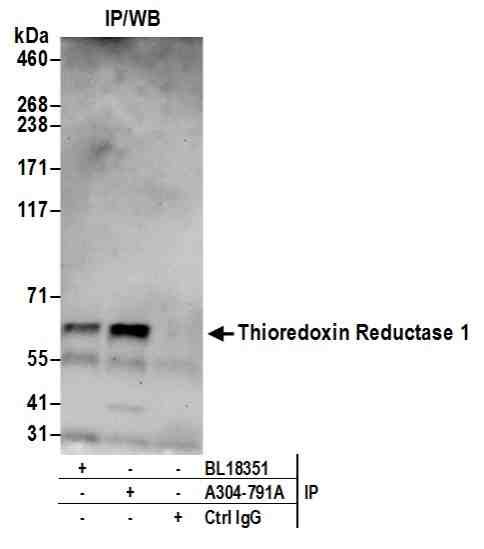 |
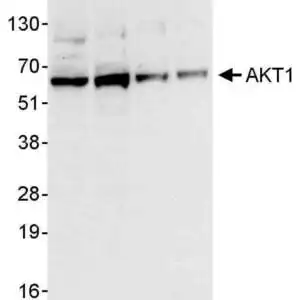
| Detection of human Thioredoxin Reductase 1 by western blot. Samples: Whole cell lysate (50 µg) from HeLa, HEK293T, and Jurkat cells prepared using NETN lysis buffer. Antibody: Affinity purified rabbit anti-Thioredoxin Reductase 1 antibody #1004 used for WB at 0.1 µg/ml. Detection: Chemiluminescence with an exposure time of 30 seconds. |
FAQ & Publications
Frequently Asked Questions
What species does the rabbit anti-Thioredoxin (TRX1) polyclonal antibody 1004 react with?
This antibody reacts with human Thioredoxin (TRX1).
For which experimental applications is this antibody validated?
The antibody is suitable for immunoprecipitation (IP) and western blotting (WB) applications.
What are the recommended dilution ranges for western blot and immunoprecipitation using this antibody?
For western blotting, the recommended dilution is 1:2000 to 1:10000. For immunoprecipitation, 2 to 10 µg of antibody per mg of lysate is suggested.
How should the rabbit anti-TRX1 polyclonal antibody 1004 be stored to maintain stability?
For short-term storage, keep the antibody at 2-8°C. For long-term storage, it should be stored at -20°C while avoiding repeated freeze/thaw cycles.
What is the concentration and form of the rabbit anti-Thioredoxin antibody provided?
The antibody is supplied as a liquid at a concentration of 1 mg/mL, available in sizes of 10 µL and 100 µL.
Publications
| pmid | title | authors | citation |
|---|---|---|---|
| We haven't added any publications to our database yet. | |||
Published literature highly relevant to the biological target of this product and referencing this antibody or clone are retrieved from the PubMed database provided by the United States National Library of Medicine at the National Institutes of Health.
Protocols
| relevant to this product |
|---|
Documents
| Batch Number | QC File | SDS |
|---|---|---|
| To view batch-specific Safety Datasheets and Quality Certificates associated with your account, please Log In. | ||
Only logged in customers who have purchased this product may leave a review.

Reviews
There are no reviews yet.