| Weight | 1 lbs |
|---|---|
| Dimensions | 9 × 5 × 2 in |
| host | mouse |
| isotype | IgG |
| clonality | monoclonal |
| concentration | concentrate, predilute |
| applications | IHC |
| reactivity | human |
| available size | 0.1 mL, 0.5 mL, 1 mL concentrated, 7 mL prediluted |

rabbit anti-SALL4 monoclonal antibody (ZR276) 6360
Price range: $160.00 through $528.00
Antibody summary
- Rabbit monoclonal to SALL4
- Suitable for: Immunohistochemistry (formalin-fixed, paraffin-embedded tissues)
- Reacts with: Human
- Isotype:IgG
- Control: Seminoma
- Visualization: Nuclear
- 0.1, 0.5, 1.0 mL concentrated, 7 mL prediluted
rabbit anti-SALL4 monoclonal antibody ZR276 6360
| target relevance |
|---|
| Homo sapiens SALL4 Sal-like protein 4 |
| Protein names Sal-like protein 4 |
| Alternative names Zinc finger protein 797, Zinc finger protein SALL4 |
| Gene names SALL4 |
| Protein family Belongs to the sal C2H2-type zinc-finger protein family |
| Function Transcription factor with a key role in the maintenance and self-renewal of embryonic and hematopoietic stem cells |
| Subcellular location Cytoplasm, Nucleus |
| Structure Interacts with POU5F1/OCT4 (PubMed:23012367). Interacts with NANOG (By similarity). Interacts with BEND3 (PubMed:21914818). Interacts with NSD2 (via PHD-type zinc fingers 1, 2 and 3) (By similarity). Interacts with NRBP1 (PubMed:22510880) |
| Post-translational modification Isoform SALL4B exists primarily as a ubiquitinated form Sumoylation with both SUMO1 and SUMO2 regulates the stability, subcellular localization, transcriptional activity, and may reduce interaction with POU5F1/OCT4 |
| Involvement in disease Duane-radial ray syndrome Disorder characterized by the association of forearm malformations with Duane retraction syndrome. IVIC syndrome An autosomal dominant condition characterized by upper limbs anomalies (radial ray defects, carpal bones fusion), extraocular motor disturbances, congenital bilateral non-progressive mixed hearing loss. Other less consistent malformations include heart involvement, mild thrombocytopenia and leukocytosis (before age 50), shoulder girdle hypoplasia, imperforate anus, kidney malrotation or rectovaginal fistula. The IVIC syndrome is an allelic disorder of Duane-radial ray syndrome with a similar phenotype. |
| Keywords 3D-structure, Alternative splicing, Cytoplasm, Deafness, Disease variant, DNA-binding, Isopeptide bond, Metal-binding, Nucleus, Oncogene, Phosphoprotein, Proteomics identification, Reference proteome, Repeat, Transcription, Transcription regulation, Ubl conjugation, Zinc, Zinc-finger |
| Sequence MSRRKQAKPQHINSEEDQGEQQPQQQTPEFADAAPAAPAAGELGAPVNHPGNDEVASEDE ATVKRLRREETHVCEKCCAEFFSISEFLEHKKNCTKNPPVLIMNDSEGPVPSEDFSGAVL SHQPTSPGSKDCHRENGGSSEDMKEKPDAESVVYLKTETALPPTPQDISYLAKGKVANTN VTLQALRGTKVAVNQRSADALPAPVPGANSIPWVLEQILCLQQQQLQQIQLTEQIRIQVN MWASHALHSSGAGADTLKTLGSHMSQQVSAAVALLSQKAGSQGLSLDALKQAKLPHANIP SATSSLSPGLAPFTLKPDGTRVLPNVMSRLPSALLPQAPGSVLFQSPFSTVALDTSKKGK GKPPNISAVDVKPKDEAALYKHKCKYCSKVFGTDSSLQIHLRSHTGERPFVCSVCGHRFT TKGNLKVHFHRHPQVKANPQLFAEFQDKVAAGNGIPYALSVPDPIDEPSLSLDSKPVLVT TSVGLPQNLSSGTNPKDLTGGSLPGDLQPGPSPESEGGPTLPGVGPNYNSPRAGGFQGSG TPEPGSETLKLQQLVENIDKATTDPNECLICHRVLSCQSSLKMHYRTHTGERPFQCKICG RAFSTKGNLKTHLGVHRTNTSIKTQHSCPICQKKFTNAVMLQQHIRMHMGGQIPNTPLPE NPCDFTGSEPMTVGENGSTGAICHDDVIESIDVEEVSSQEAPSSSSKVPTPLPSIHSASP TLGFAMMASLDAPGKVGPAPFNLQRQGSRENGSVESDGLTNDSSSLMGDQEYQSRSPDIL ETTSFQALSPANSQAESIKSKSPDAGSKAESSENSRTEMEGRSSLPSTFIRAPPTYVKVE VPGTFVGPSTLSPGMTPLLAAQPRRQAKQHGCTRCGKNFSSASALQIHERTHTGEKPFVC NICGRAFTTKGNLKVHYMTHGANNNSARRGRKLAIENTMALLGTDGKRVSEIFPKEILAP SVNVDPVVWNQYTSMLNGGLAVKTNEISVIQSGGVPTLPVSLGATSVVNNATVSKMDGSQ SGISADVEKPSATDGVPKHQFPHFLEENKIAVS |
| UniProt accession: Q9UJQ4 |
Data
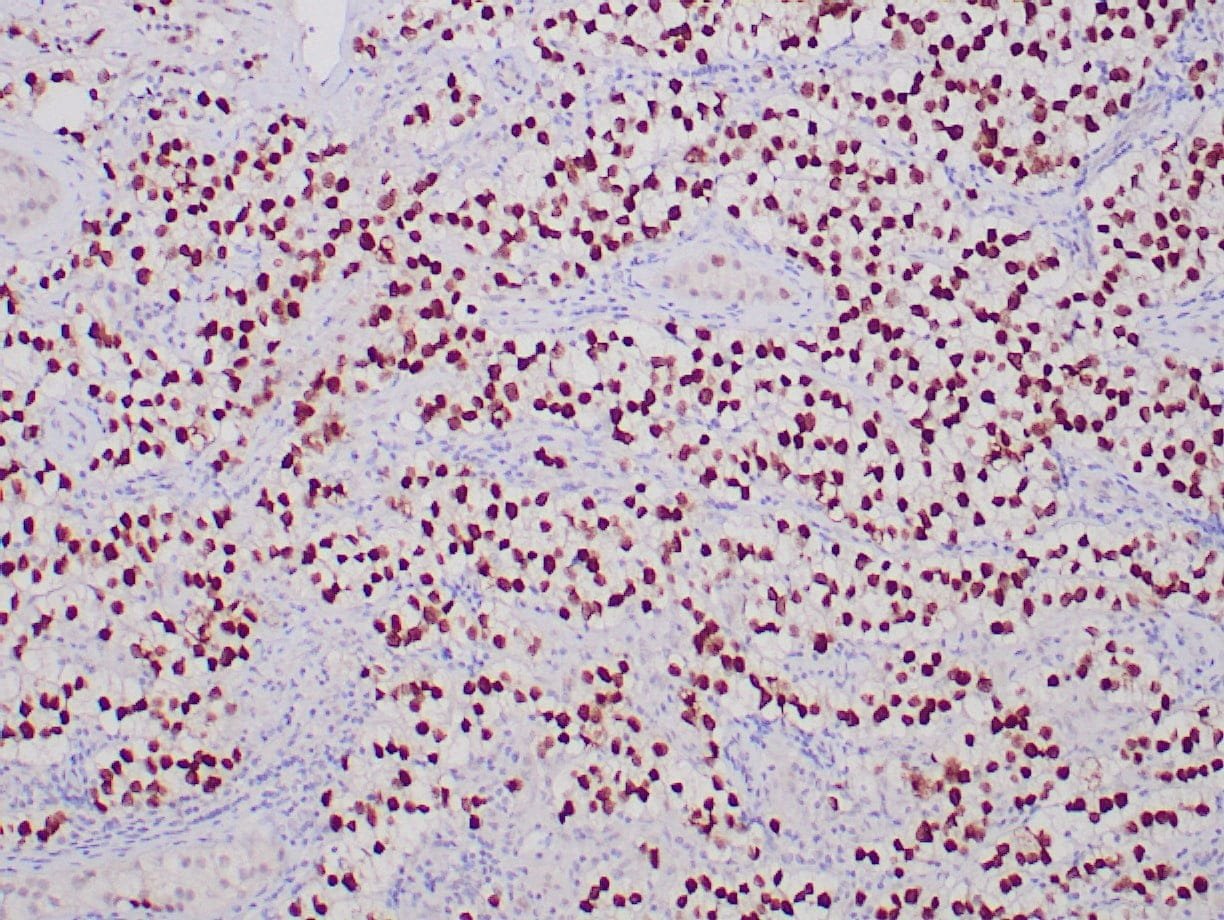 |
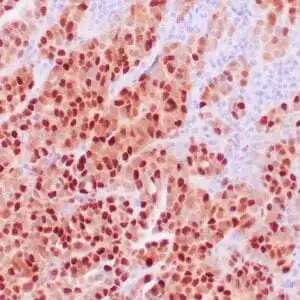
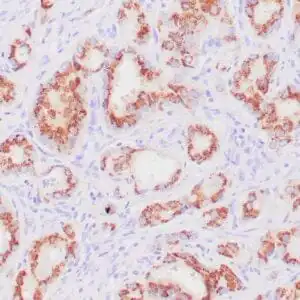
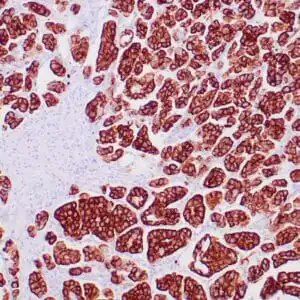
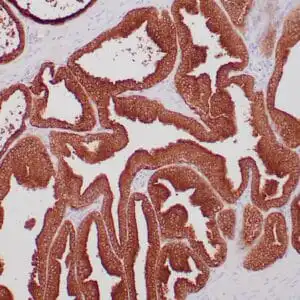
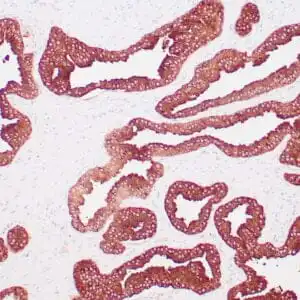
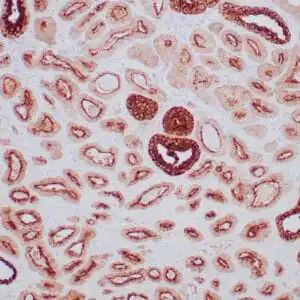
| Formalin-fixed, paraffin-embedded human seminoma stained with anti-SALL4 antibody using peroxidase-conjugate and DAB chromogen. Note nuclear staining of tumor cells |
FAQ & Publications
Frequently Asked Questions
What species reactivity does the rabbit anti-SALL4 monoclonal antibody (ZR276) display?
The rabbit anti-SALL4 monoclonal antibody (ZR276) is reactive with human tissues.
Which applications is the rabbit anti-SALL4 antibody suitable for, and what is the recommended dilution?
This antibody is suitable for immunohistochemistry (IHC) on formalin-fixed, paraffin-embedded tissues. The recommended dilution for the concentrated antibody is between 1:100 and 1:200.
How should the rabbit anti-SALL4 monoclonal antibody be stored to maintain stability?
For short-term storage, keep the antibody at 2-8°C. For longer-term storage, it should be kept at -20°C. It is important to avoid freeze/thaw cycles to maintain antibody integrity.
What is the host species and clonality of the anti-SALL4 antibody ZR276?
The anti-SALL4 antibody ZR276 is a rabbit monoclonal antibody with an IgG isotype.
Publications
| pmid | title | authors | citation |
|---|---|---|---|
| We haven't added any publications to our database yet. | |||
Published literature highly relevant to the biological target of this product and referencing this antibody or clone are retrieved from the PubMed database provided by the United States National Library of Medicine at the National Institutes of Health.
Protocols
| relevant to this product |
|---|
| IHC |
Documents
| Batch Number | QC File | SDS |
|---|---|---|
| To view batch-specific Safety Datasheets and Quality Certificates associated with your account, please Log In. | ||
Only logged in customers who have purchased this product may leave a review.
Reviews
There are no reviews yet.