| Weight | 1 lbs |
|---|---|
| Dimensions | 9 × 5 × 2 in |
| host | mouse |
| isotype | IgG |
| clonality | monoclonal |
| concentration | concentrate, predilute |
| applications | IHC |
| reactivity | human |
| available size | 0.1 mL, 0.5 mL, 1 mL concentrated, 7 mL prediluted |

rabbit anti-Perforin monoclonal antibody (ZR270) 6330
Price range: $160.00 through $528.00
Antibody summary
- Rabbit monoclonal to Perforin
- Suitable for: Immunohistochemistry (formalin-fixed, paraffin-embedded tissues)
- Reacts with: Human
- Isotype:IgG
- Control: Spleen
- Visualization: Granular cytoplasmic
- 0.1, 0.5, 1.0 mL concentrated, 7 mL prediluted
rabbit anti-Perforin monoclonal antibody ZR270 6330
| target relevance |
|---|
| Homo sapiens PRF1 Perforin-1 |
| Protein names Perforin-1 |
| Alternative names Cytolysin, Lymphocyte pore-forming protein |
| Gene names PRF1 |
| Protein family Belongs to the complement C6/C7/C8/C9 family |
| Function Pore-forming protein that plays a key role in granzyme-mediated programmed cell death, and in defense against virus-infected or neoplastic cells (PubMed:20889983, PubMed:21037563, PubMed:24558045, PubMed:9058810, PubMed:9164947). Plays an important role in killing other cells that are recognized as non-self by the immune system, e.g. in transplant rejection or some forms of autoimmune disease (PubMed:9058810). Can insert into the membrane of target cells in its calcium-bound form, oligomerize and form large pores (PubMed:20889983, PubMed:21037563). Promotes cytolysis and apoptosis of target cells by mediating the passage and uptake of cytotoxic granzymes (PubMed:20038786, PubMed:20225066, PubMed:24558045, PubMed:32299851). Facilitates the delivery of cationic cargo protein, while anionic or neural proteins are not delivered efficiently (PubMed:24558045). Perforin pores allow the release of mature caspase-7 (CASP7) into the extracellular milieu (By similarity) |
| Subcellular location Cytolytic granule, Secreted, Cell membrane, Endosome lumen |
| Structure Monomer, as soluble protein (PubMed:20889983, PubMed:21037563). Homooligomer; homooligomerizes to form a pore-forming ring (PubMed:20889983, PubMed:21037563) |
| Post-translational modification N-glycosylated |
| Involvement in disease Hemophagocytic lymphohistiocytosis, familial, 2 A rare disorder characterized by immune dysregulation with hypercytokinemia, defective function of natural killer cell, and massive infiltration of several organs by activated lymphocytes and macrophages. The clinical features of the disease include fever, hepatosplenomegaly, cytopenia, and less frequently neurological abnormalities ranging from irritability and hypotonia to seizures, cranial nerve deficits and ataxia. |
| Keywords Calcium, Cell membrane, Cytolysis, Disease variant, Disulfide bond, EGF-like domain, Endosome, Familial hemophagocytic lymphohistiocytosis, Glycoprotein, Lysosome, Membrane, Metal-binding, Proteomics identification, Reference proteome, Secreted, Signal, Transmembrane, Transmembrane beta strand |
| Sequence MAARLLLLGILLLLLPLPVPAPCHTAARSECKRSHKFVPGAWLAGEGVDVTSLRRSGSFP VDTQRFLRPDGTCTLCENALQEGTLQRLPLALTNWRAQGSGCQRHVTRAKVSSTEAVARD AARSIRNDWKVGLDVTPKPTSNVHVSVAGSHSQAANFAAQKTHQDQYSFSTDTVECRFYS FHVVHTPPLHPDFKRALGDLPHHFNASTQPAYLRLISNYGTHFIRAVELGGRISALTALR TCELALEGLTDNEVEDCLTVEAQVNIGIHGSISAEAKACEEKKKKHKMTASFHQTYRERH SEVVGGHHTSINDLLFGIQAGPEQYSAWVNSLPGSPGLVDYTLEPLHVLLDSQDPRREAL RRALSQYLTDRARWRDCSRPCPPGRQKSPRDPCQCVCHGSAVTTQDCCPRQRGLAQLEVT FIQAWGLWGDWFTATDAYVKLFFGGQELRTSTVWDNNNPIWSVRLDFGDVLLATGGPLRL QVWDQDSGRDDDLLGTCDQAPKSGSHEVRCNLNHGHLKFRYHARCLPHLGGGTCLDYVPQ MLLGEPPGNRSGAVW |
| UniProt accession: P14222 |
Data
 |
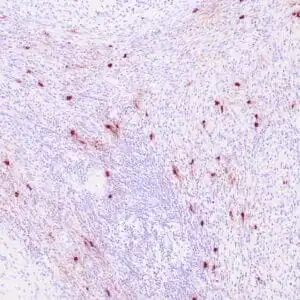
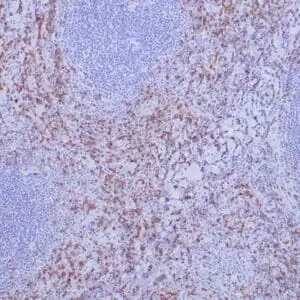
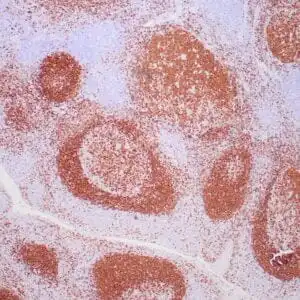
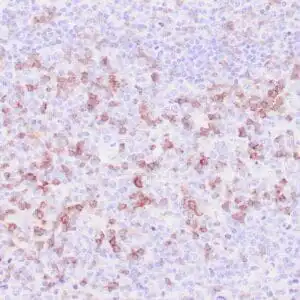
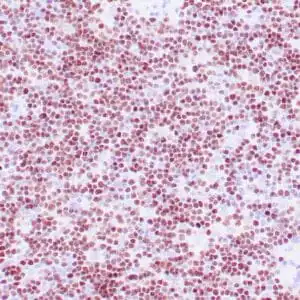
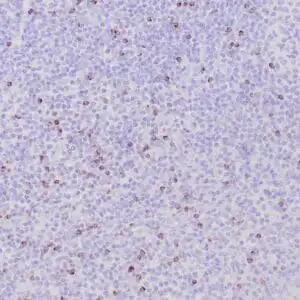
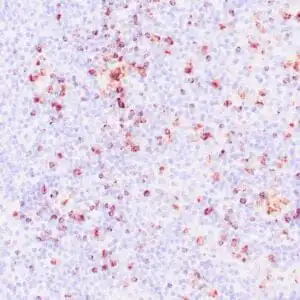
| Formalin-fixed, paraffin-embedded human spleen stained with anti-perforin antibody using peroxidase-conjugate and DAB chromogen. Note the cytoplasmic granular staining of cytotoxic T cells |
FAQ & Publications
Frequently Asked Questions
What species does the rabbit anti-Perforin monoclonal antibody (ZR270) specifically react with?
This antibody specifically reacts with human Perforin, making it suitable for studies involving human tissue samples.
What are the recommended storage conditions for maintaining the stability of this antibody?
For short-term storage, keep the antibody at 2-8°C. For long-term preservation, store it at -20°C and avoid repeated freeze-thaw cycles to maintain antibody integrity.
Which applications is the rabbit anti-Perforin monoclonal antibody (ZR270) validated for, and what is the suggested dilution for use?
This antibody is validated for immunohistochemistry (IHC) on formalin-fixed, paraffin-embedded tissues. The recommended dilution range for the concentrated antibody is between 1:100 and 1:200.
Publications
| pmid | title | authors | citation |
|---|---|---|---|
| We haven't added any publications to our database yet. | |||
Published literature highly relevant to the biological target of this product and referencing this antibody or clone are retrieved from the PubMed database provided by the United States National Library of Medicine at the National Institutes of Health.
Protocols
| relevant to this product |
|---|
| IHC |
Documents
| Batch Number | QC File | SDS |
|---|---|---|
| To view batch-specific Safety Datasheets and Quality Certificates associated with your account, please Log In. | ||
Only logged in customers who have purchased this product may leave a review.




Reviews
There are no reviews yet.