| Weight | 1 lbs |
|---|---|
| Dimensions | 9 × 5 × 2 in |
| host | mouse |
| isotype | IgG |
| clonality | monoclonal |
| concentration | concentrate, predilute |
| applications | IHC |
| reactivity | human |
| available size | 0.1 mL, 0.5 mL, 1 mL concentrated, 7 mL prediluted |

rabbit anti-MUM1 monoclonal antibody (ZR411) 7273
Price range: $160.00 through $528.00
Antibody summary
- Rabbit monoclonal to MUM1
- Suitable for: Immunohistochemistry (formalin-fixed, paraffin-embedded tissues)
- Reacts with: Human
- Isotype:IgG
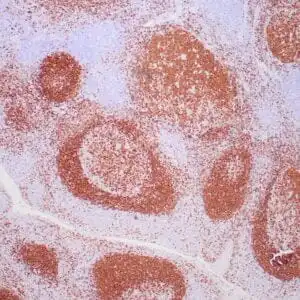
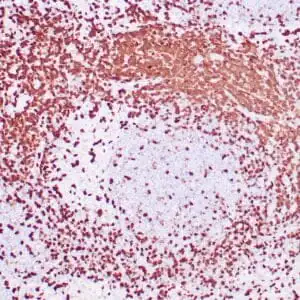
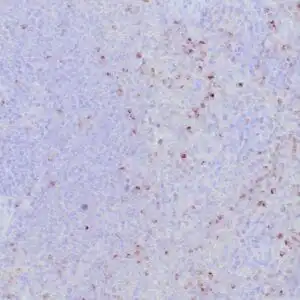
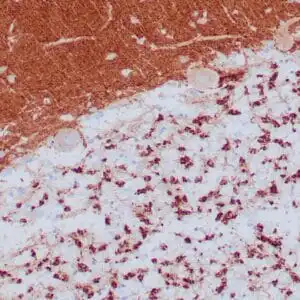
- Control: Tonsil or myeloma
- Visualization: Nucleus
- 0.1, 0.5, 1.0 mL concentrated, 7 mL prediluted
rabbit anti-MUM1 monoclonal antibody ZR411 7273
| target relevance |
|---|
| Protein names Interferon regulatory factor 4 (IRF-4) (Lymphocyte-specific interferon regulatory factor) (LSIRF) (Multiple myeloma oncogene 1) (NF-EM5) |
| Gene names IRF4,IRF4 MUM1 |
| Protein family IRF family |
| Mass 51772Da |
| Function FUNCTION: Transcriptional activator. Binds to the interferon-stimulated response element (ISRE) of the MHC class I promoter. Binds the immunoglobulin lambda light chain enhancer, together with PU.1. Probably plays a role in ISRE-targeted signal transduction mechanisms specific to lymphoid cells. Involved in CD8(+) dendritic cell differentiation by forming a complex with the BATF-JUNB heterodimer in immune cells, leading to recognition of AICE sequence (5'-TGAnTCA/GAAA-3'), an immune-specific regulatory element, followed by cooperative binding of BATF and IRF4 and activation of genes (By similarity). {ECO:0000250|UniProtKB:Q64287}. |
| Subellular location SUBCELLULAR LOCATION: Nucleus. |
| Tissues TISSUE SPECIFICITY: Lymphoid cells. |
| Structure SUBUNIT: Interacts with the BATF-JUNB heterodimer. Interacts with BATF (via bZIP domain); the interaction is direct (By similarity). Interacts with SPIB (PubMed:10196196). Interacts with DEF6 (PubMed:12651066). Directly interacts with NLRP3 in the nucleus of Th2 cells; this interaction enhances IRF4 ability to bind to the IL4 promoter and is required for optimal IRF4-dependent IL4 transcription (By similarity). Interacts with SPI1 (PubMed:33951726). {ECO:0000250, ECO:0000250|UniProtKB:Q64287, ECO:0000269|PubMed:10196196, ECO:0000269|PubMed:12651066, ECO:0000269|PubMed:33951726}. |
| Post-translational modification PTM: Phosphorylation by ROCK2 regulates IL-17 and IL-21 production. {ECO:0000250}. |
| Involvement in disease DISEASE: Multiple myeloma (MM) [MIM:254500]: A malignant tumor of plasma cells usually arising in the bone marrow and characterized by diffuse involvement of the skeletal system, hyperglobulinemia, Bence-Jones proteinuria and anemia. Complications of multiple myeloma are bone pain, hypercalcemia, renal failure and spinal cord compression. The aberrant antibodies that are produced lead to impaired humoral immunity and patients have a high prevalence of infection. Amyloidosis may develop in some patients. Multiple myeloma is part of a spectrum of diseases ranging from monoclonal gammopathy of unknown significance (MGUS) to plasma cell leukemia. {ECO:0000269|PubMed:9326949}. Note=The gene represented in this entry may be involved in disease pathogenesis. A chromosomal aberration involving IRF4 has been found in multiple myeloma. Translocation t(6;14)(p25;q32) with the IgH locus. |
| Target Relevance information above includes information from UniProt accession: Q15306 |
| The UniProt Consortium |
Data
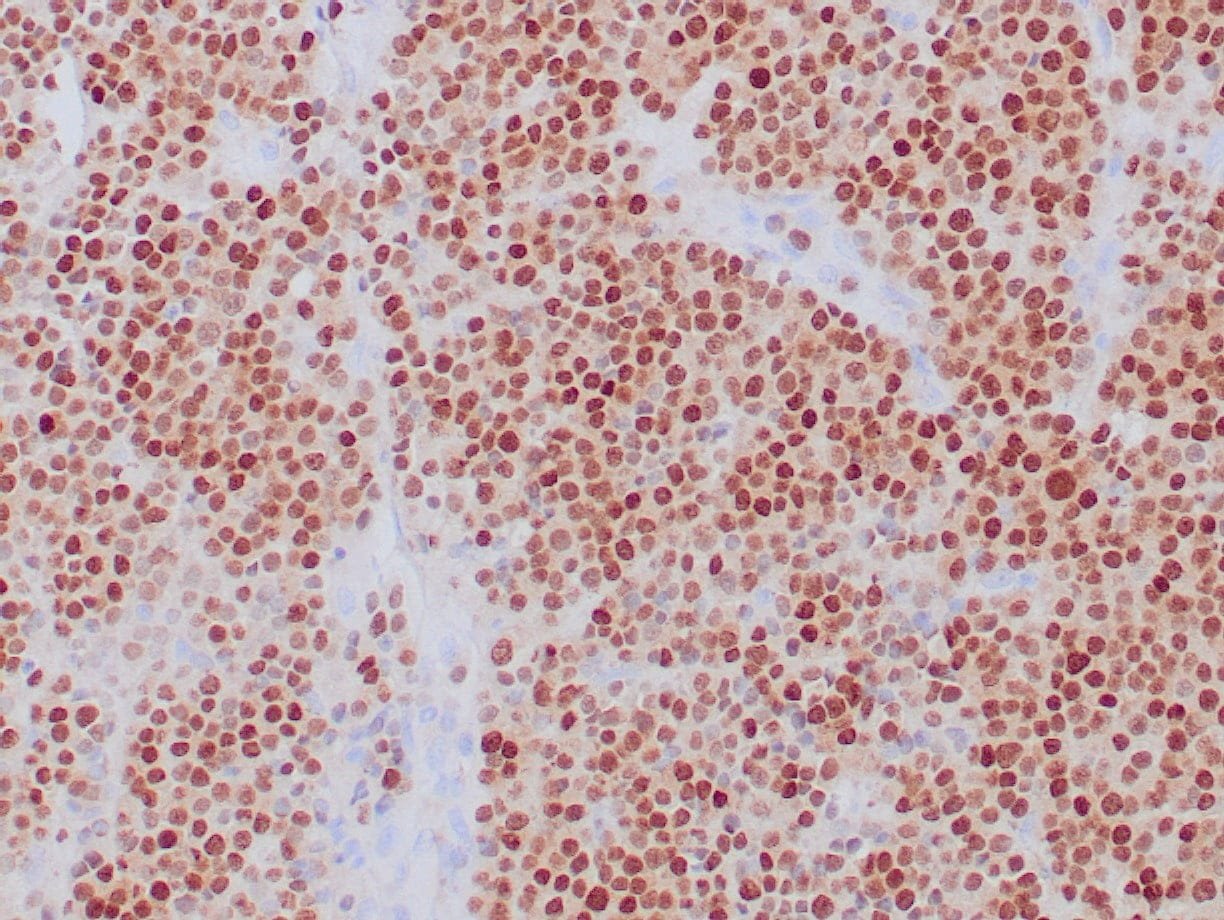 |
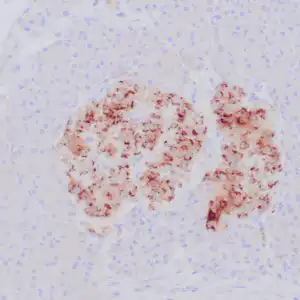
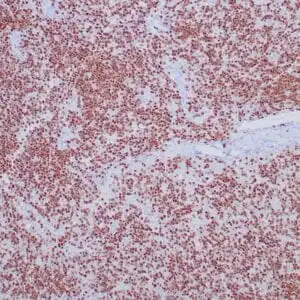
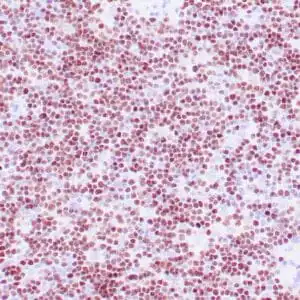
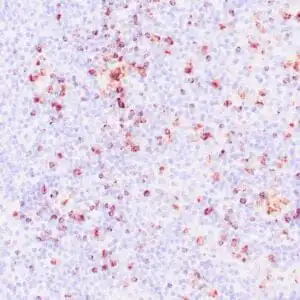
| Formalin-fixed, paraffin-embedded human IgA myeloma stained with anti-MUM1 antibody using peroxidase-conjugate and DAB chromogen. Note the nuclear staining in tumor cells |
FAQ & Publications
Frequently Asked Questions
What is the recommended application and dilution for the rabbit anti-MUM1 monoclonal antibody (ZR411) 7273?
The rabbit anti-MUM1 monoclonal antibody (ZR411) 7273 is recommended for immunohistochemistry (IHC) on formalin-fixed, paraffin-embedded human tissues. For concentrated antibody, the suggested dilution range is 1:100 to 1:200.
How should the rabbit anti-MUM1 monoclonal antibody (ZR411) 7273 be stored to maintain its stability?
For short-term storage, keep the antibody at 2-8°C. For long-term storage, it should be kept at -20°C. Avoid repeated freeze/thaw cycles to preserve antibody integrity.
Publications
| pmid | title | authors | citation |
|---|---|---|---|
| We haven't added any publications to our database yet. | |||
Published literature highly relevant to the biological target of this product and referencing this antibody or clone are retrieved from the PubMed database provided by the United States National Library of Medicine at the National Institutes of Health.
Protocols
| relevant to this product |
|---|
| IHC |
Documents
| Batch Number | QC File | SDS |
|---|---|---|
| To view batch-specific Safety Datasheets and Quality Certificates associated with your account, please Log In. | ||
Only logged in customers who have purchased this product may leave a review.



Reviews
There are no reviews yet.