| Weight | 1 lbs |
|---|---|
| Dimensions | 9 × 5 × 2 in |
| host | mouse |
| isotype | IgG |
| clonality | monoclonal |
| concentration | concentrate, predilute |
| applications | IHC |
| reactivity | human |
| available size | 0.1 mL, 0.5 mL, 1 mL concentrated, 7 mL prediluted |

rabbit anti-MDM2 monoclonal antibody (ZR258) 6249
Price range: $160.00 through $528.00
Antibody summary
- Rabbit monoclonal to MDM2
- Suitable for: Immunohistochemistry (formalin-fixed, paraffin-embedded tissues)
- Reacts with: Human
- Isotype:IgG
- Control: Liposarcoma
- Visualization: Nucleus
- 0.1, 0.5, 1.0 mL concentrated, 7 mL prediluted
rabbit anti-MDM2 monoclonal antibody ZR258 6249
| target relevance |
|---|
| Homo sapiens MDM2 E3 ubiquitin-protein ligase Mdm2 |
| Protein names E3 ubiquitin-protein ligase Mdm2 |
| Alternative names Double minute 2 protein, Oncoprotein Mdm2, RING-type E3 ubiquitin transferase Mdm2, p53-binding protein Mdm2 |
| Gene names MDM2 |
| Protein family Belongs to the MDM2/MDM4 family |
| Function E3 ubiquitin-protein ligase that mediates ubiquitination of p53/TP53, leading to its degradation by the proteasome (PubMed:29681526). Inhibits p53/TP53- and p73/TP73-mediated cell cycle arrest and apoptosis by binding its transcriptional activation domain. Also acts as a ubiquitin ligase E3 toward itself and ARRB1. Permits the nuclear export of p53/TP53. Promotes proteasome-dependent ubiquitin-independent degradation of retinoblastoma RB1 protein. Inhibits DAXX-mediated apoptosis by inducing its ubiquitination and degradation. Component of the TRIM28/KAP1-MDM2-p53/TP53 complex involved in stabilizing p53/TP53. Also a component of the TRIM28/KAP1-ERBB4-MDM2 complex which links growth factor and DNA damage response pathways. Mediates ubiquitination and subsequent proteasome degradation of DYRK2 in nucleus. Ubiquitinates IGF1R and SNAI1 and promotes them to proteasomal degradation (PubMed:12821780, PubMed:15053880, PubMed:15195100, PubMed:15632057, PubMed:16337594, PubMed:17290220, PubMed:19098711, PubMed:19219073, PubMed:19837670, PubMed:19965871, PubMed:20173098, PubMed:20385133, PubMed:20858735, PubMed:22128911). Ubiquitinates DCX, leading to DCX degradation and reduction of the dendritic spine density of olfactory bulb granule cells (By similarity). Ubiquitinates DLG4, leading to proteasomal degradation of DLG4 which is required for AMPA receptor endocytosis (By similarity). Negatively regulates NDUFS1, leading to decreased mitochondrial respiration, marked oxidative stress, and commitment to the mitochondrial pathway of apoptosis (PubMed:30879903). Binds NDUFS1 leading to its cytosolic retention rather than mitochondrial localization resulting in decreased supercomplex assembly (interactions between complex I and complex III), decreased complex I activity, ROS production, and apoptosis (PubMed:30879903) |
| Catalytic activity S-ubiquitinyl-[E2 ubiquitin-conjugating enzyme]-L-cysteine + [acceptor protein]-L-lysine = [E2 ubiquitin-conjugating enzyme]-L-cysteine + N(6)-ubiquitinyl-[acceptor protein]-L-lysine. |
| Subcellular location Nucleus, nucleoplasm, Cytoplasm, Nucleus, nucleolus, Nucleus |
| Structure (Microbial infection) Interacts with and ubiquitinates HIV-1 Tat |
| Post-translational modification Phosphorylation on Ser-166 by SGK1 activates ubiquitination of p53/TP53 (PubMed:19756449). Phosphorylated at multiple sites near the RING domain by ATM upon DNA damage; this promotes its ubiquitination and degradation, preventing p53/TP53 degradation (PubMed:10611322, PubMed:12167711, PubMed:18382127, PubMed:19816404, PubMed:26124108) Autoubiquitination leads to proteasomal degradation; resulting in p53/TP53 activation it may be regulated by SFN (PubMed:18382127, PubMed:30879903). Also ubiquitinated by TRIM13 (PubMed:21333377). ATM-phosphorylated MDM2 is ubiquitinated by the SCF(FBXO31) complex in response to genotoxic stress, promoting its degradation and p53/TP53-mediated DNA damage response (PubMed:26124108). Deubiquitinated by USP2 leads to its accumulation and increases deubiquitination and degradation of p53/TP53 (PubMed:17290220). Deubiquitinated by USP7 leading to its stabilization (PubMed:15053880) |
| Involvement in disease Lessel-Kubisch syndrome An autosomal recessive progeroid syndrome characterized by short stature, pinched facial features, prematurely gray hair, scleroderma-like skin changes, small kidneys and consecutive kidney failure, followed by severe arterial hypertension. |
| Keywords 3D-structure, Alternative splicing, Apoptosis, Cytoplasm, Host-virus interaction, Metal-binding, Nucleus, Phosphoprotein, Proteomics identification, Proto-oncogene, Reference proteome, Transferase, Ubl conjugation, Ubl conjugation pathway, Zinc, Zinc-finger |
| Sequence MCNTNMSVPTDGAVTTSQIPASEQETLVRPKPLLLKLLKSVGAQKDTYTMKEVLFYLGQY IMTKRLYDEKQQHIVYCSNDLLGDLFGVPSFSVKEHRKIYTMIYRNLVVVNQQESSDSGT SVSENRCHLEGGSDQKDLVQELQEEKPSSSHLVSRPSTSSRRRAISETEENSDELSGERQ RKRHKSDSISLSFDESLALCVIREICCERSSSSESTGTPSNPDLDAGVSEHSGDWLDQDS VSDQFSVEFEVESLDSEDYSLSEEGQELSDEDDEVYQVTVYQAGESDTDSFEEDPEISLA DYWKCTSCNEMNPPLPSHCNRCWALRENWLPEDKGKDKGEISEKAKLENSTQAEEGFDVP DCKKTIVNDSRESCVEENDDKITQASQSQESEDYSQPSTSSSIIYSSQEDVKEFEREETQ DKEESVESSLPLNAIEPCVICQGRPKNGCIVHGKTGHLMACFTCAKKLKKRNKPCPVCRQ PIQMIVLTYFP |
| UniProt accession: Q00987 |
Data
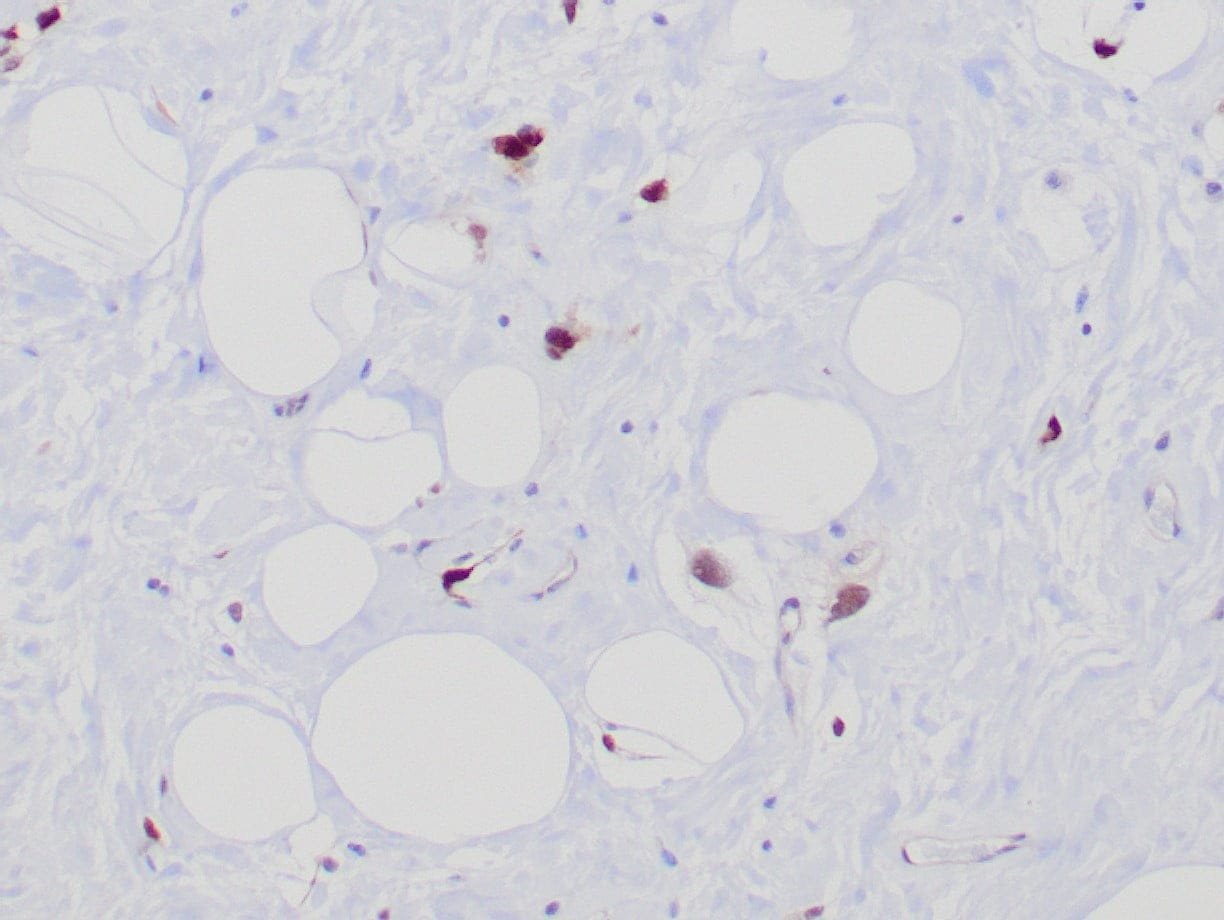 |
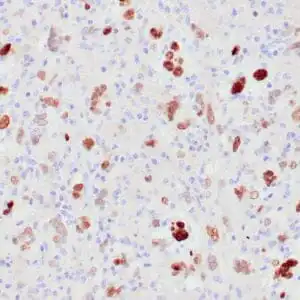
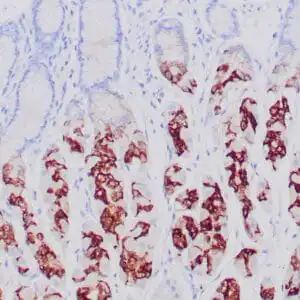
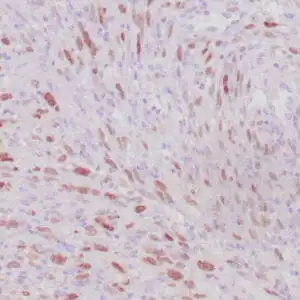
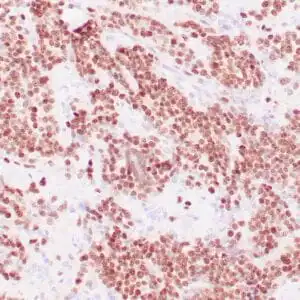
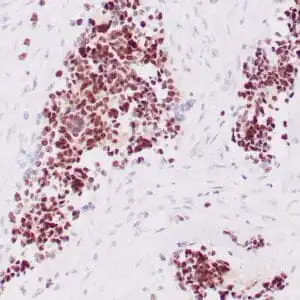
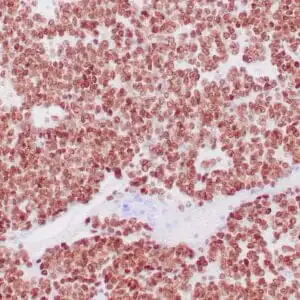
| Formalin-Fixed, paraffin-embedded human atypical lipomatous tumor stained with anti-MDM2 antibody using peroxidase-conjugate and DAB chromogen. Note the nuclear staining of tumor cells |
FAQ & Publications
Frequently Asked Questions
What species does the rabbit anti-MDM2 monoclonal antibody (ZR258) specifically react with?
This antibody specifically reacts with human MDM2 protein.
For which application is this rabbit anti-MDM2 monoclonal antibody validated?
This antibody is validated for immunohistochemistry (IHC) on formalin-fixed, paraffin-embedded tissues.
What are the recommended storage conditions for the rabbit anti-MDM2 monoclonal antibody (ZR258)?
For short-term storage, keep the antibody at 2-8°C. For longer-term storage, keep at -20°C and avoid freeze-thaw cycles.
What is the host species and clonality of this anti-MDM2 antibody?
The antibody is a rabbit monoclonal with IgG isotype.
What sizes and concentrations are available for this rabbit anti-MDM2 monoclonal antibody?
The antibody is available in 0.1 mL, 0.5 mL, and 1.0 mL concentrated formats, as well as a 7 mL prediluted format.
Publications
| pmid | title | authors | citation |
|---|---|---|---|
| We haven't added any publications to our database yet. | |||
Published literature highly relevant to the biological target of this product and referencing this antibody or clone are retrieved from the PubMed database provided by the United States National Library of Medicine at the National Institutes of Health.
Protocols
| relevant to this product |
|---|
| IHC |
Documents
| Batch Number | QC File | SDS |
|---|---|---|
| To view batch-specific Safety Datasheets and Quality Certificates associated with your account, please Log In. | ||
Only logged in customers who have purchased this product may leave a review.

Reviews
There are no reviews yet.