| Weight | 1 lbs |
|---|---|
| Dimensions | 9 × 5 × 2 in |
| host | mouse |
| isotype | IgG |
| clonality | monoclonal |
| concentration | concentrate, predilute |
| applications | IHC |
| reactivity | human |
| available size | 0.1 mL, 0.5 mL, 1 mL concentrated, 7 mL prediluted |

rabbit anti-Myoglobin monoclonal antibody (ZR69) 6280
Price range: $160.00 through $528.00
Antibody summary
- Rabbit monoclonal to Myoglobin
- Suitable for: Immunohistochemistry (formalin-fixed, paraffin-embedded tissues)
- Reacts with: Human
- Isotype:IgG
- Control: Skeletal muscle
- Visualization: Cytoplasmic
- 0.1, 0.5, 1.0 mL concentrated, 7 mL prediluted
rabbit anti-Myoglobin monoclonal antibody ZR69 6280
| target relevance |
|---|
| Homo sapiens MB Myoglobin |
| Protein names Myoglobin |
| Alternative names Nitrite reductase MB, Pseudoperoxidase MB |
| Gene names MB |
| Protein family Belongs to the globin family |
| Function Monomeric heme protein which primary function is to store oxygen and facilitate its diffusion within muscle tissues. Reversibly binds oxygen through a pentacoordinated heme iron and enables its timely and efficient release as needed during periods of heightened demand (PubMed:30918256, PubMed:34679218). Depending on the oxidative conditions of tissues and cells, and in addition to its ability to bind oxygen, it also has a nitrite reductase activity whereby it regulates the production of bioactive nitric oxide (PubMed:32891753). Under stress conditions, like hypoxia and anoxia, it also protects cells against reactive oxygen species thanks to its pseudoperoxidase activity (PubMed:34679218) |
| Catalytic activity Fe(III)-heme b-[protein] + nitric oxide + H2O = Fe(II)-heme b-[protein] + nitrite + 2 H(+) H2O2 + AH2 = A + 2 H2O |
| Subcellular location Cytoplasm, sarcoplasm |
| Structure Monomeric |
| Involvement in disease Myopathy, sarcoplasmic body An autosomal dominant, slowly progressive muscle disorder manifesting in adulthood with proximal and axial weakness that progresses to involve distal muscles. Patients may lose ambulation after a long disease course, and some individuals develop respiratory or cardiac symptoms. Muscle pathology features include sarcoplasmic bodies in skeletal and cardiac muscles. |
| Keywords 3D-structure, Cytoplasm, Direct protein sequencing, Disease variant, Heme, Iron, Metal-binding, Muscle protein, Oxidoreductase, Oxygen transport, Phosphoprotein, Proteomics identification, Reference proteome, Transport |
| Sequence MGLSDGEWQLVLNVWGKVEADIPGHGQEVLIRLFKGHPETLEKFDKFKHLKSEDEMKASE DLKKHGATVLTALGGILKKKGHHEAEIKPLAQSHATKHKIPVKYLEFISECIIQVLQSKH PGDFGADAQGAMNKALELFRKDMASNYKELGFQG |
| UniProt accession: P02144 |
Data
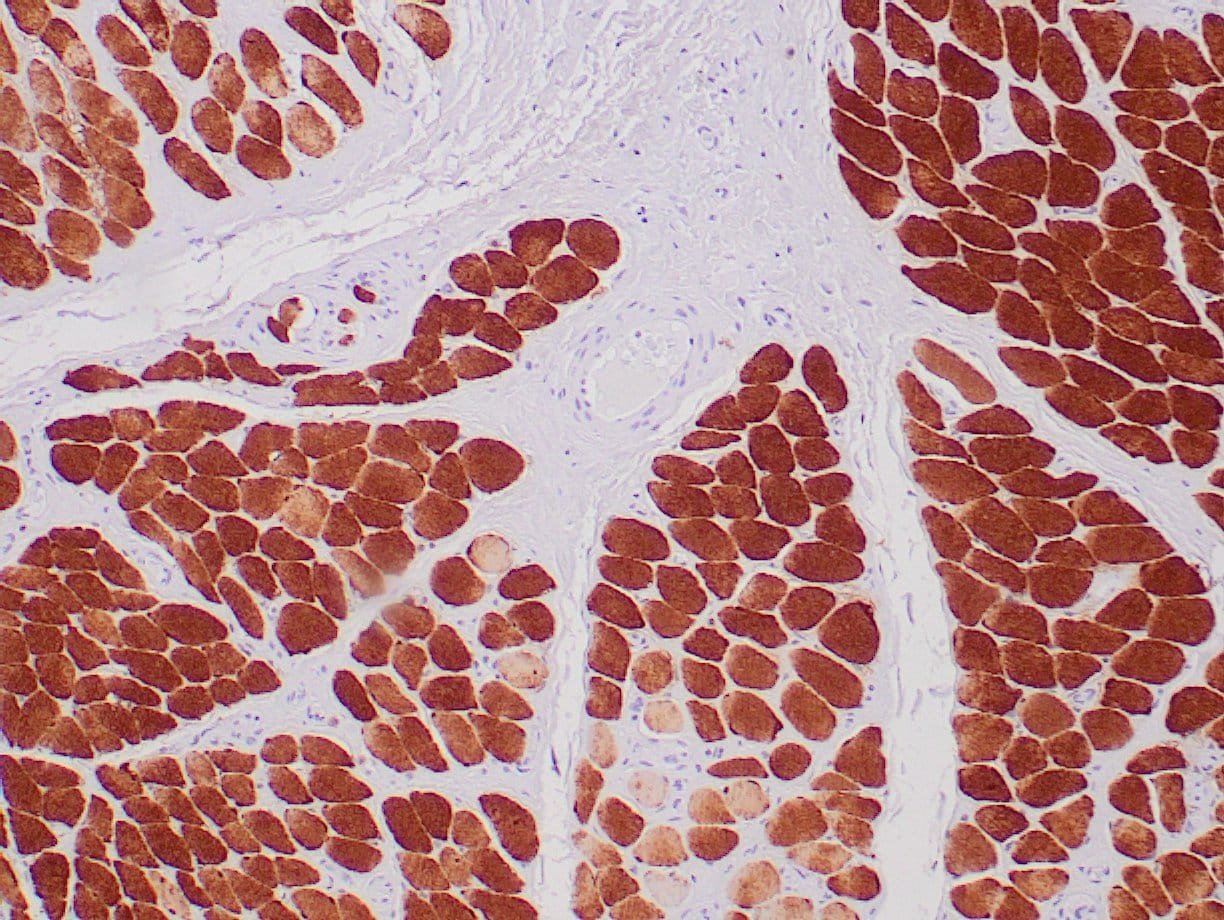 |
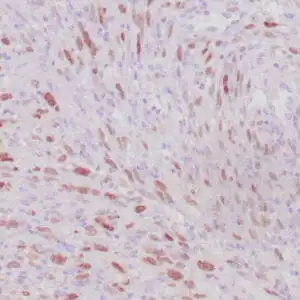
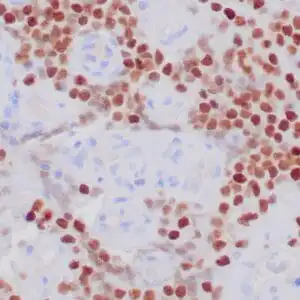
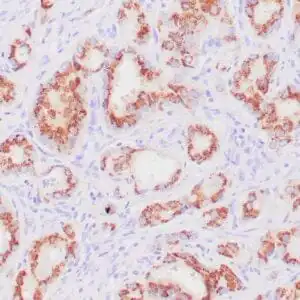
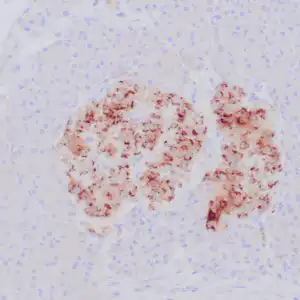
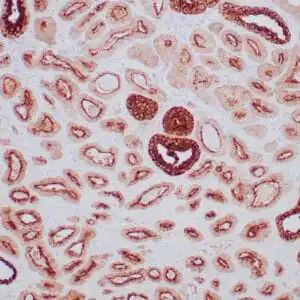
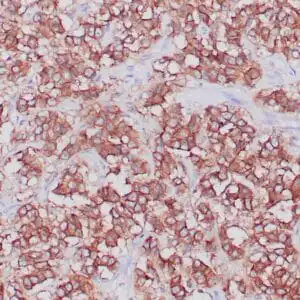
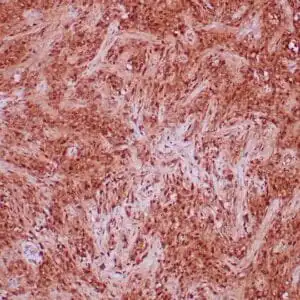
| Formalin-fixed, paraffin-embedded human skeletal muscle stained with anti-myoglobin antibody using peroxidase-conjugate and DAB chromogen. Note the cytoplasmic staining of skeletal muscle fibers. |
FAQ & Publications
Frequently Asked Questions
What species does the rabbit anti-Myoglobin monoclonal antibody (ZR69) specifically react with?
This antibody specifically reacts with human Myoglobin.
What are the recommended storage conditions for maintaining the stability of this antibody?
For short-term storage, keep the antibody at 2-8°C. For long-term storage, it should be kept at -20°C, and freeze/thaw cycles should be avoided to maintain antibody integrity.
Which applications has the rabbit anti-Myoglobin monoclonal antibody (ZR69) been validated for, and what is a suitable positive control?
This antibody is validated for immunohistochemistry (IHC) on formalin-fixed, paraffin-embedded tissues. Skeletal muscle is recommended as a positive control for this application.
Publications
| pmid | title | authors | citation |
|---|---|---|---|
| We haven't added any publications to our database yet. | |||
Published literature highly relevant to the biological target of this product and referencing this antibody or clone are retrieved from the PubMed database provided by the United States National Library of Medicine at the National Institutes of Health.
Protocols
| relevant to this product |
|---|
| IHC |
Documents
| Batch Number | QC File | SDS |
|---|---|---|
| To view batch-specific Safety Datasheets and Quality Certificates associated with your account, please Log In. | ||
Only logged in customers who have purchased this product may leave a review.


Reviews
There are no reviews yet.