| Weight | 1 lbs |
|---|---|
| Dimensions | 9 × 5 × 2 in |
| host | mouse |
| isotype | IgG |
| clonality | monoclonal |
| concentration | concentrate, predilute |
| applications | IHC |
| reactivity | human |
| available size | 0.1 mL, 0.5 mL, 1 mL concentrated, 7 mL prediluted |

rabbit anti-CA IX monoclonal antibody (ZR367) 6044
Price range: $160.00 through $528.00
Antibody summary
- Rabbit monoclonal to CA IX
- Suitable for: Immunohistochemistry (formalin-fixed, paraffin-embedded tissues)
- Reacts with: Human
- Isotype:IgG
- Control: Normal renal tissue
- Visualization: Membrane
- 0.1, 0.5, 1.0 mL concentrated, 7 mL prediluted
rabbit anti-CA IX monoclonal antibody ZR367 6044
| antibody |
|---|
| Database link: human P20849 |
| Tested applications IHC |
| Recommended dilutions Concentrated 1:100-200 |
| Application Notes Positive control: Normal renal tissue |
| Immunogen Recombinant human CA9 protein fragment (around aa 314-410) (exact sequence is proprietary) |
| Size and concentration 7 mL prediluted or 0.1, 0.5, 1.0 mL and concentrated |
| Form liquid |
| Storage Instructions 2-8°C for short term, for longer term at -20°C. Avoid freeze / thaw cycles. |
| Purity affinity purified |
| Clonality monoclonal |
| Isotype IgG |
| Compatible secondaries goat anti-rabbit IgG, H&L chain specific, peroxidase conjugated, conjugated polyclonal antibody 9512 goat anti-rabbit IgG, H&L chain specific, biotin conjugated polyclonal antibody 2079 goat anti-rabbit IgG, H&L chain specific, FITC conjugated polyclonal antibody 7863 goat anti-rabbit IgG, H&L chain specific, Cross Absorbed polyclonal antibody 2371 goat anti-rabbit IgG, H&L chain specific, biotin conjugated polyclonal antibody, crossabsorbed 1715 goat anti-rabbit IgG, H&L chain specific, FITC conjugated polyclonal antibody, crossabsorbed 1720 |
| Isotype control Rabbit polyclonal - Isotype Control |
| target relevance |
|---|
| Homo sapiens COL9A1 Collagen alpha-1(IX) chain |
| Protein names Collagen alpha-1(IX) chain |
| Gene names COL9A1 |
| Protein family Belongs to the fibril-associated collagens with interrupted helices (FACIT) family |
| Function Structural component of hyaline cartilage and vitreous of the eye |
| Subcellular location Secreted, extracellular space, extracellular matrix |
| Structure Heterotrimer of an alpha 1(IX), an alpha 2(IX) and an alpha 3(IX) chain |
| Post-translational modification Covalently linked to the telopeptides of type II collagen by lysine-derived cross-links Prolines at the third position of the tripeptide repeating unit (G-X-Y) are hydroxylated in some or all of the chains |
| Involvement in disease Multiple epiphyseal dysplasia 6 A generalized skeletal dysplasia associated with significant morbidity. Joint pain, joint deformity, waddling gait, and short stature are the main clinical signs and symptoms. Radiological examination of the skeleton shows delayed, irregular mineralization of the epiphyseal ossification centers and of the centers of the carpal and tarsal bones. Multiple epiphyseal dysplasia is broadly categorized into the more severe Fairbank and the milder Ribbing types. The Fairbank type is characterized by shortness of stature, short and stubby fingers, small epiphyses in several joints, including the knee, ankle, hand, and hip. The Ribbing type is confined predominantly to the hip joints and is characterized by hands that are normal and stature that is normal or near-normal. Stickler syndrome 4 An autosomal recessive form of Stickler syndrome, an inherited disorder that associates ocular signs with more or less complete forms of Pierre Robin sequence, bone disorders and sensorineural deafness. Ocular disorders may include juvenile cataract, myopia, strabismus, vitreoretinal or chorioretinal degeneration, retinal detachment, and chronic uveitis. Pierre Robin sequence includes an opening in the roof of the mouth (a cleft palate), a large tongue (macroglossia), and a small lower jaw (micrognathia). Bones are affected by slight platyspondylisis and large, often defective epiphyses. Juvenile joint laxity is followed by early signs of arthrosis. The degree of hearing loss varies among affected individuals and may become more severe over time. Syndrome expressivity is variable. |
| Keywords 3D-structure, Alternative splicing, Collagen, Deafness, Direct protein sequencing, Disease variant, Disulfide bond, Extracellular matrix, Glycoprotein, Hydroxylation, Metal-binding, Proteomics identification, Reference proteome, Repeat, Secreted, Signal, Stickler syndrome, Zinc |
| Sequence MKTCWKIPVFFFVCSFLEPWASAAVKRRPRFPVNSNSNGGNELCPKIRIGQDDLPGFDLI SQFQVDKAASRRAIQRVVGSATLQVAYKLGNNVDFRIPTRNLYPSGLPEEYSFLTTFRMT GSTLKKNWNIWQIQDSSGKEQVGIKINGQTQSVVFSYKGLDGSLQTAAFSNLSSLFDSQW HKIMIGVERSSATLFVDCNRIESLPIKPRGPIDIDGFAVLGKLADNPQVSVPFELQWMLI HCDPLRPRRETCHELPARITPSQTTDERGPPGEQGPPGPPGPPGVPGIDGIDGDRGPKGP PGPPGPAGEPGKPGAPGKPGTPGADGLTGPDGSPGSIGSKGQKGEPGVPGSRGFPGRGIP GPPGPPGTAGLPGELGRVGPVGDPGRRGPPGPPGPPGPRGTIGFHDGDPLCPNACPPGRS GYPGLPGMRGHKGAKGEIGEPGRQGHKGEEGDQGELGEVGAQGPPGAQGLRGITGIVGDK GEKGARGLDGEPGPQGLPGAPGDQGQRGPPGEAGPKGDRGAEGARGIPGLPGPKGDTGLP GVDGRDGIPGMPGTKGEPGKPGPPGDAGLQGLPGVPGIPGAKGVAGEKGSTGAPGKPGQM GNSGKPGQQGPPGEVGPRGPQGLPGSRGELGPVGSPGLPGKLGSLGSPGLPGLPGPPGLP GMKGDRGVVGEPGPKGEQGASGEEGEAGERGELGDIGLPGPKGSAGNPGEPGLRGPEGSR GLPGVEGPRGPPGPRGVQGEQGATGLPGVQGPPGRAPTDQHIKQVCMRVIQEHFAEMAAS LKRPDSGATGLPGRPGPPGPPGPPGENGFPGQMGIRGLPGIKGPPGALGLRGPKGDLGEK GERGPPGRGPNGLPGAIGLPGDPGPASYGRNGRDGERGPPGVAGIPGVPGPPGPPGLPGF CEPASCTMQAGQRAFNKGPDP |
| UniProt accession: P20849 |
Data
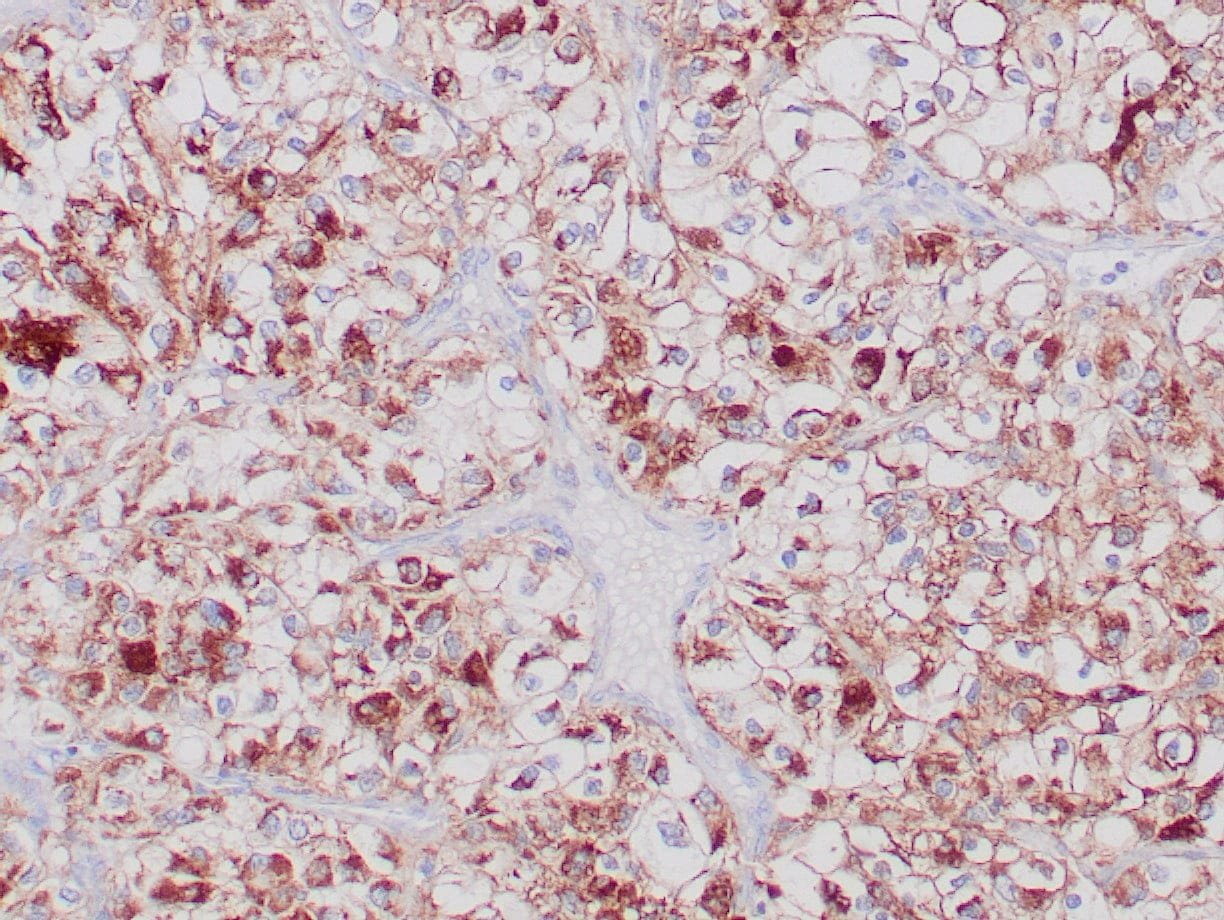 |
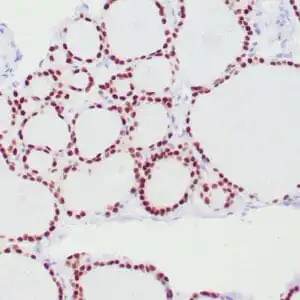
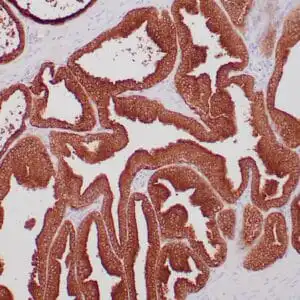
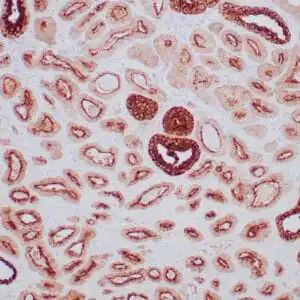
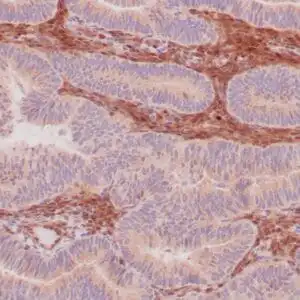
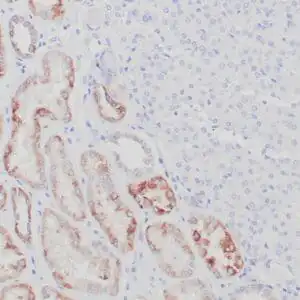
| Normal human renal tissue stained with anti-CA IX antibody using peroxidase-conjugate and DAB chromogen. Note the membranous staining of tubular cells. |
FAQ & Publications
Frequently Asked Questions
What species is the rabbit anti-CA IX monoclonal antibody (ZR367) reactive with?
This antibody specifically reacts with human species.
How should the rabbit anti-CA IX monoclonal antibody be stored to maintain stability?
For short-term storage, keep the antibody at 2-8°C. For long-term storage, it should be stored at -20°C, and freeze/thaw cycles should be avoided.
What applications is the rabbit anti-CA IX monoclonal antibody validated for, and what is the recommended dilution?
The antibody is validated for immunohistochemistry (IHC) on formalin-fixed, paraffin-embedded tissues. The recommended dilution for the concentrated antibody is between 1:100 and 1:200.
Publications
| pmid | title | authors | citation |
|---|---|---|---|
| We haven't added any publications to our database yet. | |||
Published literature highly relevant to the biological target of this product and referencing this antibody or clone are retrieved from the PubMed database provided by the United States National Library of Medicine at the National Institutes of Health.
Protocols
| relevant to this product |
|---|
| IHC |
Documents
| Batch Number | QC File | SDS |
|---|---|---|
| To view batch-specific Safety Datasheets and Quality Certificates associated with your account, please Log In. | ||
Only logged in customers who have purchased this product may leave a review.
Reviews
There are no reviews yet.