| Weight | 1 lbs |
|---|---|
| Dimensions | 9 × 5 × 2 in |
| host | mouse |
| isotype | IgG |
| clonality | monoclonal |
| concentration | concentrate, predilute |
| applications | IHC |
| reactivity | human |
| available size | 0.1 mL, 0.5 mL, 1 mL concentrated, 7 mL prediluted |

rabbit anti-Brachyury monoclonal antibody (ZR391) 6035
Price range: $160.00 through $528.00
Antibody summary
- Rabbit monoclonal to Brachyury
- Suitable for: Immunohistochemistry (formalin-fixed, paraffin-embedded tissues)
- Reacts with: Human
- Isotype:IgG
- Control: Chordoma
- Visualization: Nucleus
- 0.1, 0.5, 1.0 mL concentrated, 7 mL prediluted
rabbit anti-Brachyury monoclonal antibody ZR391 6035
| target relevance |
|---|
| Homo sapiens TBXT T-box transcription factor T |
| Protein names T-box transcription factor T |
| Alternative names Brachyury protein, Protein T |
| Gene names TBXT |
| Function Involved in the transcriptional regulation of genes required for mesoderm formation and differentiation. Binds to a palindromic T site 5'-TTCACACCTAGGTGTGAA-3' DNA sequence and activates gene transcription when bound to such a site |
| Subcellular location Nucleus |
| Structure Monomer |
| Involvement in disease Neural tube defects Congenital malformations of the central nervous system and adjacent structures related to defective neural tube closure during the first trimester of pregnancy. Failure of neural tube closure can occur at any level of the embryonic axis. Common NTD forms include anencephaly, myelomeningocele and spina bifida, which result from the failure of fusion in the cranial and spinal region of the neural tube. NTDs have a multifactorial etiology encompassing both genetic and environmental components. Chordoma Rare, clinically malignant tumors derived from notochordal remnants. They occur along the length of the spinal axis, predominantly in the sphenooccipital, vertebral and sacrococcygeal regions. They are characterized by slow growth, local destruction of bone, extension into adjacent soft tissues and rarely, distant metastatic spread. Sacral agenesis with vertebral anomalies A disorder characterized by abnormalities of the spine, including sacral agenesis, abnormal ossification of all vertebral bodies, and a persistent notochordal canal during development. |
| Keywords 3D-structure, Activator, Alternative splicing, Developmental protein, Disease variant, DNA-binding, Nucleus, Proteomics identification, Reference proteome, Transcription, Transcription regulation |
| Sequence MSSPGTESAGKSLQYRVDHLLSAVENELQAGSEKGDPTERELRVGLEESELWLRFKELTN EMIVTKNGRRMFPVLKVNVSGLDPNAMYSFLLDFVAADNHRWKYVNGEWVPGGKPEPQAP SCVYIHPDSPNFGAHWMKAPVSFSKVKLTNKLNGGGQIMLNSLHKYEPRIHIVRVGGPQR MITSHCFPETQFIAVTAYQNEEITALKIKYNPFAKAFLDAKERSDHKEMMEEPGDSQQPG YSQWGWLLPGTSTLCPPANPHPQFGGALSLPSTHSCDRYPTLRSHRSSPYPSPYAHRNNS PTYSDNSPACLSMLQSHDNWSSLGMPAHPSMLPVSHNASPPTSSSQYPSLWSVSNGAVTP GSQAAAVSNGLGAQFFRGSPAHYTPLTHPVSAPSSSGSPLYEGAAAATDIVDSQYDAAAQ GRLIASWTPVSPPSM |
| UniProt accession: O15178 |
Data
 |
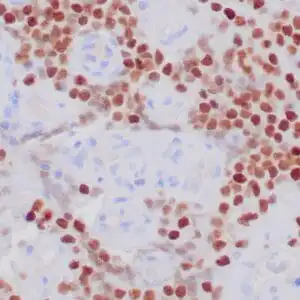
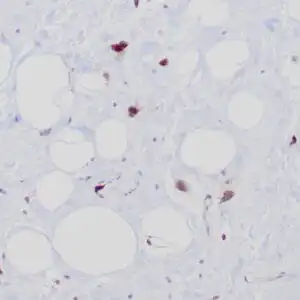
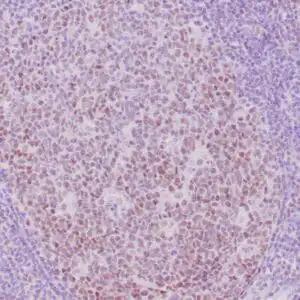
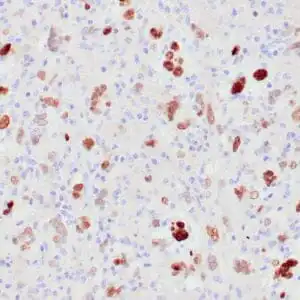
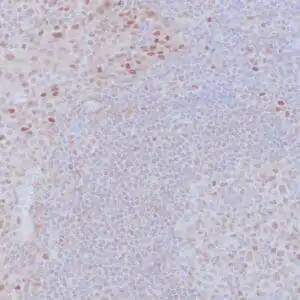
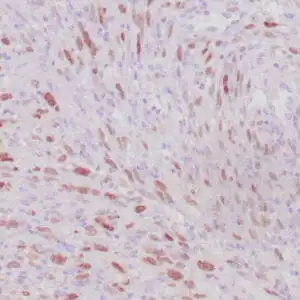
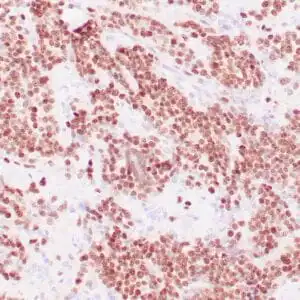
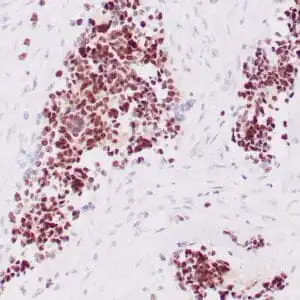
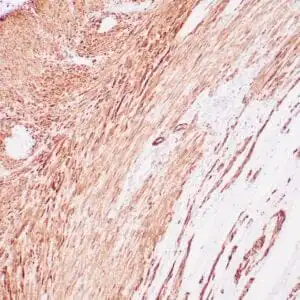
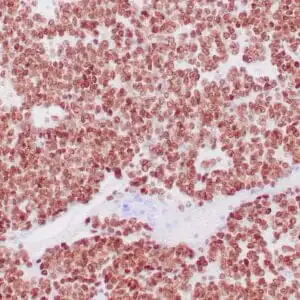
| Formalin-fixed and paraffin-embedded human chordoma stained with anti-brachyury antibody using peroxidase-conjugate and DAB chromogen. Note the absence of nuclear staining of tumor cells. |
FAQ & Publications
Frequently Asked Questions
What is the recommended application and dilution for the rabbit anti-Brachyury monoclonal antibody (ZR391)?
This antibody is suitable for Immunohistochemistry (IHC) on formalin-fixed, paraffin-embedded human tissues. The recommended dilution for the concentrated form is between 1:100 and 1:200.
How should the rabbit anti-Brachyury monoclonal antibody (ZR391) be stored to maintain its stability?
For short-term storage, keep the antibody at 2-8°C. For long-term storage, it should be kept at -20°C. Avoid repeated freeze/thaw cycles to preserve antibody integrity.
Which species does the rabbit anti-Brachyury monoclonal antibody (ZR391) specifically react with, and what is the host species of the antibody?
This antibody is reactive with human Brachyury protein. Despite being named 'rabbit anti-Brachyury,' the antibody host is actually mouse, and the isotype is IgG monoclonal.
Publications
| pmid | title | authors | citation |
|---|---|---|---|
| We haven't added any publications to our database yet. | |||
Published literature highly relevant to the biological target of this product and referencing this antibody or clone are retrieved from the PubMed database provided by the United States National Library of Medicine at the National Institutes of Health.
Protocols
| relevant to this product |
|---|
| IHC |
Documents
| Batch Number | QC File | SDS |
|---|---|---|
| To view batch-specific Safety Datasheets and Quality Certificates associated with your account, please Log In. | ||
Only logged in customers who have purchased this product may leave a review.

Reviews
There are no reviews yet.