| Weight | 1 lbs |
|---|---|
| Dimensions | 9 × 5 × 2 in |
| host | mouse |
| isotype | IgG |
| clonality | monoclonal |
| concentration | concentrate, predilute |
| applications | IHC |
| reactivity | human |
| available size | 0.1 mL, 0.5 mL, 1 mL concentrated, 7 mL prediluted |

rabbit anti-Androgen Receptor (AR) monoclonal antibody (ZR334) 6022
Price range: $160.00 through $528.00
Antibody summary
- Rabbit monoclonal to Androgen Receptor (AR)
- Suitable for: Immunohistochemistry (formalin-fixed, paraffin-embedded tissues)
- Reacts with: Human
- Isotype:IgG
- Control: Prostate or breast carcinomas
- Visualization: Nuclear
- 0.1, 0.5, 1.0 mL concentrated, 7 mL prediluted
rabbit anti-Androgen Receptor (AR) monoclonal antibody ZR334 6022
| antibody |
|---|
| Database link: human P10275 |
| Tested applications IHC |
| Recommended dilutions Concentrated 1:100-200 |
| Application Notes Positive control: Prostate or breast carcinomas |
| Immunogen Synthetic peptide corresponding to residues (within aa 1-100) of human Androgen Receptor |
| Size and concentration 7 mL prediluted or 0.1, 0.5, 1.0 mL and concentrated |
| Form liquid |
| Storage Instructions 2-8°C for short term, for longer term at -20°C. Avoid freeze / thaw cycles. |
| Purity affinity purified |
| Clonality monoclonal |
| Isotype IgG |
| Compatible secondaries goat anti-rabbit IgG, H&L chain specific, peroxidase conjugated, conjugated polyclonal antibody 9512 goat anti-rabbit IgG, H&L chain specific, biotin conjugated polyclonal antibody 2079 goat anti-rabbit IgG, H&L chain specific, FITC conjugated polyclonal antibody 7863 goat anti-rabbit IgG, H&L chain specific, Cross Absorbed polyclonal antibody 2371 goat anti-rabbit IgG, H&L chain specific, biotin conjugated polyclonal antibody, crossabsorbed 1715 goat anti-rabbit IgG, H&L chain specific, FITC conjugated polyclonal antibody, crossabsorbed 1720 |
| Isotype control Rabbit polyclonal - Isotype Control |
| target relevance |
|---|
| Homo sapiens AR Androgen receptor |
| Protein names Androgen receptor |
| Alternative names Dihydrotestosterone receptor, Nuclear receptor subfamily 3 group C member 4 |
| Gene names AR |
| Protein family Belongs to the nuclear hormone receptor family. NR3 subfamily |
| Function Steroid hormone receptors are ligand-activated transcription factors that regulate eukaryotic gene expression and affect cellular proliferation and differentiation in target tissues (PubMed:19022849). Transcription factor activity is modulated by bound coactivator and corepressor proteins like ZBTB7A that recruits NCOR1 and NCOR2 to the androgen response elements/ARE on target genes, negatively regulating androgen receptor signaling and androgen-induced cell proliferation (PubMed:20812024). Transcription activation is also down-regulated by NR0B2. Activated, but not phosphorylated, by HIPK3 and ZIPK/DAPK3 |
| Subcellular location Nucleus, Cytoplasm |
| Structure Binds DNA as a homodimer. Part of a ternary complex containing AR, EFCAB6/DJBP and PARK7. Interacts with HIPK3 and NR0B2 in the presence of androgen. The ligand binding domain interacts with KAT7/HBO1 in the presence of dihydrotestosterone. Interacts with EFCAB6/DJBP, PQBP1, RANBP9, RBAK, SPDEF, SRA1, TGFB1I1 and RREB1. Interacts with ZMIZ1/ZIMP10 and ZMIZ2/ZMIP7 which both enhance its transactivation activity. Interacts with SLC30A9 and RAD54L2/ARIP4. Interacts with MACROD1 (via macro domain) (PubMed:19022849). Interacts via the ligand-binding domain with LXXLL and FXXLF motifs from NCOA1, NCOA2, NCOA3 and MAGEA11. Interacts (via nuclear receptor DNA binding domain and nuclear receptor ligand binding domain) with NCOA4 (PubMed:15563469, PubMed:8643607). The AR N-terminal poly-Gln region binds Ran resulting in enhancement of AR-mediated transactivation. Ran-binding decreases as the poly-Gln length increases. Interacts with HIP1 (via coiled coil domain). Interacts (via ligand-binding domain) with TRIM68. Interacts with TNK2. Interacts with USP26. Interacts with RNF6. Interacts (regulated by RNF6 probably through polyubiquitination) with RNF14; regulates AR transcriptional activity. Interacts with PRMT2 and TRIM24. Interacts with RACK1. Interacts with RANBP10; this interaction enhances dihydrotestosterone-induced AR transcriptional activity. Interacts with PRPF6 in a hormone-independent way; this interaction enhances dihydrotestosterone-induced AR transcriptional activity. Interacts with STK4/MST1. Interacts with ZIPK/DAPK3. Interacts with LPXN. Interacts with MAK. Part of a complex containing AR, MAK and NCOA3. Interacts with CRY1. Interacts with CCAR1 and GATA2. Interacts with ZNF318 (By similarity). Interacts with BUD31 (PubMed:25091737). Interacts with ARID4A (PubMed:23487765). Interacts with ARID4B (By similarity). Interacts (via NR LBD domain) with ZBTB7A; the interaction is direct and androgen-dependent (PubMed:20812024). Interacts with NCOR1 (PubMed:20812024). Interacts with NCOR2 (PubMed:20812024). Interacts with CRY2 in a ligand-dependent manner (By similarity). Interacts (via NR LBD domain) with RWDD1; the interaction is direct and may stimulate AR activity (PubMed:22406838) |
| Post-translational modification Sumoylated on Lys-388 (major) and Lys-521. Ubiquitinated. Deubiquitinated by USP26. 'Lys-6' and 'Lys-27'-linked polyubiquitination by RNF6 modulates AR transcriptional activity and specificity Phosphorylated in prostate cancer cells in response to several growth factors including EGF. Phosphorylation is induced by c-Src kinase (CSK). Tyr-535 is one of the major phosphorylation sites and an increase in phosphorylation and Src kinase activity is associated with prostate cancer progression. Phosphorylation by TNK2 enhances the DNA-binding and transcriptional activity and may be responsible for androgen-independent progression of prostate cancer. Phosphorylation at Ser-83 by CDK9 regulates AR promoter selectivity and cell growth. Phosphorylation by PAK6 leads to AR-mediated transcription inhibition Palmitoylated by ZDHHC7 and ZDHHC21. Palmitoylation is required for plasma membrane targeting and for rapid intracellular signaling via ERK and AKT kinases and cAMP generation |
| Involvement in disease Androgen insensitivity syndrome An X-linked recessive form of pseudohermaphroditism due end-organ resistance to androgen. Affected males have female external genitalia, female breast development, blind vagina, absent uterus and female adnexa, and abdominal or inguinal testes, despite a normal 46,XY karyotype. Spinal and bulbar muscular atrophy X-linked 1 An X-linked recessive form of spinal muscular atrophy. Spinal muscular atrophy refers to a group of neuromuscular disorders characterized by degeneration of the anterior horn cells of the spinal cord, leading to symmetrical muscle weakness and atrophy. SMAX1 occurs only in men. Age at onset is usually in the third to fifth decade of life, but earlier involvement has been reported. It is characterized by slowly progressive limb and bulbar muscle weakness with fasciculations, muscle atrophy, and gynecomastia. The disorder is clinically similar to classic forms of autosomal spinal muscular atrophy. Prostate cancer, hereditary, X-linked 3 A condition associated with familial predisposition to cancer of the prostate. Most prostate cancers are adenocarcinomas that develop in the acini of the prostatic ducts. Other rare histopathologic types of prostate cancer that occur in approximately 5% of patients include small cell carcinoma, mucinous carcinoma, prostatic ductal carcinoma, transitional cell carcinoma, squamous cell carcinoma, basal cell carcinoma, adenoid cystic carcinoma (basaloid), signet-ring cell carcinoma and neuroendocrine carcinoma. Androgen insensitivity, partial A disorder that is characterized by hypospadias, hypogonadism, gynecomastia, genital ambiguity, normal XY karyotype, and a pedigree pattern consistent with X-linked recessive inheritance. Some patients present azoospermia or severe oligospermia without other clinical manifestations. Hypospadias 1, X-linked A common malformation in which the urethra opens on the ventral side of the penis, due to developmental arrest of urethral fusion. The opening can be located glandular, penile, or even more posterior in the scrotum or perineum. Hypospadias is a feature of several syndromic disorders, including the androgen insensitivity syndrome and Opitz syndrome. |
| Keywords 3D-structure, Activator, Alternative splicing, Cytoplasm, Disease variant, DNA-binding, Isopeptide bond, Lipid-binding, Lipoprotein, Metal-binding, Neurodegeneration, Nucleus, Palmitate, Phosphoprotein, Proteomics identification, Pseudohermaphroditism, Receptor, Reference proteome, Steroid-binding, Transcription, Transcription regulation, Triplet repeat expansion, Ubl conjugation, Zinc, Zinc-finger |
| Sequence MEVQLGLGRVYPRPPSKTYRGAFQNLFQSVREVIQNPGPRHPEAASAAPPGASLLLLQQQ QQQQQQQQQQQQQQQQQQQQETSPRQQQQQQGEDGSPQAHRRGPTGYLVLDEEQQPSQPQ SALECHPERGCVPEPGAAVAASKGLPQQLPAPPDEDDSAAPSTLSLLGPTFPGLSSCSAD LKDILSEASTMQLLQQQQQEAVSEGSSSGRAREASGAPTSSKDNYLGGTSTISDNAKELC KAVSVSMGLGVEALEHLSPGEQLRGDCMYAPLLGVPPAVRPTPCAPLAECKGSLLDDSAG KSTEDTAEYSPFKGGYTKGLEGESLGCSGSAAAGSSGTLELPSTLSLYKSGALDEAAAYQ SRDYYNFPLALAGPPPPPPPPHPHARIKLENPLDYGSAWAAAAAQCRYGDLASLHGAGAA GPGSGSPSAAASSSWHTLFTAEEGQLYGPCGGGGGGGGGGGGGGGGGGGGGGGEAGAVAP YGYTRPPQGLAGQESDFTAPDVWYPGGMVSRVPYPSPTCVKSEMGPWMDSYSGPYGDMRL ETARDHVLPIDYYFPPQKTCLICGDEASGCHYGALTCGSCKVFFKRAAEGKQKYLCASRN DCTIDKFRRKNCPSCRLRKCYEAGMTLGARKLKKLGNLKLQEEGEASSTTSPTEETTQKL TVSHIEGYECQPIFLNVLEAIEPGVVCAGHDNNQPDSFAALLSSLNELGERQLVHVVKWA KALPGFRNLHVDDQMAVIQYSWMGLMVFAMGWRSFTNVNSRMLYFAPDLVFNEYRMHKSR MYSQCVRMRHLSQEFGWLQITPQEFLCMKALLLFSIIPVDGLKNQKFFDELRMNYIKELD RIIACKRKNPTSCSRRFYQLTKLLDSVQPIARELHQFTFDLLIKSHMVSVDFPEMMAEII SVQVPKILSGKVKPIYFHTQ |
| UniProt accession: P10275 |
Data
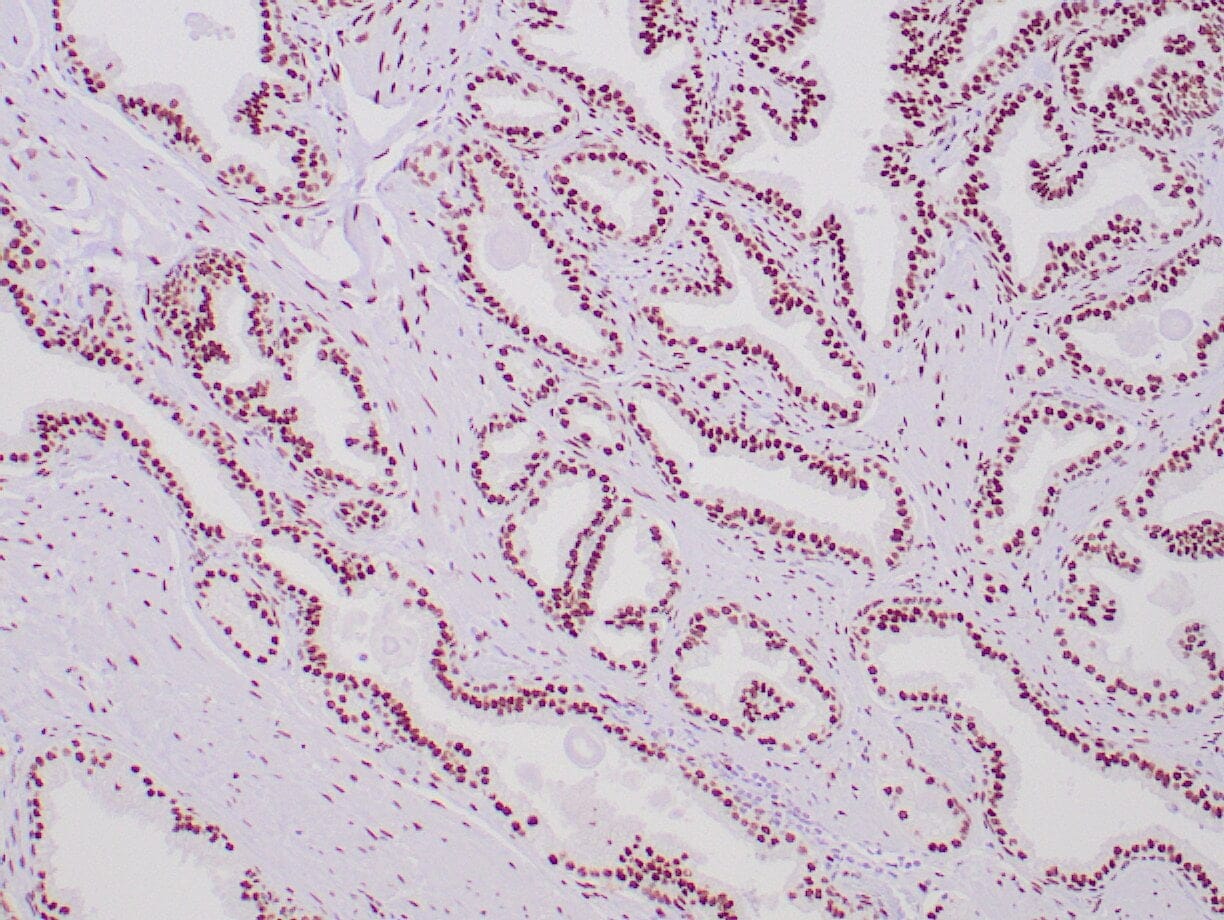 |
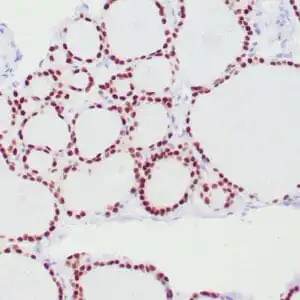
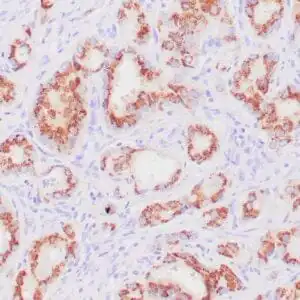
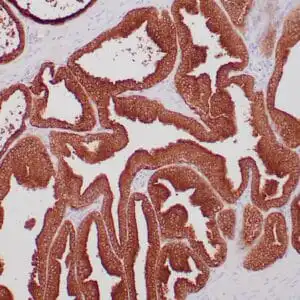
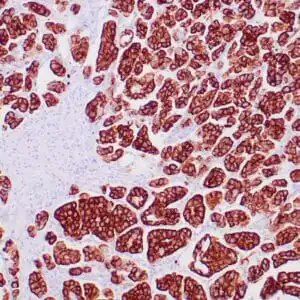
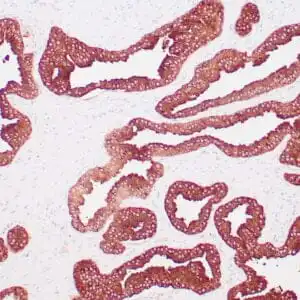
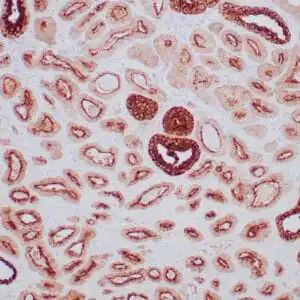
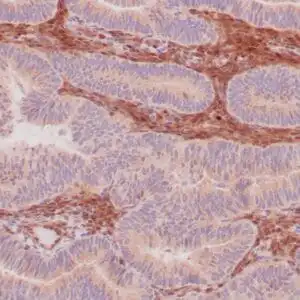
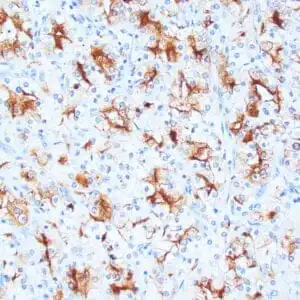
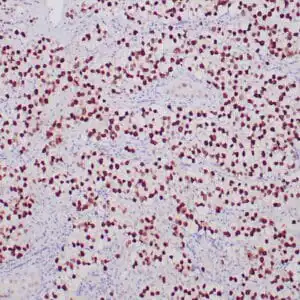
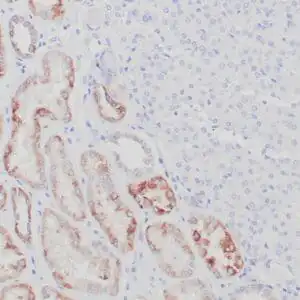
| human prostate tissue stained with anti-AR receptor using peroxidase conjugate and DAB chromogen. Note nuclear staining of glandular cells |
FAQ & Publications
Frequently Asked Questions
What species does the rabbit anti-Androgen Receptor (AR) monoclonal antibody ZR334 specifically react with?
This antibody is reactive with human tissues and is suitable for immunohistochemistry applications on formalin-fixed, paraffin-embedded human samples.
How should the rabbit anti-Androgen Receptor (AR) monoclonal antibody ZR334 be stored to maintain its stability?
For short-term storage, keep the antibody at 2-8°C. For long-term preservation, store it at -20°C and avoid repeated freeze-thaw cycles to maintain antibody integrity.
What are the recommended dilutions and positive controls for using the rabbit anti-Androgen Receptor (AR) monoclonal antibody ZR334 in immunohistochemistry?
For concentrated antibody, recommended dilutions range from 1:100 to 1:200. Positive controls for immunohistochemistry include prostate or breast carcinoma tissue samples to validate antibody specificity.
Publications
| pmid | title | authors | citation |
|---|---|---|---|
| We haven't added any publications to our database yet. | |||
Published literature highly relevant to the biological target of this product and referencing this antibody or clone are retrieved from the PubMed database provided by the United States National Library of Medicine at the National Institutes of Health.
Protocols
| relevant to this product |
|---|
| IHC |
Documents
| Batch Number | QC File | SDS |
|---|---|---|
| To view batch-specific Safety Datasheets and Quality Certificates associated with your account, please Log In. | ||
Only logged in customers who have purchased this product may leave a review.
Reviews
There are no reviews yet.