| Weight | 1 lbs |
|---|---|
| Dimensions | 9 × 5 × 2 in |
| host | mouse |
| isotype | IgG, IgG1a/k |
| clonality | monoclonal |
| concentration | concentrate, predilute |
| applications | IHC |
| reactivity | human |
| available size | 0.1 mL, 0.5 mL, 1 mL concentrated, 7 mL prediluted |

rabbit anti-AMACR + p63 monoclonal antibody (13H4 + ZM70) 6018
Price range: $160.00 through $528.00
Antibody summary
- Rabbit monoclonal to AMACR + p63
- Suitable for: Immunohistochemistry (formalin-fixed, paraffin-embedded tissues)
- Reacts with: Human
- Isotype:IgG, IgG1a/k
- Control: Prostate carcinoma
- Visualization: Cytoplasmic and nuclear
- 0.1, 0.5, 1.0 mL concentrated, 7 mL prediluted
rabbit anti-AMACR + p63 monoclonal antibody 13H4 + ZM70 6018
| target relevance |
|---|
| Homo sapiens AMACR Alpha-methylacyl-CoA racemase |
| Protein names Alpha-methylacyl-CoA racemase |
| Alternative names 2-methylacyl-CoA racemase |
| Gene names AMACR |
| Protein family Belongs to the CoA-transferase III family |
| Function Catalyzes the interconversion of (R)- and (S)-stereoisomers of alpha-methyl-branched-chain fatty acyl-CoA esters (PubMed:10655068, PubMed:11060359, PubMed:7649182). Acts only on coenzyme A thioesters, not on free fatty acids, and accepts as substrates a wide range of alpha-methylacyl-CoAs, including pristanoyl-CoA, trihydroxycoprostanoyl-CoA (an intermediate in bile acid synthesis), and arylpropionic acids like the anti-inflammatory drug ibuprofen (2-(4-isobutylphenyl)propionic acid) but neither 3-methyl-branched nor linear-chain acyl-CoAs (PubMed:10655068, PubMed:11060359, PubMed:7649182) |
| Catalytic activity a (2S)-2-methylacyl-CoA = a (2R)-2-methylacyl-CoA (25R)-3alpha,7alpha,12alpha-trihydroxy-5beta-cholestan-26-oyl-CoA = (25S)-3alpha,7alpha,12alpha-trihydroxy-5beta-cholestan-26-oyl-CoA (2R,6)-dimethylheptanoyl-CoA = (2S,6)-dimethylheptanoyl-CoA |
| Subcellular location Peroxisome, Mitochondrion |
| Structure Monomer |
| Involvement in disease Alpha-methylacyl-CoA racemase deficiency A rare autosomal recessive peroxisomal disorder characterized by elevated plasma concentrations of pristanic acid C27-bile-acid intermediates, and adult onset of variable neurodegenerative symptoms affecting the central and peripheral nervous systems. Features may include seizures, visual failure, sensorimotor neuropathy, spasticity, migraine, and white matter hyperintensities on brain imaging. Congenital bile acid synthesis defect 4 A disorder characterized by the presence of trihydroxycoprostanic acid in the bile and absence of cholic acid. Patients manifest neonatal jaundice, intrahepatic cholestasis and bile duct deficiency. |
| Keywords Acetylation, Alternative splicing, Disease variant, Intrahepatic cholestasis, Isomerase, Mitochondrion, Peroxisome, Proteomics identification, Reference proteome |
| Sequence MALQGISVVELSGLAPGPFCAMVLADFGARVVRVDRPGSRYDVSRLGRGKRSLVLDLKQP RGAAVLRRLCKRSDVLLEPFRRGVMEKLQLGPEILQRENPRLIYARLSGFGQSGSFCRLA GHDINYLALSGVLSKIGRSGENPYAPLNLLADFAGGGLMCALGIIMALFDRTRTGKGQVI DANMVEGTAYLSSFLWKTQKLSLWEAPRGQNMLDGGAPFYTTYRTADGEFMAVGAIEPQF YELLIKGLGLKSDELPNQMSMDDWPEMKKKFADVFAEKTKAEWCQIFDGTDACVTPVLTF EEVVHHDHNKERGSFITSEEQDVSPRPAPLLLNTPAIPSFKRDPFIGEHTEEILEEFGFS REEIYQLNSDKIIESNKVKASL |
| UniProt accession: Q9UHK6 |
Data
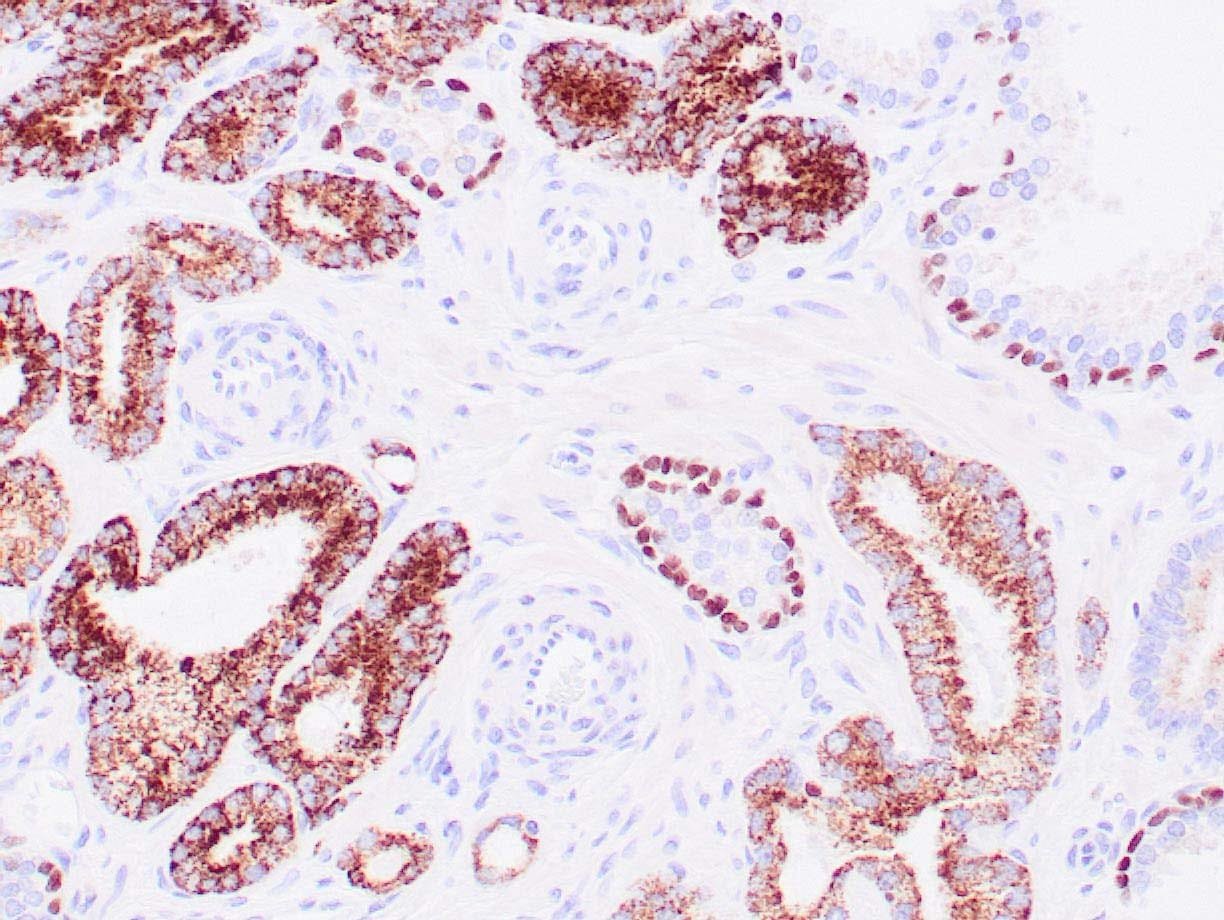 |
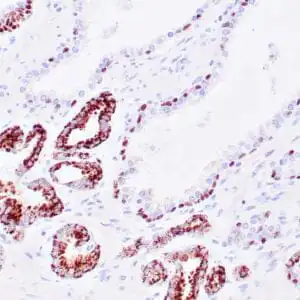
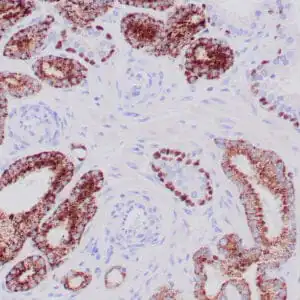
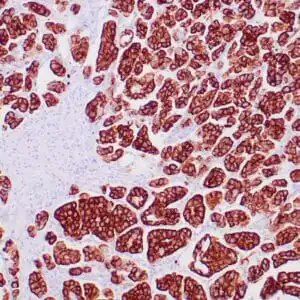
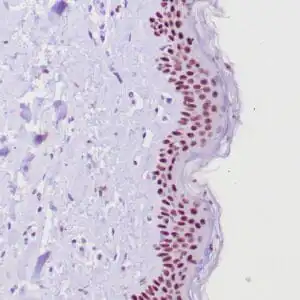
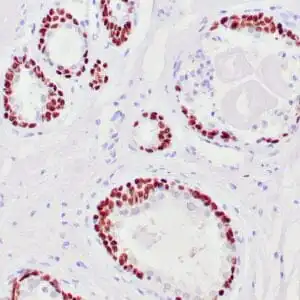
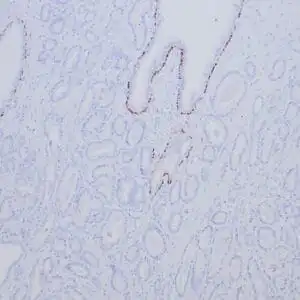
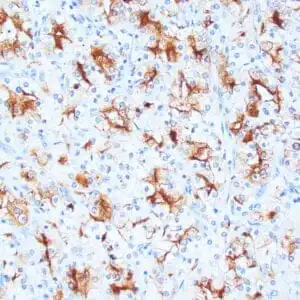
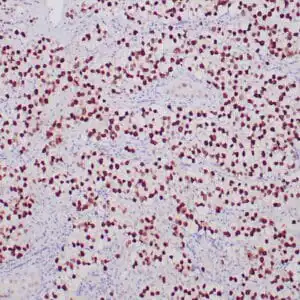
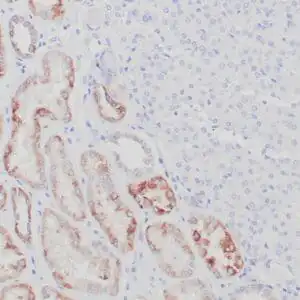
| Human prostate carcinoma stained anti-AMACR and anti-p63 antibodies using peroxidase-conjugate and DAB chromogen. Note cytoplasmic and luminal circumferential staining of carcinoma glands with AMACR and basal cell nuclear staining with p63. |
FAQ & Publications
Frequently Asked Questions
What species is the rabbit anti-AMACR + p63 monoclonal antibody (13H4 + ZM70) 6018 reactive with?
This antibody is reactive with human tissues, making it suitable for studies involving human samples.
How should the rabbit anti-AMACR + p63 monoclonal antibody be stored to maintain its stability?
For short-term storage, keep the antibody at 2-8°C. For long-term preservation, store it at -20°C and avoid repeated freeze/thaw cycles to maintain antibody integrity.
Publications
| pmid | title | authors | citation |
|---|---|---|---|
| We haven't added any publications to our database yet. | |||
Published literature highly relevant to the biological target of this product and referencing this antibody or clone are retrieved from the PubMed database provided by the United States National Library of Medicine at the National Institutes of Health.
Protocols
| relevant to this product |
|---|
| IHC |
Documents
| Batch Number | QC File | SDS |
|---|---|---|
| To view batch-specific Safety Datasheets and Quality Certificates associated with your account, please Log In. | ||
Only logged in customers who have purchased this product may leave a review.
Reviews
There are no reviews yet.