| Weight | 1 lbs |
|---|---|
| Dimensions | 9 × 5 × 2 in |
| target | Q-Fever |
| species reactivity | For the detection of Coxiella burnetii |
| applications | RT PCR |
| assay type | direct & qualitative |
| available sizes | 96 tests |

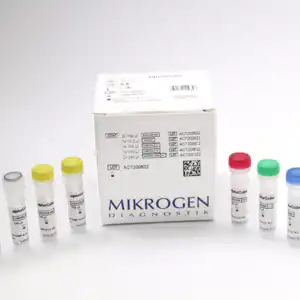
Q-Fever RT-PCR test Mikrogen 830555
$487.00
Summary
- Mikrogen diagnostik RT PCR kit for research use (RUO)
- Direct Coxiella burnetii (Q-Fever) detection
- High sensitivity and specificity
- Internal control for monitoring nucleic acid extraction
(RNA/DNA) and real-time PCR inhibition in each reaction - Compatible with most common real-time PCR cyclers & RNA/DNA extraction methods
- 96 tests
Q-Fever RT-PCR test Mikrogen 830555
| kit | |||||||||||||||
|---|---|---|---|---|---|---|---|---|---|---|---|---|---|---|---|
| Assay type RT PCR | |||||||||||||||
| Research area Infectious Disease | |||||||||||||||
| Sample type whole blood, serum, plasma, urine, tissue, stool, etc., food and environmental samples or from the carrier material | |||||||||||||||
Notes
| |||||||||||||||
Components
| |||||||||||||||
| Storage Store at -20°C. | |||||||||||||||
| Additional information Highly sensitive and specific direct detection of pathogens that can cause tick-borne infections
Applicable to human starting material as well as RNA/DNA from the tick |
| target relevance |
|---|
| Organism Coxiella burnetii |
| Protein names Coxiella burnetii |
| Structure and strains Coxiella burnetii is an obligate intracellular bacterial pathogen, and is the causative agent of Q fever. The genus Coxiella is morphologically similar to Rickettsia, but with a variety of genetic and physiological differences. C. burnetii is a small Gram-negative, coccobacillary bacterium that is highly resistant to environmental stresses such as high temperature, osmotic pressure, and ultraviolet light. These characteristics are attributed to a small cell variant form of the organism that is part of a biphasic developmental cycle, including a more metabolically and replicatively active large cell variant form. It can survive standard disinfectants, and is resistant to many other environmental changes like those presented in the phagolysosome. |
| Detection and diagnosis The diagnosis of Q fever is performed by the demonstration of specific antibodies directed against Coxiella burnetii. Due to variations in the lipopolysaccharide (LPS) structure on the surface of the pathogen, as the disease enters the chronic state, a serological differentiation of acute from chronic infections is possible. Due to the high sensitivity and specificity, the use of ELISA immunoassays is recommended by the World Health Organization (WHO). Following the regular course of an acute primary infection, specific IgM and IgG antibodies directed against the immunogenic phase 2 antigens can be demonstrated. IgG antibodies directed against phase 2 antigens often persist over several years. In the lead-up to a chronic infection, IgG and IgA antibodies directed against the phase 1 antigens appear, which are of diagnostic value particularly for the diagnosis of Q fever endocarditis |
Data
| No results found |
FAQ & Publications
Frequently Asked Questions
What types of samples can be used with the Q-Fever RT-PCR test Mikrogen 830555?
The Q-Fever RT-PCR test Mikrogen 830555 can be used with a variety of sample types including whole blood, serum, plasma, urine, tissue, stool, as well as food and environmental samples or carrier material.
Is the Q-Fever RT-PCR test compatible with common real-time PCR cyclers?
Yes, this test is compatible and validated for use with several common real-time PCR cyclers such as the Roche LightCycler 480 Instrument II, Roche cobas z 480 Analyzer, Qiagen Rotor-Gene Q, Bio-Rad CFX 96, Applied Biosystems QuantStudio 5 Dx, and Stratagene Mx3000P.
What storage conditions are required for the Q-Fever RT-PCR test Mikrogen 830555?
The test components should be stored at -20°C to maintain stability and performance.
What is the target organism detected by the Q-Fever RT-PCR test Mikrogen 830555?
The assay specifically detects Coxiella burnetii, the obligate intracellular bacterium responsible for Q fever.
Publications
| pmid | title | authors | citation |
|---|---|---|---|
| We haven't added any publications to our database yet. | |||
Published literature highly relevant to the biological target of this product and referencing this antibody or clone are retrieved from the PubMed database provided by the United States National Library of Medicine at the National Institutes of Health.
Protocols
| relevant to this product |
|---|
| This product has moved to a digital protocol. Please use the URL provided on the product packaging to access the electronic Instructions for Use (eIFU). 830555 protocol |
Documents
| # | ||
|---|---|---|
| Please enter your product and batch number here. | ||
Only logged in customers who have purchased this product may leave a review.
Reviews
There are no reviews yet.