| Weight | 1 lbs |
|---|---|
| Dimensions | 9 × 5 × 2 in |
| host | mouse |
| isotype | IgG1 |
| clonality | monoclonal |
| concentration | concentrate, predilute |
| applications | IHC |
| reactivity | human |
| available size | 0.1 mL, 0.5 mL, 1 mL concentrated, 7 mL prediluted |

mouse anti-TTF-1 monoclonal antibody (8G7G3&1) 6396
Price range: $160.00 through $528.00
Antibody summary
- Mouse monoclonal to TTF-1
- Suitable for: Immunohistochemistry (formalin-fixed, paraffin-embedded tissues)
- Reacts with: Human
- Isotype:IgG1
- Control: Normal thyroid or lung
- Visualization: Nuclear
- 0.1, 0.5, 1.0 mL concentrated, 7 mL prediluted
mouse anti-TTF-1 monoclonal antibody 8G7G3&1 6396
| target relevance |
|---|
| Homo sapiens NKX2-1 Homeobox protein Nkx-2.1 |
| Protein names Homeobox protein Nkx-2.1 |
| Alternative names Homeobox protein NK-2 homolog A, Thyroid nuclear factor 1, Thyroid transcription factor 1, Thyroid-specific enhancer-binding protein |
| Gene names NKX2-1 |
| Protein family Belongs to the NK-2 homeobox family |
| Function Transcription factor that binds and activates the promoter of thyroid specific genes such as thyroglobulin, thyroperoxidase, and thyrotropin receptor. Crucial in the maintenance of the thyroid differentiation phenotype. May play a role in lung development and surfactant homeostasis. Forms a regulatory loop with GRHL2 that coordinates lung epithelial cell morphogenesis and differentiation. Activates the transcription of GNRHR and plays a role in enhancing the circadian oscillation of its gene expression. Represses the transcription of the circadian transcriptional repressor NR1D1 (By similarity) |
| Subcellular location Nucleus |
| Structure Interacts with WWTR1 |
| Post-translational modification Phosphorylated on serine residues by STK3/MST2 |
| Involvement in disease Chorea, hereditary benign A rare autosomal dominant movement disorder, defined by early onset in childhood, a stable or non-progressive course of chorea, and no mental deterioration. Chorea is characterized by involuntary, forcible, rapid, jerky movements that may be subtle or become confluent, markedly altering normal patterns of movement. Choreoathetosis and congenital hypothyroidism with or without pulmonary dysfunction An autosomal dominant disorder that manifests in infancy with neurological disturbances, hypothyroidism, and respiratory problems. It is characterized by movement abnormalities beginning with muscular hypotonia followed by the development of chorea, athetosis, dystonia, ataxia, and dysarthria. Thyroid cancer, non-medullary, 1 A form of non-medullary thyroid cancer (NMTC), a cancer characterized by tumors originating from the thyroid follicular cells. NMTCs represent approximately 95% of all cases of thyroid cancer and are classified into papillary, follicular, Hurthle cell, and anaplastic neoplasms. |
| Keywords Activator, Alternative splicing, Biological rhythms, Congenital hypothyroidism, Disease variant, DNA-binding, Homeobox, Nucleus, Phosphoprotein, Proteomics identification, Reference proteome, Repressor, Transcription, Transcription regulation |
| Sequence MSMSPKHTTPFSVSDILSPLEESYKKVGMEGGGLGAPLAAYRQGQAAPPTAAMQQHAVGH HGAVTAAYHMTAAGVPQLSHSAVGGYCNGNLGNMSELPPYQDTMRNSASGPGWYGANPDP RFPAISRFMGPASGMNMSGMGGLGSLGDVSKNMAPLPSAPRRKRRVLFSQAQVYELERRF KQQKYLSAPEREHLASMIHLTPTQVKIWFQNHRYKMKRQAKDKAAQQQLQQDSGGGGGGG GTGCPQQQQAQQQSPRRVAVPVLVKDGKPCQAGAPAPGAASLQGHAQQQAQHQAQAAQAA AAAISVGSGGAGLGAHPGHQPGSAGQSPDLAHHAASPAALQGQVSSLSHLNSSGSDYGTM SCSTLLYGRTW |
| UniProt accession: P43699 |
Data
 |
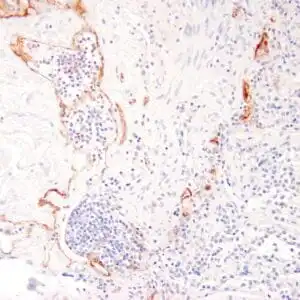
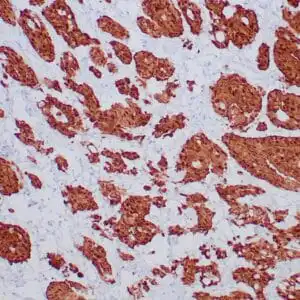
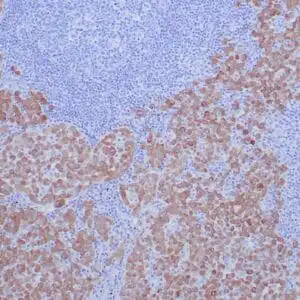
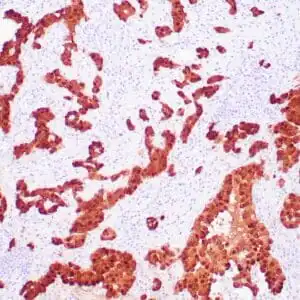
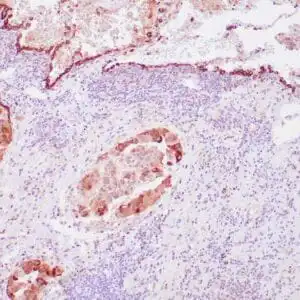
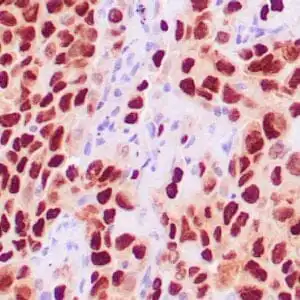
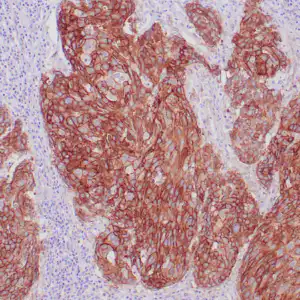
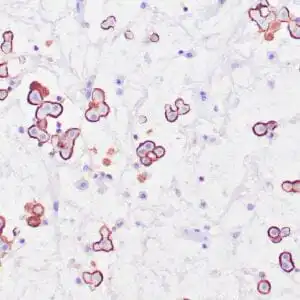
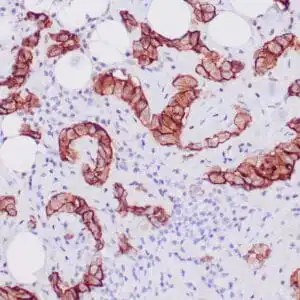
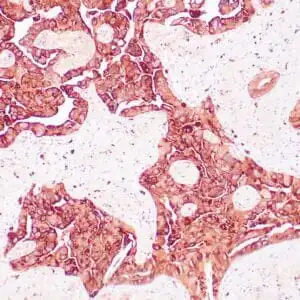
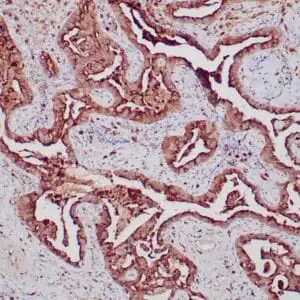
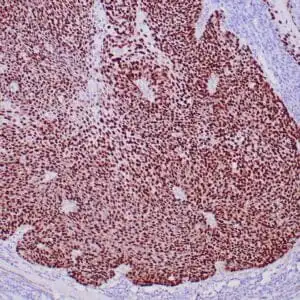
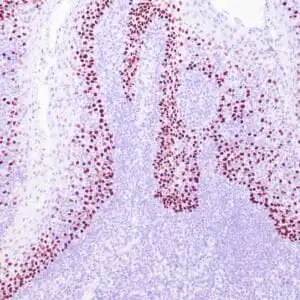
| Human lung adenocarcinoma stained with anti-TTF-1 antibody using peroxidase-conjugate and DAB chromogen. Note the nuclear staining of tumor cells. |
FAQ & Publications
Frequently Asked Questions
What species does the mouse anti-TTF-1 monoclonal antibody (8G7G3&1) specifically react with?
This antibody specifically reacts with human tissues.
How should the mouse anti-TTF-1 monoclonal antibody be stored to maintain stability?
Store the antibody at 2-8°C for short term use and at -20°C for long term storage, while avoiding freeze/thaw cycles to preserve antibody integrity.
What applications and sample types is this monoclonal antibody validated for?
The antibody is validated for immunohistochemistry (IHC) on formalin-fixed, paraffin-embedded human tissue samples, with positive controls including normal thyroid or lung tissues.
Publications
| pmid | title | authors | citation |
|---|---|---|---|
| We haven't added any publications to our database yet. | |||
Published literature highly relevant to the biological target of this product and referencing this antibody or clone are retrieved from the PubMed database provided by the United States National Library of Medicine at the National Institutes of Health.
Protocols
| relevant to this product |
|---|
| IHC |
Documents
| Batch Number | QC File | SDS |
|---|---|---|
| To view batch-specific Safety Datasheets and Quality Certificates associated with your account, please Log In. | ||
Only logged in customers who have purchased this product may leave a review.
Reviews
There are no reviews yet.