| Weight | 1 lbs |
|---|---|
| Dimensions | 9 × 5 × 2 in |
| host | mouse |
| isotype | IgG2a |
| clonality | monoclonal |
| concentration | concentrate, predilute |
| applications | IHC |
| reactivity | human |
| available size | 0.1 mL, 0.5 mL, 1 mL concentrated, 7 mL prediluted |

mouse anti-TLE1 monoclonal antibody (ZM93) 6387
Price range: $160.00 through $528.00
Antibody summary
- Mouse monoclonal to TLE1
- Suitable for: Immunohistochemistry (formalin-fixed, paraffin-embedded tissues)
- Reacts with: Human
- Isotype:IgG2a
- Control: Synovial sarcoma
- Visualization: Cytoplasmic
- 0.1, 0.5, 1.0 mL concentrated, 7 mL prediluted
mouse anti-TLE1 monoclonal antibody ZM93 6387
| target relevance |
|---|
| Homo sapiens TLE1 Transducin-like enhancer protein 1 |
| Protein names Transducin-like enhancer protein 1 |
| Alternative names E(Sp1) homolog, Enhancer of split groucho-like protein 1 |
| Gene names TLE1 |
| Protein family Belongs to the WD repeat Groucho/TLE family |
| Function Transcriptional corepressor that binds to a number of transcription factors. Inhibits NF-kappa-B-regulated gene expression. Inhibits the transcriptional activation mediated by FOXA2, and by CTNNB1 and TCF family members in Wnt signaling. Enhances FOXG1/BF-1- and HES1-mediated transcriptional repression (By similarity). The effects of full-length TLE family members may be modulated by association with dominant-negative AES. Unusual function as coactivator for ESRRG |
| Subcellular location Nucleus |
| Structure Homooligomer and heterooligomer with other family members. Binds RUNX1, RUNX3, FOXA2, KDM6A, UTY, histone H3, HESX1, ESRRG and the NF-kappa-B subunit RELA. Interacts with HES1 (via WRPW motif). Binds TCF7, LEF1, TCF7L1 and TCF7L2 (By similarity). Interacts with SIX3. Interacts with EFNB1. Interacts with TLE4 (By similarity). Interacts with FOXG1/BF-1; the interaction is inhibited by TLE6/GRG6 (By similarity) |
| Post-translational modification Phosphorylated, probably by CDK1. The degree of phosphorylation varies throughout the cell cycle, and is highest at the G2/M transition. Becomes hyperphosphorylated in response to cell differentiation and interaction with HES1 or RUNX1 Ubiquitinated by XIAP/BIRC4 |
| Keywords 3D-structure, Direct protein sequencing, Nucleus, Phosphoprotein, Proteomics identification, Reference proteome, Repeat, Repressor, Transcription, Transcription regulation, Ubl conjugation, WD repeat, Wnt signaling pathway |
| Sequence MFPQSRHPTPHQAAGQPFKFTIPESLDRIKEEFQFLQAQYHSLKLECEKLASEKTEMQRH YVMYYEMSYGLNIEMHKQTEIAKRLNTICAQVIPFLSQEHQQQVAQAVERAKQVTMAELN AIIGQQQLQAQHLSHGHGPPVPLTPHPSGLQPPGIPPLGGSAGLLALSSALSGQSHLAIK DDKKHHDAEHHRDREPGTSNSLLVPDSLRGTDKRRNGPEFSNDIKKRKVDDKDSSHYDSD GDKSDDNLVVDVSNEDPSSPRASPAHSPRENGIDKNRLLKKDASSSPASTASSASSTSLK SKEMSLHEKASTPVLKSSTPTPRSDMPTPGTSATPGLRPGLGKPPAIDPLVNQAAAGLRT PLAVPGPYPAPFGMVPHAGMNGELTSPGAAYASLHNMSPQMSAAAAAAAVVAYGRSPMVG FDPPPHMRVPTIPPNLAGIPGGKPAYSFHVTADGQMQPVPFPPDALIGPGIPRHARQINT LNHGEVVCAVTISNPTRHVYTGGKGCVKVWDISHPGNKSPVSQLDCLNRDNYIRSCKLLP DGCTLIVGGEASTLSIWDLAAPTPRIKAELTSSAPACYALAISPDSKVCFSCCSDGNIAV WDLHNQTLVRQFQGHTDGASCIDISNDGTKLWTGGLDNTVRSWDLREGRQLQQHDFTSQI FSLGYCPTGEWLAVGMESSNVEVLHVNKPDKYQLHLHESCVLSLKFAYCGKWFVSTGKDN LLNAWRTPYGASIFQSKESSSVLSCDISVDDKYIVTGSGDKKATVYEVIY |
| UniProt accession: Q04724 |
Data
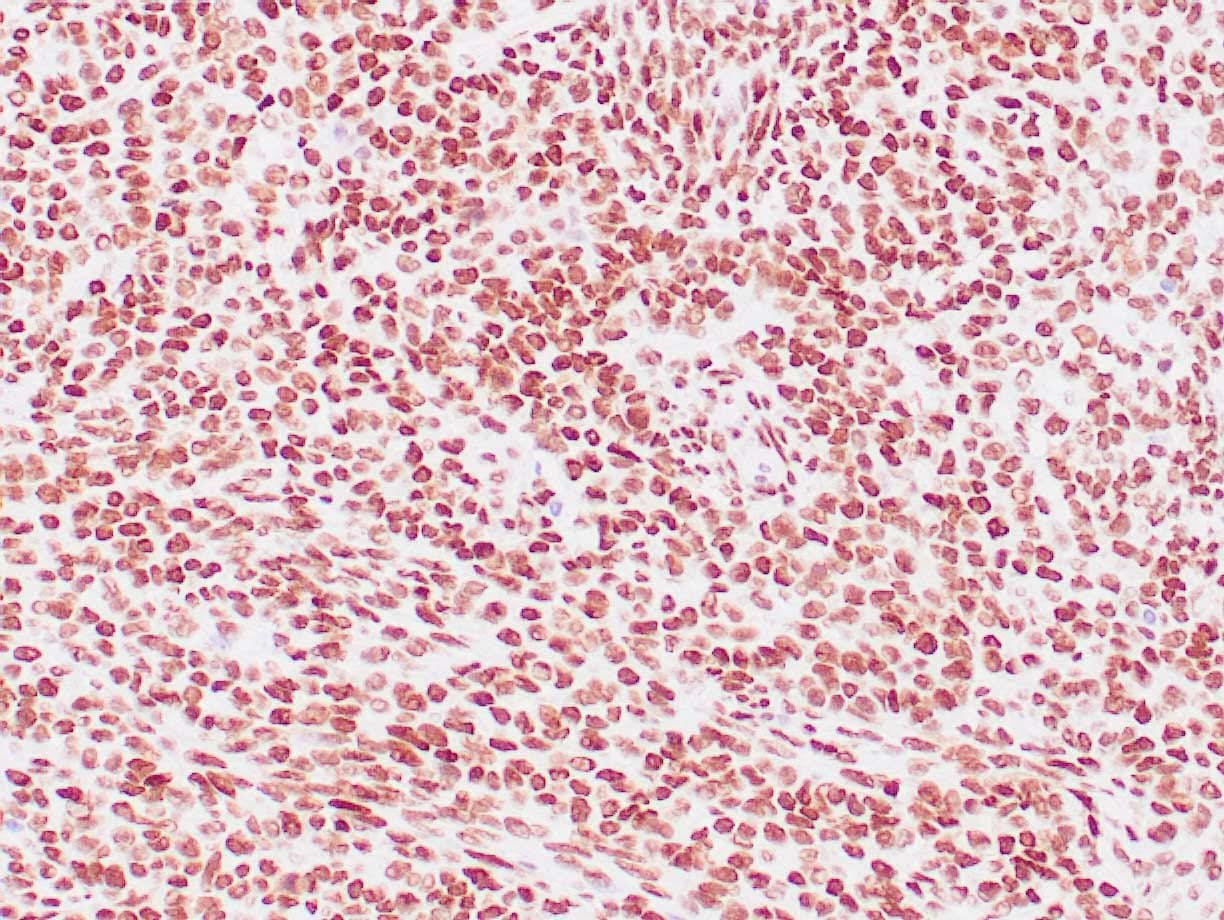 |
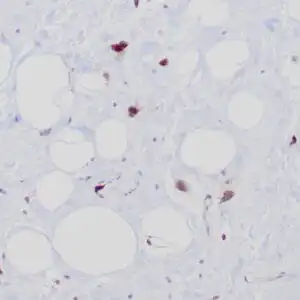
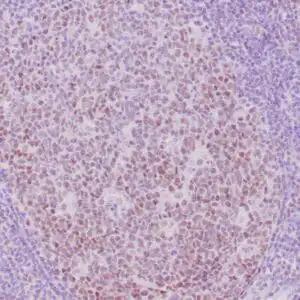
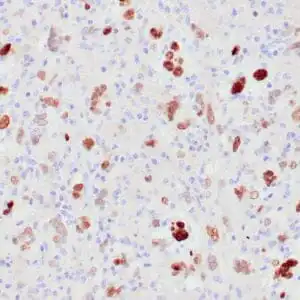
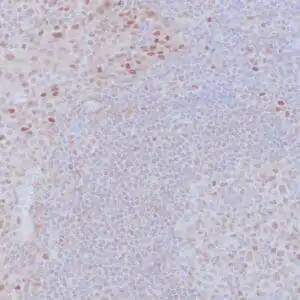
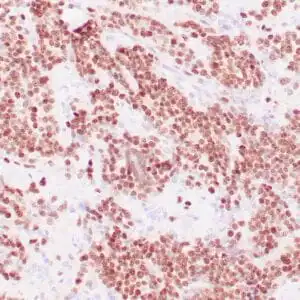
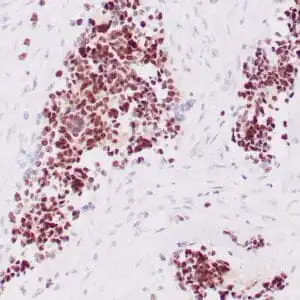
| Human synovial sarcoma stained with anti-TLE1 antibody using peroxidase-conjugate and DAB chromogen. Note nuclear staining of tumor cells. |
FAQ & Publications
Frequently Asked Questions
What applications is the mouse anti-TLE1 monoclonal antibody (ZM93) validated for?
This antibody is validated for Immunohistochemistry (IHC) on formalin-fixed, paraffin-embedded human tissues.
How should the mouse anti-TLE1 antibody be stored to maintain its stability?
For short-term storage, keep the antibody at 2-8°C, and for long-term storage, freeze at -20°C while avoiding repeated freeze/thaw cycles.
What is the host species and clonality of the anti-TLE1 antibody ZM93?
The antibody is a mouse monoclonal with an IgG2a isotype.
Which species does the mouse anti-TLE1 monoclonal antibody specifically react with?
This antibody reacts specifically with human TLE1 protein.
What positive control is recommended when using the mouse anti-TLE1 antibody in IHC experiments?
Synovial sarcoma tissue is recommended as a positive control for this antibody.
Publications
| pmid | title | authors | citation |
|---|---|---|---|
| We haven't added any publications to our database yet. | |||
Published literature highly relevant to the biological target of this product and referencing this antibody or clone are retrieved from the PubMed database provided by the United States National Library of Medicine at the National Institutes of Health.
Protocols
| relevant to this product |
|---|
| IHC |
Documents
| Batch Number | QC File | SDS |
|---|---|---|
| To view batch-specific Safety Datasheets and Quality Certificates associated with your account, please Log In. | ||
Only logged in customers who have purchased this product may leave a review.


Reviews
There are no reviews yet.