| Weight | 1 lbs |
|---|---|
| Dimensions | 9 × 5 × 2 in |
| host | mouse |
| isotype | IgG1 |
| clonality | monoclonal |
| concentration | concentrate, predilute |
| applications | IHC |
| reactivity | human |
| available size | 0.1 mL, 0.5 mL, 1 mL concentrated, 7 mL prediluted |

mouse anti-Myogenin monoclonal antibody (ZM149) 6279
Price range: $160.00 through $528.00
Antibody summary
- Mouse monoclonal to Myogenin
- Suitable for: Immunohistochemistry (formalin-fixed, paraffin-embedded tissues)
- Reacts with: Human
- Isotype:IgG1
- Control: Rhabdomyosarcoma or Wilm’s tumor
- Visualization: Nuclear
- 0.1, 0.5, 1.0 mL concentrated, 7 mL prediluted
mouse anti-Myogenin monoclonal antibody ZM149 6279
| target relevance |
|---|
| Homo sapiens MYOG Myogenin |
| Protein names Myogenin |
| Alternative names Class C basic helix-loop-helix protein 3, Myogenic factor 4 |
| Gene names MYOG |
| Function Acts as a transcriptional activator that promotes transcription of muscle-specific target genes and plays a role in muscle differentiation, cell cycle exit and muscle atrophy. Essential for the development of functional embryonic skeletal fiber muscle differentiation. However is dispensable for postnatal skeletal muscle growth; phosphorylation by CAMK2G inhibits its transcriptional activity in respons to muscle activity. Required for the recruitment of the FACT complex to muscle-specific promoter regions, thus promoting gene expression initiation. During terminal myoblast differentiation, plays a role as a strong activator of transcription at loci with an open chromatin structure previously initiated by MYOD1. Together with MYF5 and MYOD1, co-occupies muscle-specific gene promoter core regions during myogenesis. Also cooperates with myocyte-specific enhancer factor MEF2D and BRG1-dependent recruitment of SWI/SNF chromatin-remodeling enzymes to alter chromatin structure at myogenic late gene promoters. Facilitates cell cycle exit during terminal muscle differentiation through the up-regulation of miR-20a expression, which in turn represses genes involved in cell cycle progression. Binds to the E-box containing (E1) promoter region of the miR-20a gene. Also plays a role in preventing reversal of muscle cell differentiation. Contributes to the atrophy-related gene expression in adult denervated muscles. Induces fibroblasts to differentiate into myoblasts (By similarity) |
| Subcellular location Nucleus |
| Structure Homodimer and heterodimer with E12; heterodimerization enhances MYOG DNA-binding and transcriptional activities. Interacts with SMARCA4/BRG1/BAF190A. Interacts (via C-terminal region) with SSRP1 and SUPT16H; the interaction is indicative of an interaction with the FACT complex (By similarity). Interacts with CSRP3 |
| Post-translational modification Phosphorylated by CAMK2G on threonine and serine amino acids in a muscle activity-dependent manner. Phosphorylation of Thr-87 impairs both DNA-binding and trans-activation functions in contracting muscles (By similarity) |
| Keywords Activator, Cell cycle, Developmental protein, Differentiation, DNA-binding, Myogenesis, Nucleus, Phosphoprotein, Proteomics identification, Reference proteome, Transcription, Transcription regulation |
| Sequence MELYETSPYFYQEPRFYDGENYLPVHLQGFEPPGYERTELTLSPEAPGPLEDKGLGTPEH CPGQCLPWACKVCKRKSVSVDRRRAATLREKRRLKKVNEAFEALKRSTLLNPNQRLPKVE ILRSAIQYIERLQALLSSLNQEERDLRYRGGGGPQPGVPSECSSHSASCSPEWGSALEFS ANPGDHLLTADPTDAHNLHSLTSIVDSITVEDVSVAFPDETMPN |
| UniProt accession: P15173 |
Data
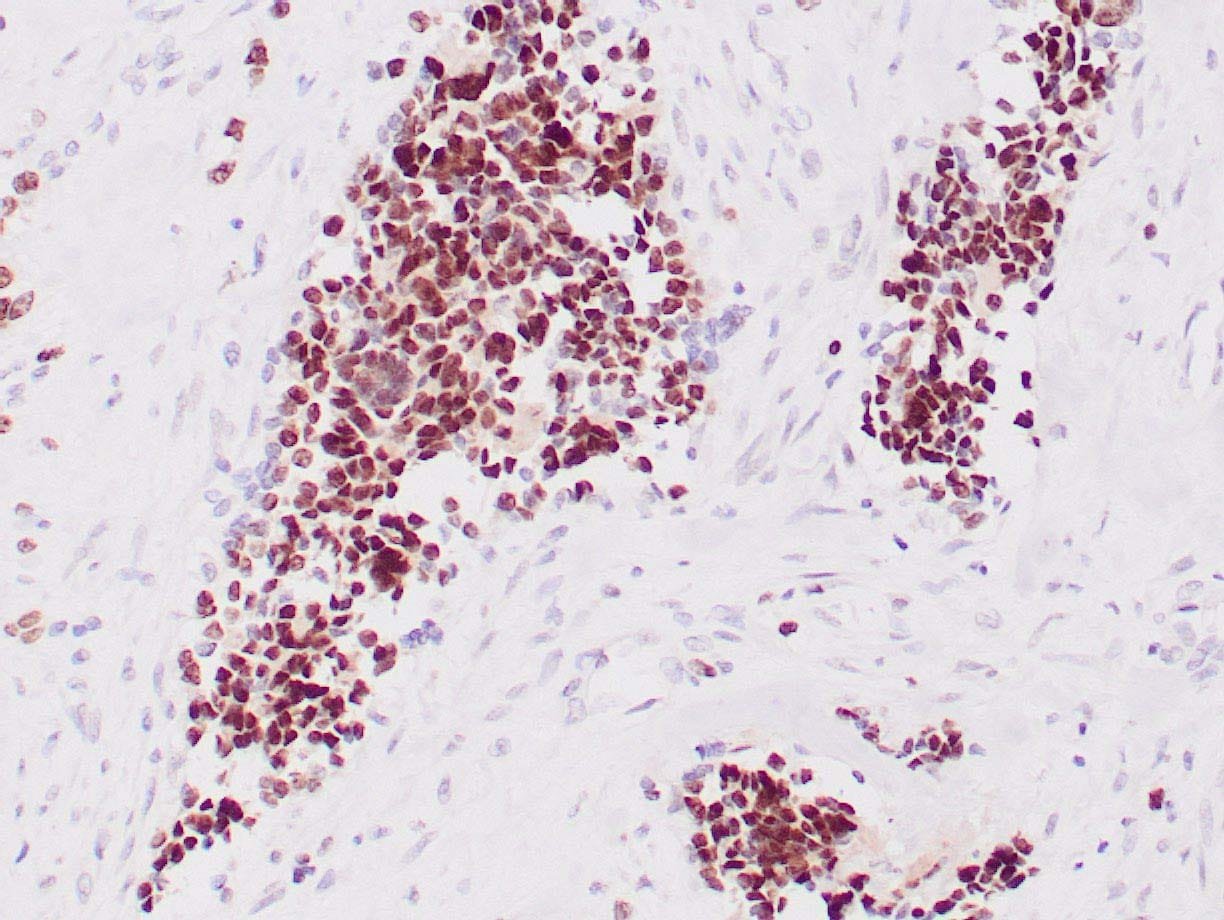 |
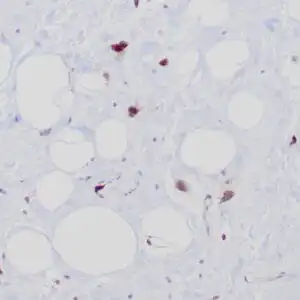
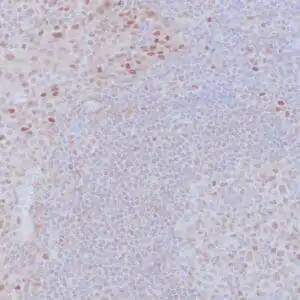
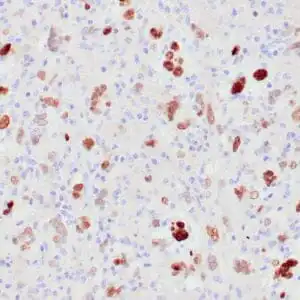
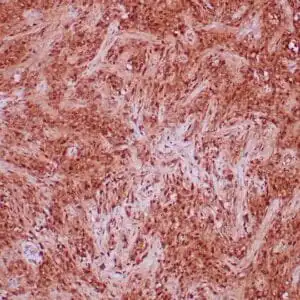
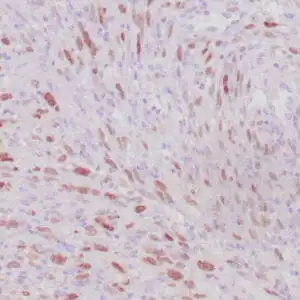
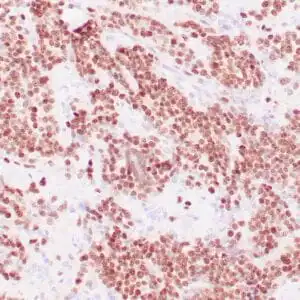
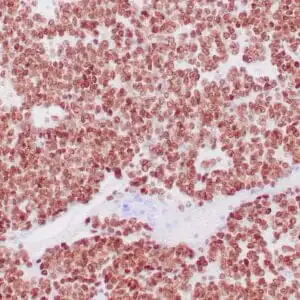
| Human rhabdomyosarcoma stained with anti-Myogenin antibody using peroxidase-conjugate and DAB chromogen. Note nuclear staining of tumor cells. |
FAQ & Publications
Frequently Asked Questions
What is the recommended dilution for the mouse anti-Myogenin monoclonal antibody (ZM149) when used in immunohistochemistry?
For immunohistochemistry applications, the concentrated mouse anti-Myogenin monoclonal antibody (ZM149) is recommended to be diluted between 1:100 and 1:200.
Which species does the mouse anti-Myogenin monoclonal antibody (ZM149) react with, and what tissues are suitable for its application?
This antibody specifically reacts with human tissues and is suitable for immunohistochemistry on formalin-fixed, paraffin-embedded human tissue samples.
How should the mouse anti-Myogenin monoclonal antibody (ZM149) be stored to maintain stability and avoid degradation?
For short-term storage, keep the antibody at 2-8°C. For long-term preservation, it should be stored at -20°C, and freeze-thaw cycles should be avoided to maintain antibody integrity.
Publications
| pmid | title | authors | citation |
|---|---|---|---|
| We haven't added any publications to our database yet. | |||
Published literature highly relevant to the biological target of this product and referencing this antibody or clone are retrieved from the PubMed database provided by the United States National Library of Medicine at the National Institutes of Health.
Protocols
| relevant to this product |
|---|
| IHC |
Documents
| Batch Number | QC File | SDS |
|---|---|---|
| To view batch-specific Safety Datasheets and Quality Certificates associated with your account, please Log In. | ||
Only logged in customers who have purchased this product may leave a review.

Reviews
There are no reviews yet.