| Weight | 1 lbs |
|---|---|
| Dimensions | 9 × 5 × 2 in |
| host | mouse |
| isotype | IgG1 |
| clonality | monoclonal |
| concentration | concentrate, predilute |
| applications | IHC |
| reactivity | human |
| available size | 0.1 mL, 0.5 mL, 1 mL concentrated, 7 mL prediluted |

mouse anti-CD8 monoclonal antibody (ZM54) 6114
Price range: $160.00 through $528.00
Antibody summary
- Mouse monoclonal to CD8
- Suitable for: Immunohistochemistry (formalin-fixed, paraffin-embedded tissues)
- Reacts with: Human
- Isotype:IgG1
- Control: Lymph node
- Visualization: Membrane
- 0.1, 0.5, 1.0 mL concentrated, 7 mL prediluted
mouse anti-CD8 monoclonal antibody ZM54 6114
| target relevance |
|---|
| Homo sapiens CD8A T-cell surface glycoprotein CD8 alpha chain |
| Protein names T-cell surface glycoprotein CD8 alpha chain |
| Alternative names T-lymphocyte differentiation antigen T8/Leu-2 |
| Gene names CD8A |
| Function Integral membrane glycoprotein that plays an essential role in the immune response and serves multiple functions in responses against both external and internal offenses. In T-cells, functions primarily as a coreceptor for MHC class I molecule:peptide complex. The antigens presented by class I peptides are derived from cytosolic proteins while class II derived from extracellular proteins. Interacts simultaneously with the T-cell receptor (TCR) and the MHC class I proteins presented by antigen presenting cells (APCs). In turn, recruits the Src kinase LCK to the vicinity of the TCR-CD3 complex. LCK then initiates different intracellular signaling pathways by phosphorylating various substrates ultimately leading to lymphokine production, motility, adhesion and activation of cytotoxic T-lymphocytes (CTLs). This mechanism enables CTLs to recognize and eliminate infected cells and tumor cells. In NK-cells, the presence of CD8A homodimers at the cell surface provides a survival mechanism allowing conjugation and lysis of multiple target cells. CD8A homodimer molecules also promote the survival and differentiation of activated lymphocytes into memory CD8 T-cells |
| Subcellular location Secreted |
| Structure Forms disulfide-linked heterodimers with CD8B at the cell surface. Also forms homodimers in several cell types including NK-cells or peripheral blood T-lymphocytes. Interacts with the MHC class I HLA-A/B2M dimer. One HLA-A molecule (mainly via nonpolymorphic alpha-3 domain) interacts with one CD8A homodimer (via CDR-like loop) (PubMed:2784196, PubMed:9177355). Interacts with LCK in a zinc-dependent manner. Interacts with HLA-G; this interaction is direct and might down-regulate T cell receptor signaling |
| Post-translational modification Palmitoylated, but association with CD8B seems to be more important for the enrichment of CD8A in lipid rafts O-glycosylated Phosphorylated in cytotoxic T-lymphocytes (CTLs) following activation |
| Involvement in disease Immunodeficiency 116 An autosomal recessive immunologic defect characterized by absence of CD8+ cells, leading to recurrent bacterial infections. |
| Keywords 3D-structure, Adaptive immunity, Alternative splicing, Cell membrane, Disease variant, Disulfide bond, Glycoprotein, Immunity, Immunoglobulin domain, Lipoprotein, Membrane, Palmitate, Proteomics identification, Reference proteome, Secreted, Signal, Transmembrane, Transmembrane helix |
| Sequence MALPVTALLLPLALLLHAARPSQFRVSPLDRTWNLGETVELKCQVLLSNPTSGCSWLFQP RGAAASPTFLLYLSQNKPKAAEGLDTQRFSGKRLGDTFVLTLSDFRRENEGYYFCSALSN SIMYFSHFVPVFLPAKPTTTPAPRPPTPAPTIASQPLSLRPEACRPAAGGAVHTRGLDFA CDIYIWAPLAGTCGVLLLSLVITLYCNHRNRRRVCKCPRPVVKSGDKPSLSARYV |
| UniProt accession: P01732 |
Data
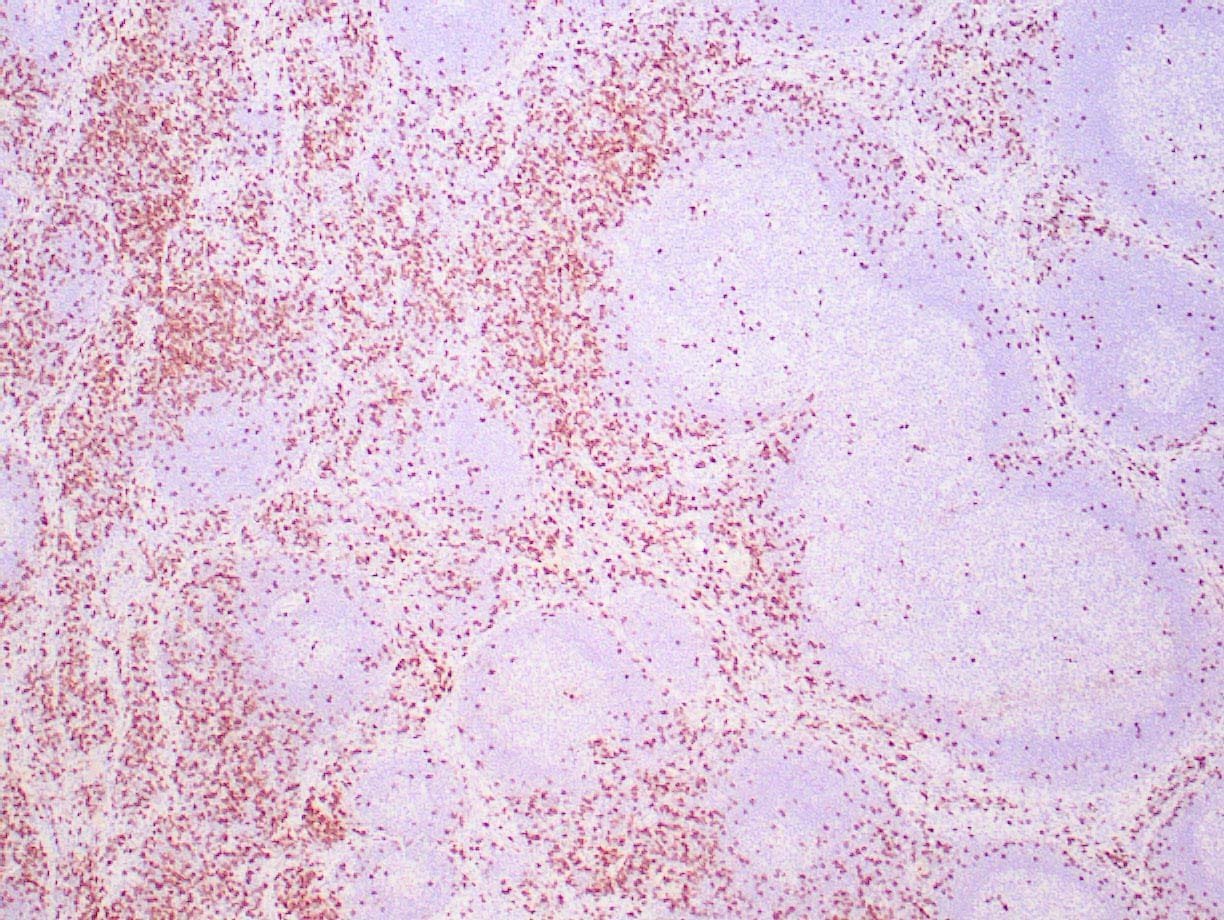 |
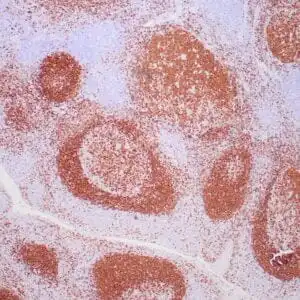
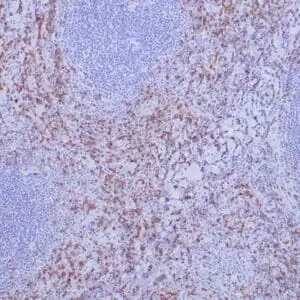
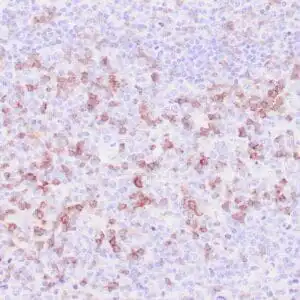
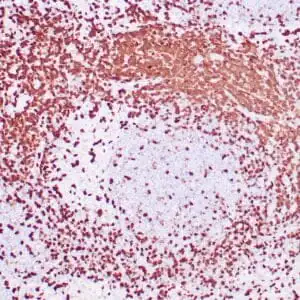
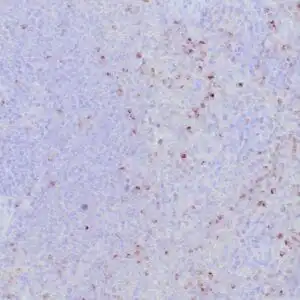
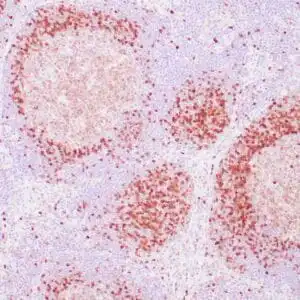
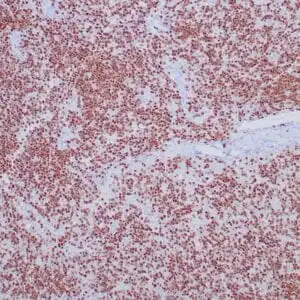
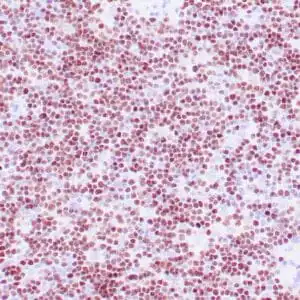
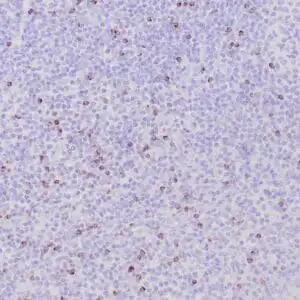
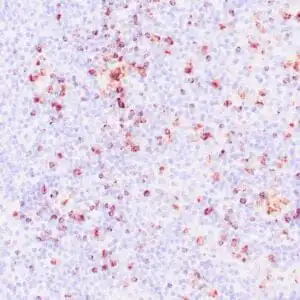
| Human tonsil stained with anti-CD8 antibody using peroxidase-conjugate and DAB chromogen. Not the membrane staining of perifollicular T-cells. |
FAQ & Publications
Frequently Asked Questions
What is the recommended application for the mouse anti-CD8 monoclonal antibody (ZM54) 6114?
This antibody is suitable for immunohistochemistry (IHC) on formalin-fixed, paraffin-embedded human tissues.
What species does the mouse anti-CD8 monoclonal antibody (ZM54) specifically react with?
The antibody specifically reacts with human CD8 protein.
How should the mouse anti-CD8 antibody be stored to maintain stability?
For short-term storage, keep the antibody at 2-8°C. For long-term storage, it should be kept at -20°C while avoiding freeze/thaw cycles.
What is the clonality and isotype of the anti-CD8 monoclonal antibody ZM54 6114?
The antibody is a mouse monoclonal antibody of the IgG1 isotype.
Which secondary antibodies are compatible with the mouse anti-CD8 monoclonal antibody for detection?
Compatible secondary antibodies include goat anti-mouse IgG, H&L chain specific, conjugated with peroxidase, biotin, or FITC, including cross-absorbed versions.
Publications
| pmid | title | authors | citation |
|---|---|---|---|
| We haven't added any publications to our database yet. | |||
Published literature highly relevant to the biological target of this product and referencing this antibody or clone are retrieved from the PubMed database provided by the United States National Library of Medicine at the National Institutes of Health.
Protocols
| relevant to this product |
|---|
| IHC |
Documents
| Batch Number | QC File | SDS |
|---|---|---|
| To view batch-specific Safety Datasheets and Quality Certificates associated with your account, please Log In. | ||
Only logged in customers who have purchased this product may leave a review.


Reviews
There are no reviews yet.