| Weight | 1 lbs |
|---|---|
| Dimensions | 9 × 5 × 2 in |
| host | mouse |
| isotype | IgG2a |
| clonality | monoclonal |
| concentration | concentrate, predilute |
| applications | IHC |
| reactivity | human |
| available size | 0.1 mL, 0.5 mL, 1 mL concentrated, 7 mL prediluted |

mouse anti-CD20 monoclonal antibody (L26) 6073
Price range: $160.00 through $528.00
Antibody summary
- Mouse monoclonal to CD20
- Suitable for: Immunohistochemistry (formalin-fixed, paraffin-embedded tissues)
- Reacts with: Human
- Isotype:IgG2a
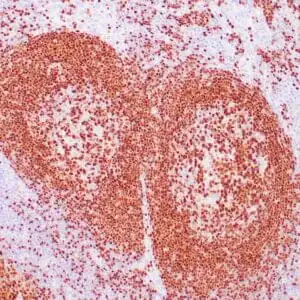
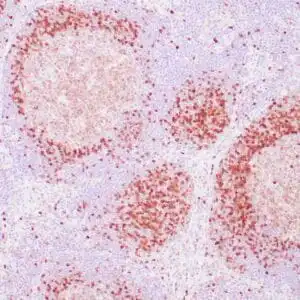
- Control: Tonsil, lymph node
- Visualization: Cell membrane/cytoplasmic
- 0.1, 0.5, 1.0 mL concentrated, 7 mL prediluted
mouse anti-CD20 monoclonal antibody L26 6073
| target relevance |
|---|
| Homo sapiens MS4A1 B-lymphocyte antigen CD20 |
| Protein names B-lymphocyte antigen CD20 |
| Alternative names B-lymphocyte surface antigen B1, Bp35, Leukocyte surface antigen Leu-16, Membrane-spanning 4-domains subfamily A member 1 |
| Gene names MS4A1 |
| Protein family Belongs to the MS4A family |
| Function B-lymphocyte-specific membrane protein that plays a role in the regulation of cellular calcium influx necessary for the development, differentiation, and activation of B-lymphocytes (PubMed:12920111, PubMed:3925015, PubMed:7684739). Functions as a store-operated calcium (SOC) channel component promoting calcium influx after activation by the B-cell receptor/BCR (PubMed:12920111, PubMed:18474602, PubMed:7684739) |
| Subcellular location Cell membrane, Cell membrane |
| Structure Forms homotetramers (PubMed:18474602, PubMed:7684739). Interacts with the heavy and light chains of cell surface IgM, the antigen-binding components of the BCR (PubMed:18474602) |
| Post-translational modification Phosphorylated on serines and threonines in resting B-cells. Protein kinase C/PKC can use CD20 as substrate |
| Involvement in disease Immunodeficiency, common variable, 5 A primary immunodeficiency characterized by antibody deficiency, hypogammaglobulinemia, recurrent bacterial infections and an inability to mount an antibody response to antigen. The defect results from a failure of B-cell differentiation and impaired secretion of immunoglobulins; the numbers of circulating B-cells is usually in the normal range, but can be low. |
| Keywords 3D-structure, Alternative splicing, B-cell activation, Cell membrane, Disulfide bond, Lipoprotein, Membrane, Palmitate, Pharmaceutical, Phosphoprotein, Proteomics identification, Reference proteome, Transmembrane, Transmembrane helix |
| Sequence MTTPRNSVNGTFPAEPMKGPIAMQSGPKPLFRRMSSLVGPTQSFFMRESKTLGAVQIMNG LFHIALGGLLMIPAGIYAPICVTVWYPLWGGIMYIISGSLLAATEKNSRKCLVKGKMIMN SLSLFAAISGMILSIMDILNIKISHFLKMESLNFIRAHTPYINIYNCEPANPSEKNSPST QYCYSIQSLFLGILSVMLIFAFFQELVIAGIVENEWKRTCSRPKSNIVLLSAEEKKEQTI EIKEEVVGLTETSSQPKNEEDIEIIPIQEEEEEETETNFPEPPQDQESSPIENDSSP |
| UniProt accession: P11836 |
Data
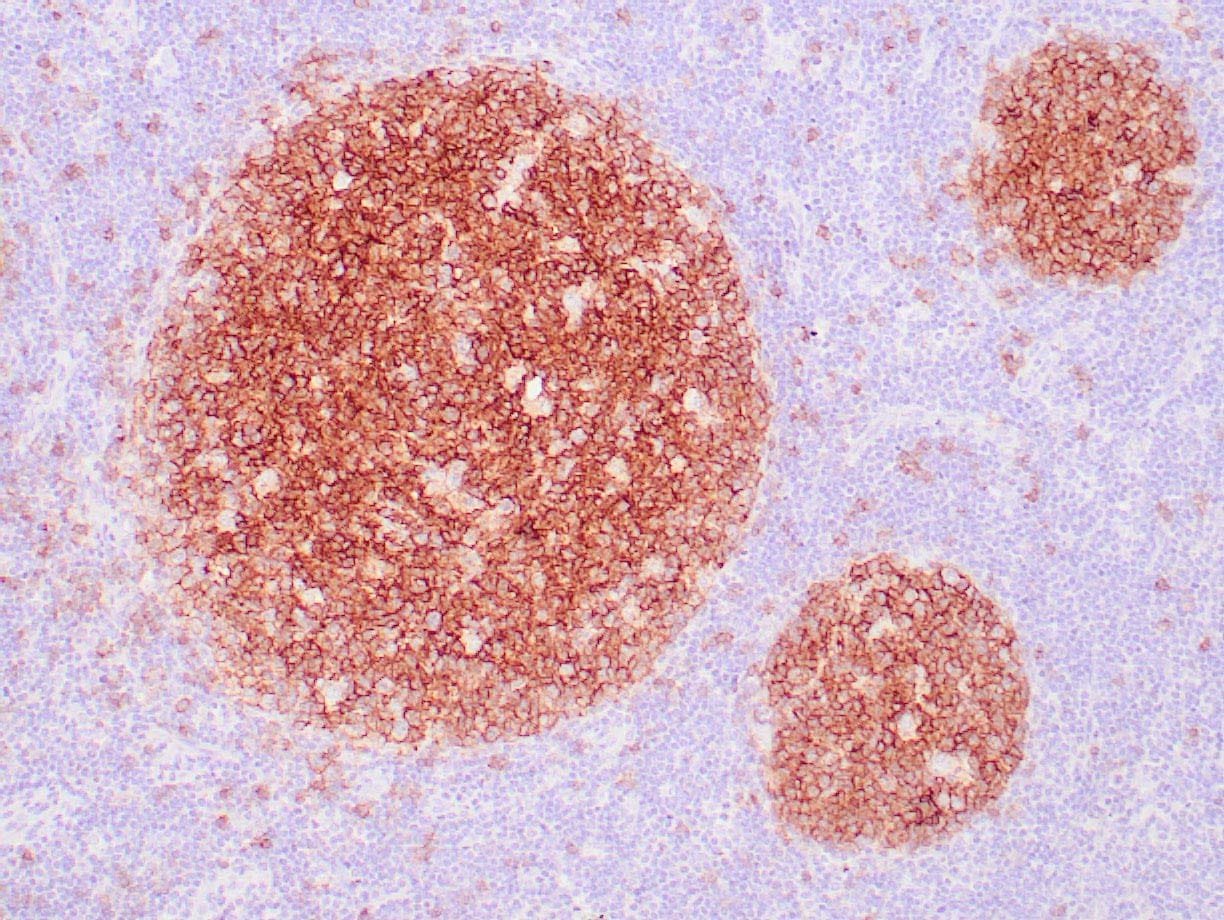 |
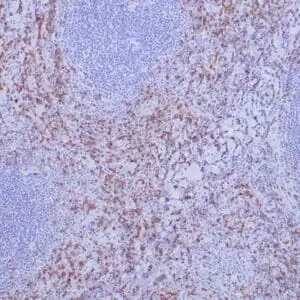
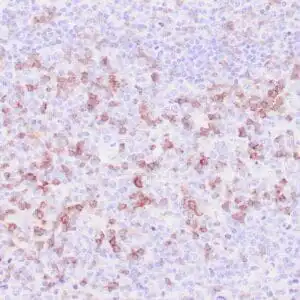
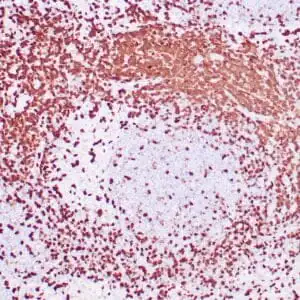
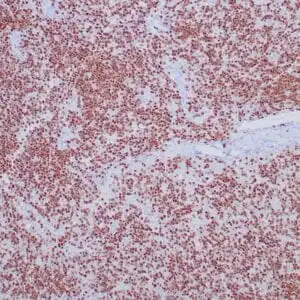
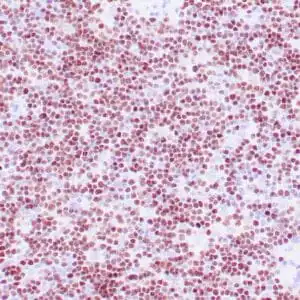
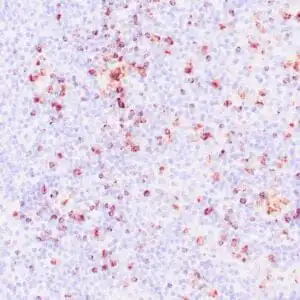
| Human lymph node stained with anti-CD20 antibody using peroxidase-conjugate and DAB chromogen. Note the membrane and cytoplasmic staining of B-cells in mantle and follicle. |
FAQ & Publications
Frequently Asked Questions
What is the recommended dilution range for the concentrated mouse anti-CD20 monoclonal antibody (L26) 6073 when used in immunohistochemistry?
The recommended dilution for the concentrated mouse anti-CD20 monoclonal antibody (L26) 6073 in immunohistochemistry (IHC) applications is between 1:100 and 1:300.
How should the mouse anti-CD20 monoclonal antibody (L26) 6073 be stored to maintain its stability?
For short-term storage, the mouse anti-CD20 monoclonal antibody (L26) 6073 should be kept at 2-8°C. For long-term storage, it is recommended to store the antibody at -20°C and to avoid repeated freeze/thaw cycles to preserve antibody integrity.
Publications
| pmid | title | authors | citation |
|---|---|---|---|
| We haven't added any publications to our database yet. | |||
Published literature highly relevant to the biological target of this product and referencing this antibody or clone are retrieved from the PubMed database provided by the United States National Library of Medicine at the National Institutes of Health.
Protocols
| relevant to this product |
|---|
| IHC |
Documents
| Batch Number | QC File | SDS |
|---|---|---|
| To view batch-specific Safety Datasheets and Quality Certificates associated with your account, please Log In. | ||
Only logged in customers who have purchased this product may leave a review.



Reviews
There are no reviews yet.