| Weight | 1 lbs |
|---|---|
| Dimensions | 9 × 5 × 2 in |
| host | mouse |
| isotype | IgM |
| clonality | monoclonal |
| concentration | concentrate, predilute |
| applications | IHC |
| reactivity | human |
| available size | 0.1 mL, 0.5 mL, 1 mL concentrated, 7 mL prediluted |

mouse anti-CD15 monoclonal antibody (MMA) 6064
Price range: $160.00 through $528.00
Antibody summary
- Mouse monoclonal to CD15
- Suitable for: Immunohistochemistry (formalin-fixed, paraffin-embedded tissues)
- Reacts with: Human
- Isotype:IgM
- Control: Hodgkin lymphoma
- Visualization: Cell membrane and granular perinuclear
- 0.1, 0.5, 1.0 mL concentrated, 7 mL prediluted
mouse anti-CD15 monoclonal antibody MMA 6064
| target relevance |
|---|
| Homo sapiens FUT4 Alpha-(1,3)-fucosyltransferase 4 |
| Protein names Alpha-(1,3)-fucosyltransferase 4 |
| Alternative names 4-galactosyl-N-acetylglucosaminide 3-alpha-L-fucosyltransferase, ELAM-1 ligand fucosyltransferase, Fucosyltransferase 4, Fucosyltransferase IV, Galactoside 3-L-fucosyltransferase |
| Gene names FUT4 |
| Protein family Belongs to the glycosyltransferase 10 family |
| Function Catalyzes alpha(1->3) linkage of fucosyl moiety transferred from GDP-beta-L-fucose to N-acetyl glucosamine (GlcNAc) within type 2 lactosamine (LacNAc, Gal-beta(1->4)GlcNAc) glycan attached to N- or O-linked glycoproteins (PubMed:1702034, PubMed:1716630, PubMed:29593094). Robustly fucosylates nonsialylated distal LacNAc unit of the polylactosamine chain to form Lewis X antigen (CD15), a glycan determinant known to mediate important cellular functions in development and immunity. Fucosylates with lower efficiency sialylated LacNAc acceptors to form sialyl Lewis X and 6-sulfo sialyl Lewis X determinants that serve as recognition epitopes for C-type lectins (PubMed:1716630, PubMed:29593094). Together with FUT7 contributes to SELE, SELL and SELP selectin ligand biosynthesis and selectin-dependent lymphocyte homing, leukocyte migration and blood leukocyte homeostasis (By similarity). In a cell type specific manner, may also fucosylate the internal LacNAc unit of the polylactosamine chain to form VIM-2 antigen that serves as recognition epitope for SELE (PubMed:11278338, PubMed:1716630) |
| Catalytic activity a beta-D-galactosyl-(1->4)-N-acetyl-beta-D-glucosaminyl derivative + GDP-beta-L-fucose = a beta-D-galactosyl-(1->4)-[alpha-L-fucosyl-(1->3)]-N-acetyl-beta-D-glucosaminyl derivative + GDP + H(+) an N-acetyl-alpha-neuraminyl-(2->3)-beta-D-galactosyl-(1->4)-N-acetyl-beta-D-glucosaminyl derivative + GDP-beta-L-fucose = an alpha-Neu5Ac-(2->3)-beta-D-Gal-(1->4)-[alpha-L-Fuc-(1->3)]-beta-D-GlcNAc derivative + GDP + H(+) an alpha-Neu5Ac-(2->3)-beta-D-Gal-(1->4)-beta-D-GlcNAc-(1->3)-beta-D-Gal-(1->4)-beta-D-GlcNAc derivative + GDP-beta-L-fucose = an alpha-Neu5Ac-(2->3)-beta-D-Gal-(1->4)-beta-D-GlcNAc-(1->3)-beta-D-Gal-(1->4)-[alpha-L-Fuc-(1->3)]-beta-D-GlcNAc derivative + GDP + H(+) an alpha-Neu5Ac-(2->3)-beta-D-Gal-(1->4)-beta-D-GlcNAc6S derivative + GDP-beta-L-fucose = an alpha-Neu5Ac-(2->3)-beta-D-Gal-(1->4)-[alpha-L-Fuc-(1->3)]-beta-D-GlcNAc6S derivative + GDP + H(+) |
| Subcellular location Golgi apparatus, Golgi stack membrane |
| Keywords Alternative initiation, Glycoprotein, Glycosyltransferase, Golgi apparatus, Inflammatory response, Membrane, Proteomics identification, Reference proteome, Signal-anchor, Transferase, Transmembrane, Transmembrane helix |
| Sequence MRRLWGAARKPSGAGWEKEWAEAPQEAPGAWSGRLGPGRSGRKGRAVPGWASWPAHLALA ARPARHLGGAGQGPRPLHSGTAPFHSRASGERQRRLEPQLQHESRCRSSTPADAWRAEAA LPVRAMGAPWGSPTAAAGGRRGWRRGRGLPWTVCVLAAAGLTCTALITYACWGQLPPLPW ASPTPSRPVGVLLWWEPFGGRDSAPRPPPDCRLRFNISGCRLLTDRASYGEAQAVLFHHR DLVKGPPDWPPPWGIQAHTAEEVDLRVLDYEEAAAAAEALATSSPRPPGQRWVWMNFESP SHSPGLRSLASNLFNWTLSYRADSDVFVPYGYLYPRSHPGDPPSGLAPPLSRKQGLVAWV VSHWDERQARVRYYHQLSQHVTVDVFGRGGPGQPVPEIGLLHTVARYKFYLAFENSQHLD YITEKLWRNALLAGAVPVVLGPDRANYERFVPRGAFIHVDDFPSASSLASYLLFLDRNPA VYRRYFHWRRSYAVHITSFWDEPWCRVCQAVQRAGDRPKSIRNLASWFER |
| UniProt accession: P22083 |
Data
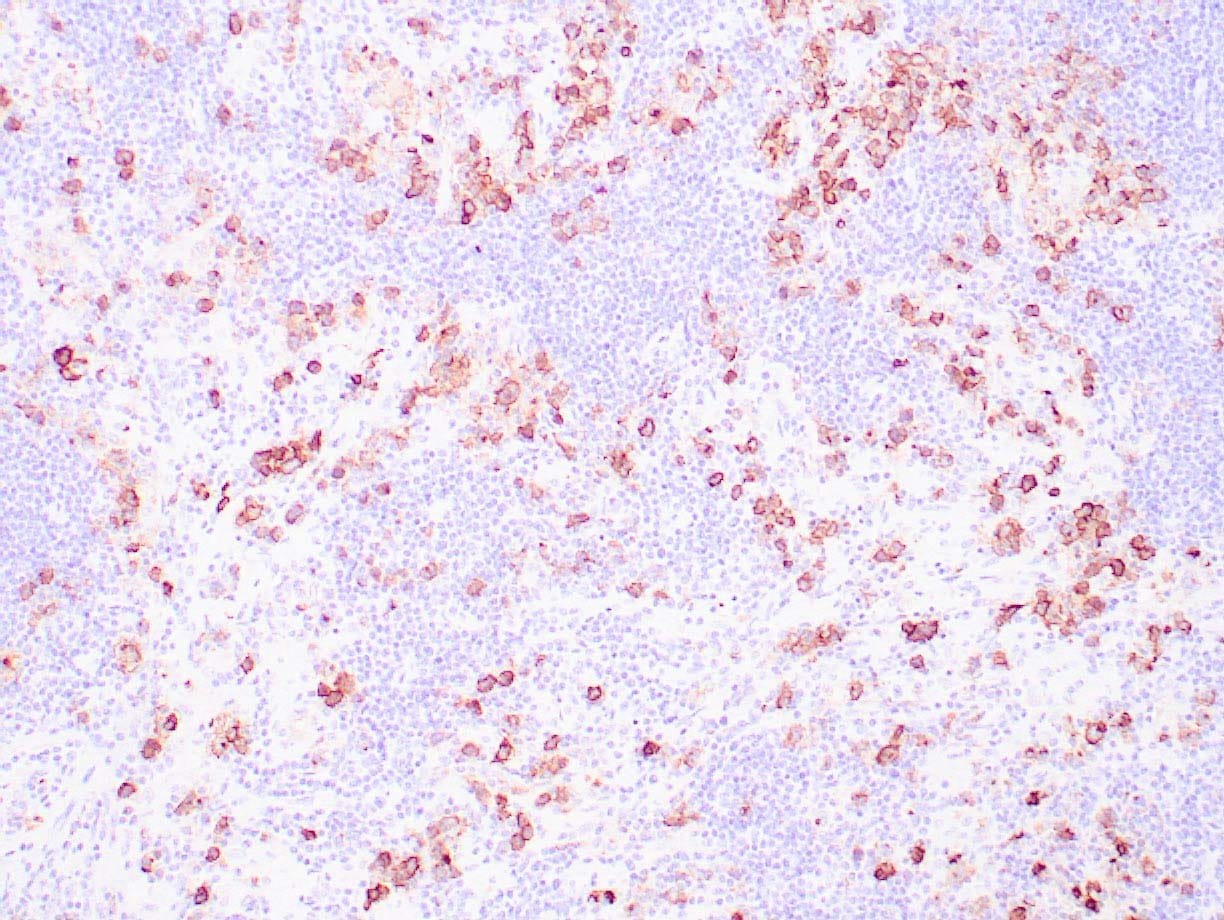 |
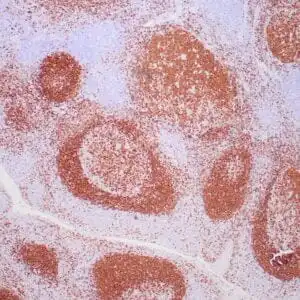
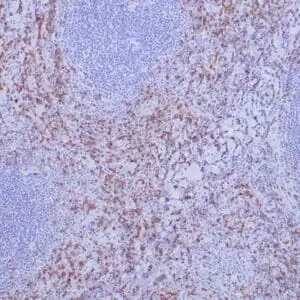
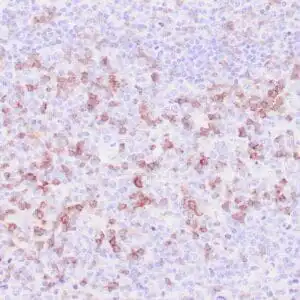
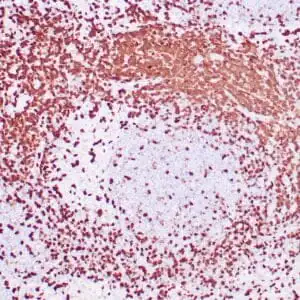
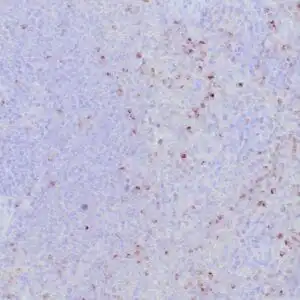
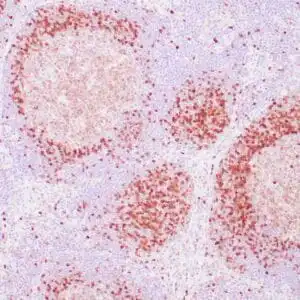
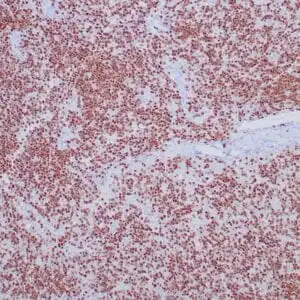
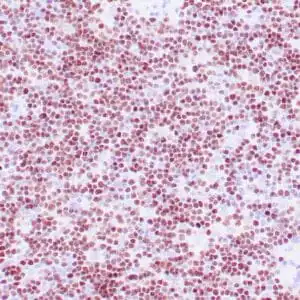
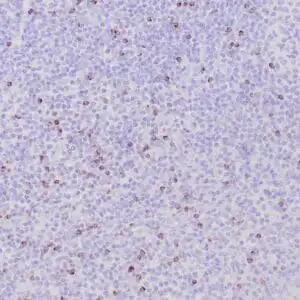
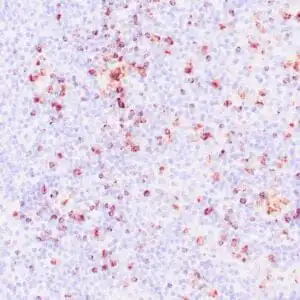
| Human Hodgkin lymphoma stained with anti-CD15 antibody using peroxidase conjugate and DAB chromogen. Note membranous staining of Reed-Sternberg cells. |
FAQ & Publications
Frequently Asked Questions
What species reactivity does the mouse anti-CD15 monoclonal antibody (MMA) 6064 exhibit?
This antibody reacts specifically with human species.
Which applications is the mouse anti-CD15 monoclonal antibody (MMA) 6064 validated for?
It is suitable and tested for Immunohistochemistry (IHC) on formalin-fixed, paraffin-embedded tissues.
How should the mouse anti-CD15 monoclonal antibody (MMA) 6064 be stored to maintain stability?
For short-term storage, keep the antibody at 2-8°C; for long-term storage, it should be kept at -20°C. Avoid repeated freeze-thaw cycles.
What is the recommended dilution range when using the concentrated form of this anti-CD15 antibody for IHC?
The recommended dilution for the concentrated antibody in immunohistochemistry is between 1:100 and 1:200.
What is the immunogen used to generate the mouse anti-CD15 monoclonal antibody (MMA) 6064?
The antibody was raised against a glycoprotein fraction derived from human lymphocytes.
Publications
| pmid | title | authors | citation |
|---|---|---|---|
| We haven't added any publications to our database yet. | |||
Published literature highly relevant to the biological target of this product and referencing this antibody or clone are retrieved from the PubMed database provided by the United States National Library of Medicine at the National Institutes of Health.
Protocols
| relevant to this product |
|---|
| IHC |
Documents
| Batch Number | QC File | SDS |
|---|---|---|
| To view batch-specific Safety Datasheets and Quality Certificates associated with your account, please Log In. | ||
Only logged in customers who have purchased this product may leave a review.


Reviews
There are no reviews yet.