| Weight | 1 lbs |
|---|---|
| Dimensions | 9 × 5 × 2 in |
| host | mouse |
| isotype | IgG1 |
| clonality | monoclonal |
| concentration | concentrate, predilute |
| applications | IHC |
| reactivity | human |
| available size | 0.1 mL, 0.5 mL, 1 mL concentrated, 7 mL prediluted |

mouse anti-BCL-2 monoclonal antibody (124) 6029
Price range: $160.00 through $528.00
Antibody summary
- Mouse monoclonal to BCL-2
- Suitable for: Immunohistochemistry (formalin-fixed, paraffin-embedded tissues)
- Reacts with: Human
- Isotype:IgG1
- Control: Tonsil or lymph node
- Visualization: Cytoplasmic
- 0.1, 0.5, 1.0 mL concentrated, 7 mL prediluted
mouse anti-BCL-2 monoclonal antibody 124 6029
| target relevance |
|---|
| Homo sapiens BCL2 Apoptosis regulator Bcl-2 |
| Protein names Apoptosis regulator Bcl-2 |
| Gene names BCL2 |
| Protein family Belongs to the Bcl-2 family |
| Function Suppresses apoptosis in a variety of cell systems including factor-dependent lymphohematopoietic and neural cells (PubMed:1508712, PubMed:8183370). Regulates cell death by controlling the mitochondrial membrane permeability (PubMed:11368354). Appears to function in a feedback loop system with caspases (PubMed:11368354). Inhibits caspase activity either by preventing the release of cytochrome c from the mitochondria and/or by binding to the apoptosis-activating factor (APAF-1) (PubMed:11368354). Also acts as an inhibitor of autophagy: interacts with BECN1 and AMBRA1 during non-starvation conditions and inhibits their autophagy function (PubMed:18570871, PubMed:20889974, PubMed:21358617). May attenuate inflammation by impairing NLRP1-inflammasome activation, hence CASP1 activation and IL1B release (PubMed:17418785) |
| Subcellular location Mitochondrion outer membrane, Nucleus membrane, Endoplasmic reticulum membrane, Cytoplasm |
| Structure (Microbial infection) Interacts with Toxoplasma gondii ROP17; the interaction probably promotes BCL2 phosphorylation and degradation |
| Post-translational modification Phosphorylation/dephosphorylation on Ser-70 regulates anti-apoptotic activity (PubMed:11368354). Growth factor-stimulated phosphorylation on Ser-70 by PKC is required for the anti-apoptosis activity and occurs during the G2/M phase of the cell cycle (PubMed:11368354). In the absence of growth factors, BCL2 appears to be phosphorylated by other protein kinases such as ERKs and stress-activated kinases (PubMed:11368354). Phosphorylated by MAPK8/JNK1 at Thr-69, Ser-70 and Ser-87, which stimulates starvation-induced autophagy (PubMed:10567572, PubMed:18570871). Dephosphorylated by protein phosphatase 2A (PP2A) (By similarity) Proteolytically cleaved by caspases during apoptosis. The cleaved protein, lacking the BH4 motif, has pro-apoptotic activity, causes the release of cytochrome c into the cytosol promoting further caspase activity Monoubiquitinated by PRKN, leading to an increase in its stability (PubMed:20889974). Ubiquitinated by SCF(FBXO10), leading to its degradation by the proteasome (PubMed:23431138). Ubiquitinated by XIAP, leading to its degradation by the proteasome (PubMed:29020630) |
| Keywords 3D-structure, Alternative splicing, Apoptosis, Autophagy, Chromosomal rearrangement, Cytoplasm, Disease variant, Endoplasmic reticulum, Membrane, Mitochondrion, Mitochondrion outer membrane, Nucleus, Phosphoprotein, Proteomics identification, Proto-oncogene, Reference proteome, Transmembrane, Transmembrane helix, Ubl conjugation |
| Sequence MAHAGRTGYDNREIVMKYIHYKLSQRGYEWDAGDVGAAPPGAAPAPGIFSSQPGHTPHPA ASRDPVARTSPLQTPAAPGAAAGPALSPVPPVVHLTLRQAGDDFSRRYRRDFAEMSSQLH LTPFTARGRFATVVEELFRDGVNWGRIVAFFEFGGVMCVESVNREMSPLVDNIALWMTEY LNRHLHTWIQDNGGWDAFVELYGPSMRPLFDFSWLSLKTLLSLALVGACITLGAYLGHK |
| UniProt accession: P10415 |
Data
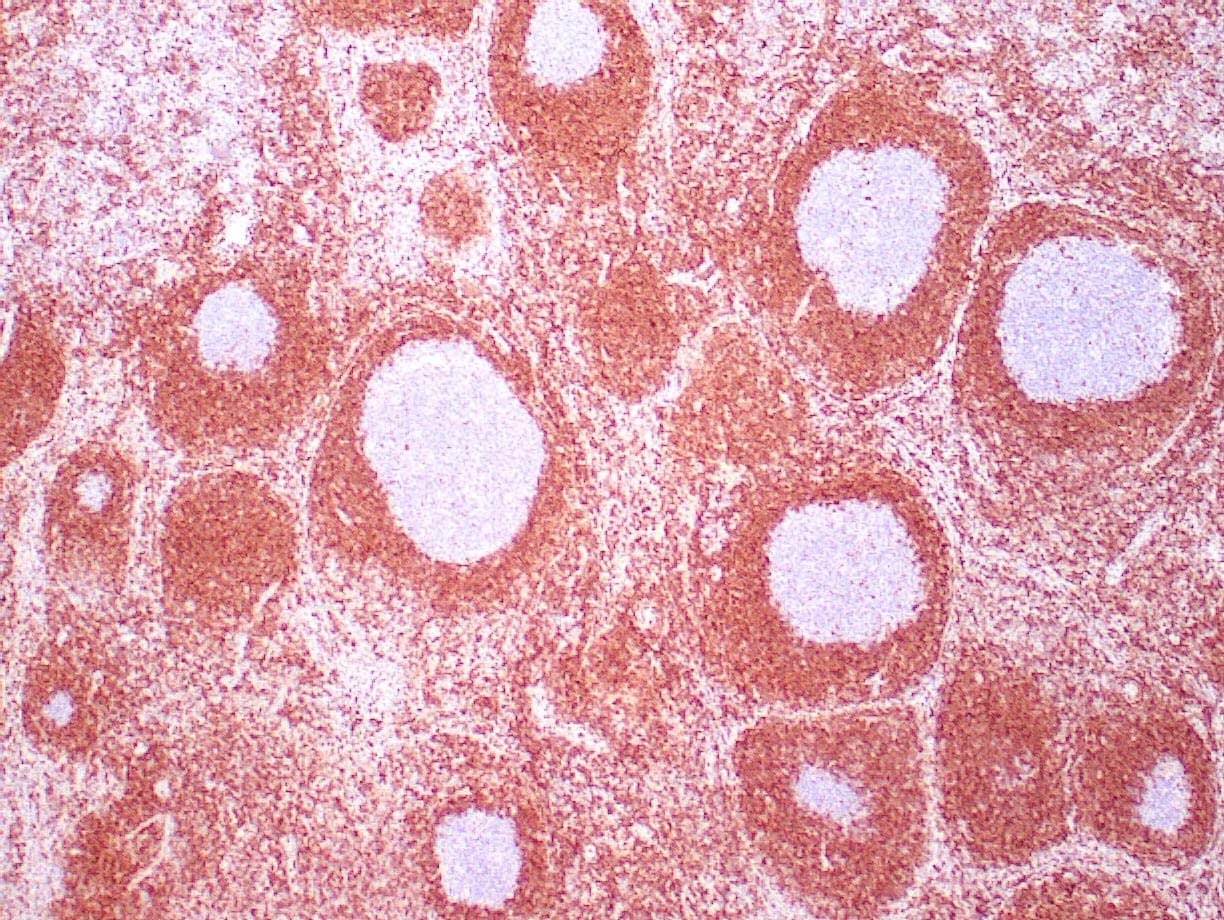 |
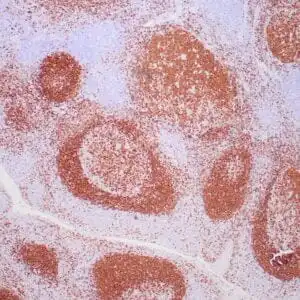
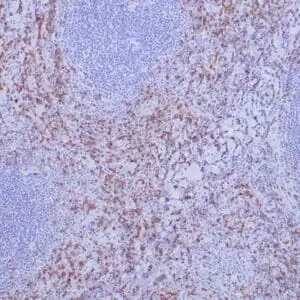
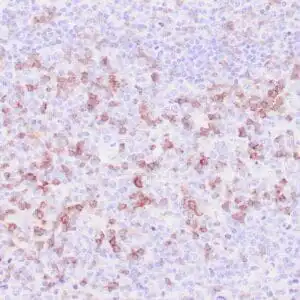
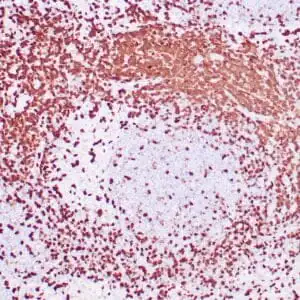
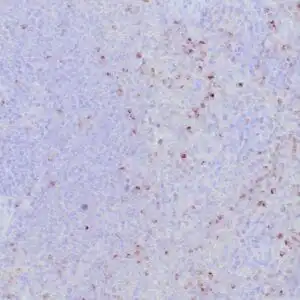
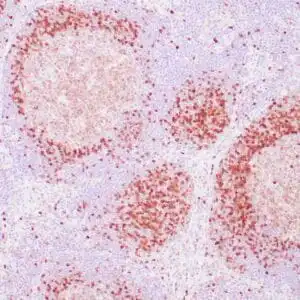
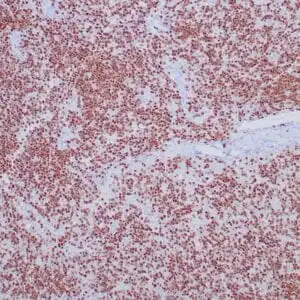
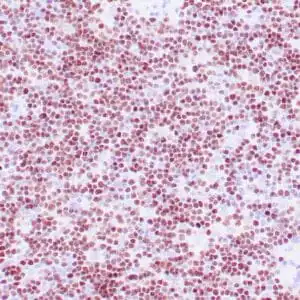
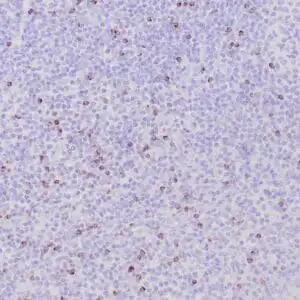
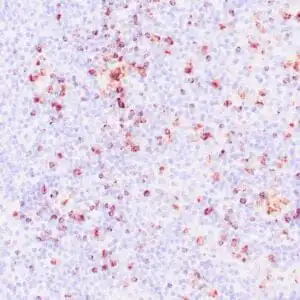
| Human reactive lymph node stained with anti-BCL-2 antibody using peroxidase-conjugate and DAB chromogen. Note cytoplasmic and membrane staining of mantle B-cells and perifollicular T-cells, and no staining of reactive B-cells in the germinal centers. |
FAQ & Publications
Frequently Asked Questions
For which species is the mouse anti-BCL-2 monoclonal antibody (124) 6029 reactive?
This antibody is reactive with human tissues.
What applications is this anti-BCL-2 monoclonal antibody validated for?
It is suitable for immunohistochemistry (IHC) on formalin-fixed, paraffin-embedded tissues.
How should the mouse anti-BCL-2 antibody be stored to maintain stability?
Store the antibody at 2-8°C for short-term use, and for longer-term storage, keep it at -20°C while avoiding freeze/thaw cycles.
What are the available sizes and concentrations for this BCL-2 antibody?
The antibody is available as concentrated formats in 0.1 mL, 0.5 mL, and 1.0 mL volumes, as well as a 7 mL prediluted format.
What is the recommended dilution range for using the concentrated mouse anti-BCL-2 monoclonal antibody in IHC?
The recommended dilution for the concentrated antibody is between 1:100 and 1:200.
Publications
| pmid | title | authors | citation |
|---|---|---|---|
| We haven't added any publications to our database yet. | |||
Published literature highly relevant to the biological target of this product and referencing this antibody or clone are retrieved from the PubMed database provided by the United States National Library of Medicine at the National Institutes of Health.
Protocols
| relevant to this product |
|---|
| IHC |
Documents
| Batch Number | QC File | SDS |
|---|---|---|
| To view batch-specific Safety Datasheets and Quality Certificates associated with your account, please Log In. | ||
Only logged in customers who have purchased this product may leave a review.


Reviews
There are no reviews yet.