| Weight | 1 lbs |
|---|---|
| Dimensions | 9 × 5 × 2 in |
| target | GBS |
| species reactivity | Real Time PCR for direct detection of Streptococcus agalactiae (Group B Streptococcus (GBS) |
| applications | RT PCR |
| assay type | direct & qualitative |
| available sizes | 96 tests |

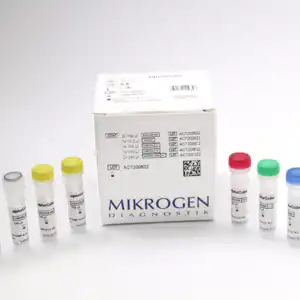
GBS RT-PCR test Mikrogen 830547
$487.00
Summary
- Mikrogen diagnostik RT PCR kit for research use (RUO)
- Direct Streptococcus group B (S. agalactiae) detection
- High sensitivity and specificity
- Internal control for monitoring nucleic acid extraction
(RNA/DNA) and real-time PCR inhibition in each reaction - Compatible with most common real-time PCR cyclers & RNA/DNA extraction methods
- 96 tests
GBS RT-PCR test Mikrogen 830547
| kit | |||||||||||||||
|---|---|---|---|---|---|---|---|---|---|---|---|---|---|---|---|
| Assay type RT PCR | |||||||||||||||
| Research area Infectious Disease | |||||||||||||||
| Sample type whole blood, serum, plasma, urine, tissue, stool, etc., food and environmental samples or from the carrier material | |||||||||||||||
Notes
| |||||||||||||||
Components
| |||||||||||||||
| Storage Store at -20°C. | |||||||||||||||
| Additional information Highly sensitive and specific direct detection of pathogens that can cause tick-borne infections
Applicable to human starting material as well as RNA/DNA from the tick |
| target relevance |
|---|
| Streptococcus |
| Description Bacterial genus that causes streptococcal infections including strep throat, pneumonia, sepsis, and invasive disease |
| Structure Streptococcus is a genus of Gram-positive, spherical bacteria belonging to the family Streptococcaceae. These organisms typically occur in pairs or chains and are facultative anaerobes capable of colonizing a wide variety of human and animal tissues. Numerous species within the genus are medically important, including Streptococcus pyogenes (Group A Streptococcus), Streptococcus agalactiae (Group B Streptococcus), Streptococcus pneumoniae, and members of the viridans streptococci group. Streptococci possess a variety of virulence factors including capsules, adhesins, hemolysins, and exotoxins that facilitate colonization, immune evasion, and tissue invasion. Depending on the species, streptococci may exist as harmless commensals or cause diseases ranging from mild localized infections to severe invasive systemic illness. |
| Diagnosis The diagnosis of Streptococcus infection is performed through microbiological, molecular, antigen detection, and serological methods. Culture of clinical specimens on blood agar remains a fundamental diagnostic approach and allows identification based on hemolytic patterns, biochemical characteristics, and species-specific testing. Rapid antigen detection tests are widely used for the diagnosis of Group A Streptococcus pharyngitis. Molecular methods such as polymerase chain reaction (PCR) provide highly sensitive and specific detection of streptococcal DNA from respiratory, blood, cerebrospinal fluid, and tissue specimens. Serological assays measuring antibodies against streptococcal antigens, including antistreptolysin O (ASO) and anti-DNase B, may be useful in the diagnosis of post-streptococcal complications such as rheumatic fever and glomerulonephritis. |
| Symptoms Clinical manifestations of Streptococcus infections vary widely depending on the infecting species and site of infection. Streptococcus pyogenes commonly causes pharyngitis (strep throat), tonsillitis, impetigo, cellulitis, scarlet fever, and necrotizing fasciitis. Streptococcus pneumoniae is a major cause of pneumonia, sinusitis, otitis media, bacteremia, and meningitis. Streptococcus agalactiae is an important cause of neonatal sepsis, pneumonia, and meningitis. Common symptoms associated with streptococcal infections include fever, sore throat, swollen lymph nodes, cough, skin inflammation, pain, and fatigue. Invasive disease may result in sepsis, toxic shock syndrome, organ failure, or death. Certain infections may also lead to immune-mediated complications such as acute rheumatic fever and post-streptococcal glomerulonephritis. |
Data
| No results found |
FAQ & Publications
Frequently Asked Questions
What sample types are compatible with the GBS RT-PCR test Mikrogen 830547?
The GBS RT-PCR test Mikrogen 830547 is compatible with a variety of sample types including whole blood, serum, plasma, urine, tissue, stool, food and environmental samples, as well as carrier material.
Which real-time PCR cyclers have been validated for use with this GBS RT-PCR test kit?
This kit has been validated for use with several real-time PCR cyclers including the Roche LightCycler 480 Instrument II, Roche cobas z 480 Analyzer, Qiagen Rotor-Gene Q, Bio-Rad CFX 96, Applied Biosystems QuantStudio 5 Dx, and Stratagene Mx3000P.
How should the GBS RT-PCR test Mikrogen 830547 be stored to maintain reagent stability?
The GBS RT-PCR test Mikrogen 830547 should be stored at -20°C to ensure reagent stability and optimal performance.
Publications
| pmid | title | authors | citation |
|---|---|---|---|
| We haven't added any publications to our database yet. | |||
Published literature highly relevant to the biological target of this product and referencing this antibody or clone are retrieved from the PubMed database provided by the United States National Library of Medicine at the National Institutes of Health.
Protocols
| relevant to this product |
|---|
| This product has moved to a digital protocol. Please use the URL provided on the product packaging to access the electronic Instructions for Use (eIFU). 830547 protocol |
Documents
| # | ||
|---|---|---|
| Please enter your product and batch number here. | ||
Only logged in customers who have purchased this product may leave a review.
Reviews
There are no reviews yet.