| Weight | 1 lbs |
|---|---|
| Dimensions | 9 × 5 × 2 in |
| host | mouse |
| isotype | IgG2a |
| clonality | monoclonal |
| concentration | concentrate, predilute |
| applications | IHC |
| reactivity | human |
| available size | 0.1 mL, 0.5 mL, 1 mL concentrated, 7 mL prediluted |

mouse anti-NKX3.1 monoclonal antibody (ZM95) 6291
Price range: $160.00 through $528.00
Antibody summary
- Mouse monoclonal to NKX3.1
- Suitable for: Immunohistochemistry (formalin-fixed, paraffin-embedded tissues)
- Reacts with: Human
- Isotype:IgG2a
- Control: Prostate
- Visualization: Nuclear
- 0.1, 0.5, 1.0 mL concentrated, 7 mL prediluted
mouse anti-NKX3.1 monoclonal antibody ZM95 6291
| target relevance |
|---|
| Homo sapiens NKX3-1 Homeobox protein Nkx-3.1 |
| Protein names Homeobox protein Nkx-3.1 |
| Alternative names Homeobox protein NK-3 homolog A |
| Gene names NKX3-1 |
| Protein family Belongs to the NK-3 homeobox family |
| Function Transcription factor, which binds preferentially the consensus sequence 5'-TAAGT[AG]-3' and can behave as a transcriptional repressor. Plays an important role in normal prostate development, regulating proliferation of glandular epithelium and in the formation of ducts in prostate. Acts as a tumor suppressor controlling prostate carcinogenesis, as shown by the ability to inhibit proliferation and invasion activities of PC-3 prostate cancer cells |
| Subcellular location Nucleus |
| Structure Interacts with serum response factor (SRF) (By similarity). Interacts with SPDEF (PubMed:11809674). Interacts with WDR77 (PubMed:12972618). Interacts with TOPORS which polyubiquitinates NKX3-1 and induces its proteasomal degradation (PubMed:18077445). Interacts with FEM1B (By similarity) |
| Post-translational modification Ubiquitinated by TOPORS; monoubiquitinated at several residues and also polyubiquitinated on single residues |
| Keywords 3D-structure, Alternative splicing, DNA-binding, Homeobox, Nucleus, Proteomics identification, Reference proteome, Repressor, Transcription, Transcription regulation, Tumor suppressor, Ubl conjugation |
| Sequence MLRVPEPRPGEAKAEGAAPPTPSKPLTSFLIQDILRDGAQRQGGRTSSQRQRDPEPEPEP EPEGGRSRAGAQNDQLSTGPRAAPEEAETLAETEPERHLGSYLLDSENTSGALPRLPQTP KQPQKRSRAAFSHTQVIELERKFSHQKYLSAPERAHLAKNLKLTETQVKIWFQNRRYKTK RKQLSSELGDLEKHSSLPALKEEAFSRASLVSVYNSYPYYPYLYCVGSWSPAFW |
| UniProt accession: Q99801 |
Data
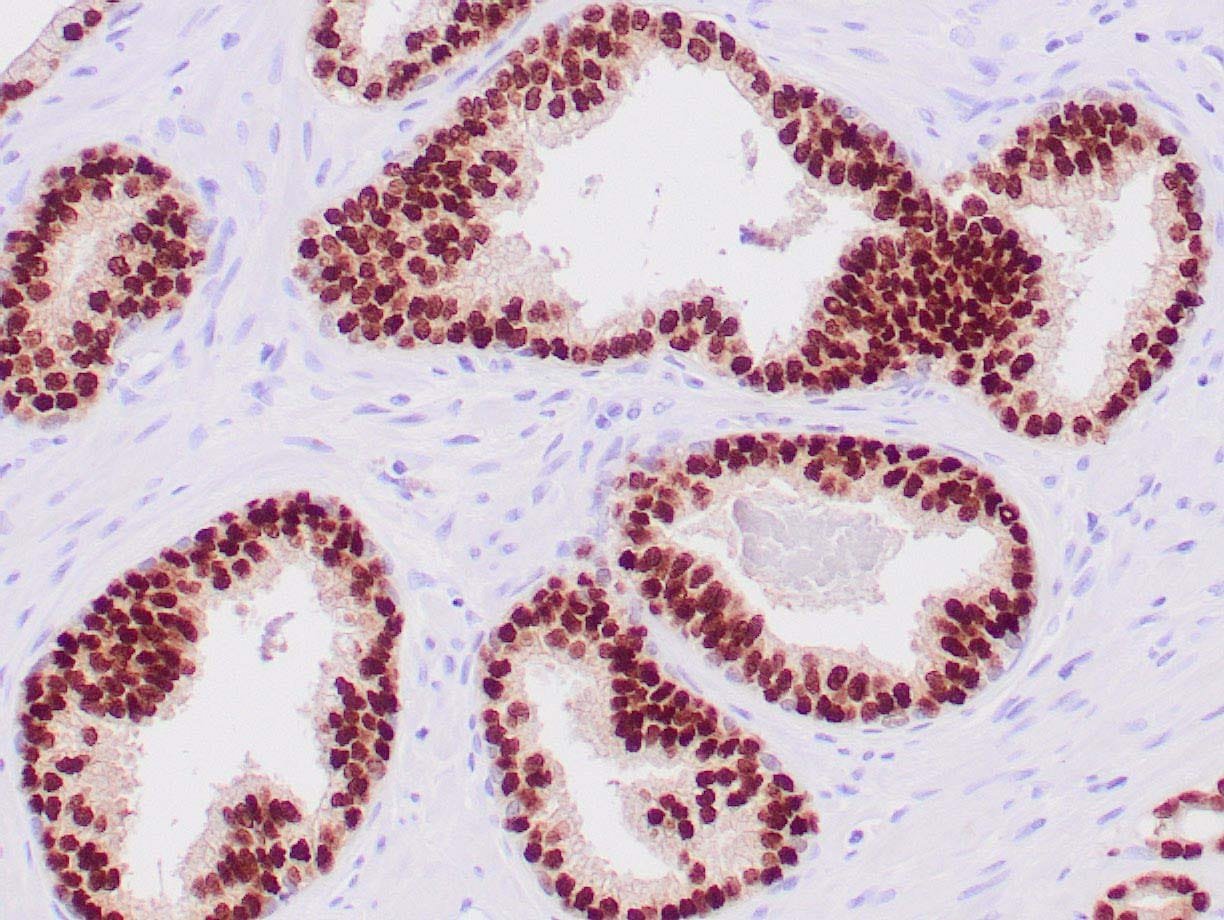 |
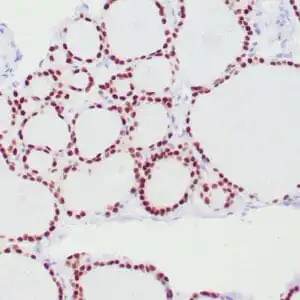
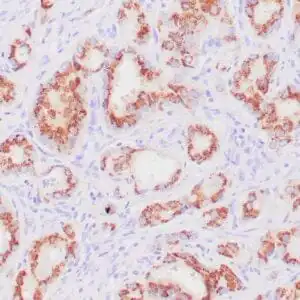
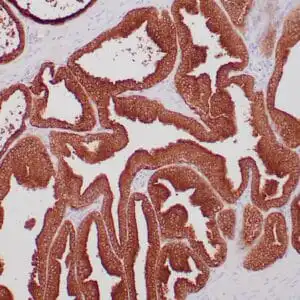
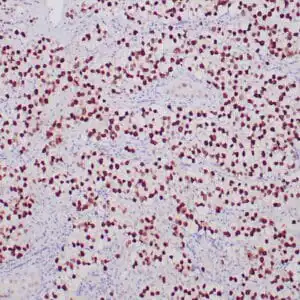
| Human prostate stained with anti-NKX3.1 antibody using peroxidase-conjugate and DAB chromogen. Note nuclear staining of glandular cells. |
FAQ & Publications
Frequently Asked Questions
What applications is the mouse anti-NKX3.1 monoclonal antibody (ZM95) recommended for?
This antibody is suitable for immunohistochemistry (IHC) on formalin-fixed, paraffin-embedded human tissue samples.
What are the storage conditions for the mouse anti-NKX3.1 monoclonal antibody?
For short-term storage, keep the antibody at 2-8°C. For long-term storage, it should be kept at -20°C, and freeze/thaw cycles should be avoided to maintain antibody integrity.
Which species does the mouse anti-NKX3.1 antibody specifically react with?
The antibody reacts specifically with human NKX3.1 protein.
What immunogen was used to generate the mouse anti-NKX3.1 monoclonal antibody (ZM95)?
The immunogen is a recombinant fragment of the human NKX3.1 protein, approximately amino acids 92 to 224.
Publications
| pmid | title | authors | citation |
|---|---|---|---|
| We haven't added any publications to our database yet. | |||
Published literature highly relevant to the biological target of this product and referencing this antibody or clone are retrieved from the PubMed database provided by the United States National Library of Medicine at the National Institutes of Health.
Protocols
| relevant to this product |
|---|
| IHC |
Documents
| Batch Number | QC File | SDS |
|---|---|---|
| To view batch-specific Safety Datasheets and Quality Certificates associated with your account, please Log In. | ||
Only logged in customers who have purchased this product may leave a review.
Reviews
There are no reviews yet.