| Weight | 1 lbs |
|---|---|
| Dimensions | 9 × 5 × 2 in |
| host | mouse |
| isotype | IgG |
| clonality | monoclonal |
| concentration | concentrate, predilute |
| applications | IHC |
| reactivity | human |
| available size | 0.1 mL, 0.5 mL, 1 mL concentrated, 7 mL prediluted |

rabbit anti-VEGF monoclonal antibody (ZR389) 6401
Price range: $160.00 through $528.00
Antibody summary
- Rabbit monoclonal to VEGF
- Suitable for: Immunohistochemistry (formalin-fixed, paraffin-embedded tissues)
- Reacts with: Human
- Isotype:IgG
- Control: Tumor cells in astrocytomas, breast or ovarian carcinomas
- Visualization: Cytoplasm, cell surface
- 0.1, 0.5, 1.0 mL concentrated, 7 mL prediluted
rabbit anti-VEGF monoclonal antibody ZR389 6401
| antibody |
|---|
| Database link: human P15692 |
| Tested applications IHC |
| Recommended dilutions Concentrated 1:100-200 |
| Application Notes Positive control: Tumor cells in astrocytomas, breast or ovarian carcinomas |
| Immunogen Recombinant fragment (around aa1-200) of human VEGFA protein (exact sequence is proprietary) |
| Size and concentration 7 mL prediluted or 0.1, 0.5, 1.0 mL and concentrated |
| Form liquid |
| Storage Instructions 2-8°C for short term, for longer term at -20°C. Avoid freeze / thaw cycles. |
| Purity affinity purified |
| Clonality monoclonal |
| Isotype IgG |
| Compatible secondaries goat anti-rabbit IgG, H&L chain specific, peroxidase conjugated, conjugated polyclonal antibody 9512 goat anti-rabbit IgG, H&L chain specific, biotin conjugated polyclonal antibody 2079 goat anti-rabbit IgG, H&L chain specific, FITC conjugated polyclonal antibody 7863 goat anti-rabbit IgG, H&L chain specific, Cross Absorbed polyclonal antibody 2371 goat anti-rabbit IgG, H&L chain specific, biotin conjugated polyclonal antibody, crossabsorbed 1715 goat anti-rabbit IgG, H&L chain specific, FITC conjugated polyclonal antibody, crossabsorbed 1720 |
| Isotype control Rabbit polyclonal - Isotype Control |
| target relevance |
|---|
| Homo sapiens VEGFA Vascular endothelial growth factor A, long form |
| Protein names Vascular endothelial growth factor A, long form |
| Alternative names Vascular permeability factor |
| Gene names VEGFA |
| Protein family Belongs to the PDGF/VEGF growth factor family |
| Function Participates in the induction of key genes involved in the response to hypoxia and in the induction of angiogenesis such as HIF1A (PubMed:35455969). Involved in protecting cells from hypoxia-mediated cell death (By similarity) |
| Subcellular location Secreted |
| Structure Homodimer; disulfide-linked (By similarity). Also found as heterodimer with PGF (By similarity). Interacts with NRP1 (PubMed:26503042). Interacts with isoform 2 of BSG (PubMed:25825981). Interacts with CD82; this interaction inhibits VEGFA-mediated signaling pathway (PubMed:34530889) |
| Post-translational modification Produced by use of an alternative upstream CUG codon and post-translationally processed into the N-terminal N-VEGF form and the C-terminal secreted VEGFA form |
| Involvement in disease Microvascular complications of diabetes 1 Pathological conditions that develop in numerous tissues and organs as a consequence of diabetes mellitus. They include diabetic retinopathy, diabetic nephropathy leading to end-stage renal disease, and diabetic neuropathy. Diabetic retinopathy remains the major cause of new-onset blindness among diabetic adults. It is characterized by vascular permeability and increased tissue ischemia and angiogenesis. |
| Keywords 3D-structure, Alternative initiation, Alternative promoter usage, Alternative splicing, Angiogenesis, Cytoplasm, Developmental protein, Differentiation, Direct protein sequencing, Disulfide bond, Endoplasmic reticulum, Extracellular matrix, Glycoprotein, Golgi apparatus, Growth factor, Heparin-binding, Mitogen, Nucleus, Proteomics identification, Reference proteome, Secreted |
| Sequence MTDRQTDTAPSPSYHLLPGRRRTVDAAASRGQGPEPAPGGGVEGVGARGVALKLFVQLLG CSRFGGAVVRAGEAEPSGAARSASSGREEPQPEEGEEEEEKEEERGPQWRLGARKPGSWT GEAAVCADSAPAARAPQALARASGRGGRVARRGAEESGPPHSPSRRGSASRAGPGRASET MNFLLSWVHWSLALLLYLHHAKWSQAAPMAEGGGQNHHEVVKFMDVYQRSYCHPIETLVD IFQEYPDEIEYIFKPSCVPLMRCGGCCNDEGLECVPTEESNITMQIMRIKPHQGQHIGEM SFLQHNKCECRPKKDRARQEKKSVRGKGKGQKRKRKKSRYKSWSVPCGPCSERRKHLFVQ DPQTCKCSCKNTDSRCKARQLELNERTCRCDKPRR |
| UniProt accession: P15692 |
Data
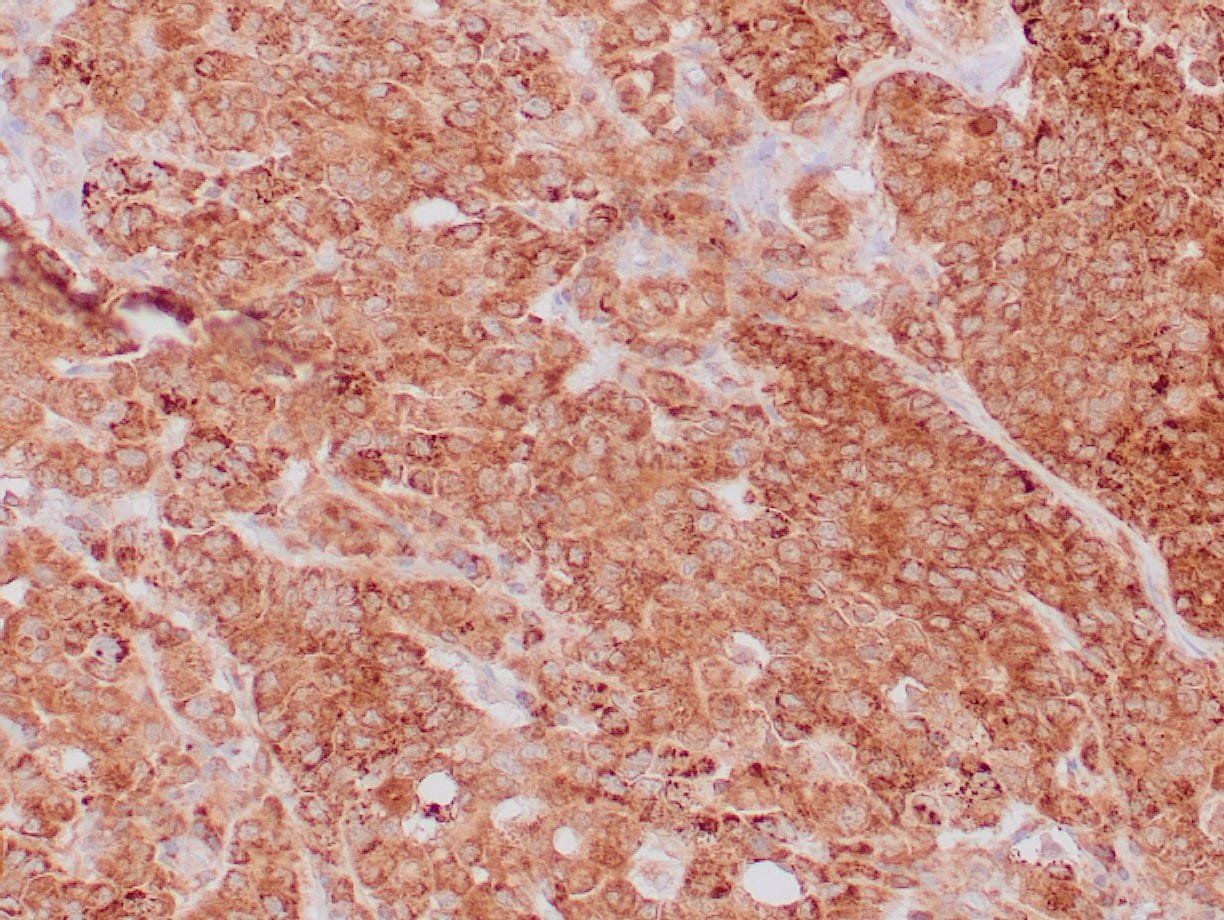 |
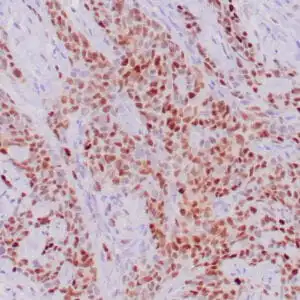
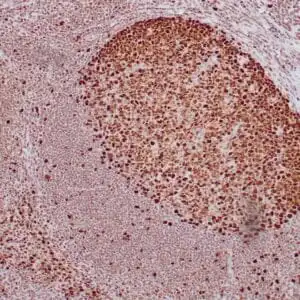
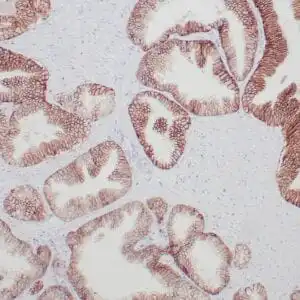
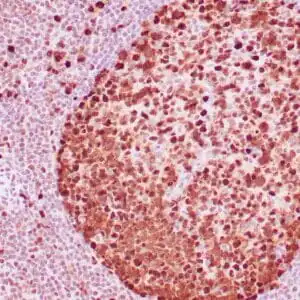
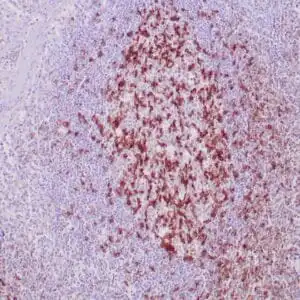
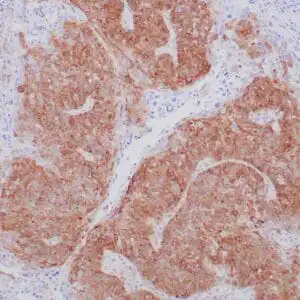
| Formalin-fixed, paraffin-embedded human breast carcinoma stained with anti-VEGF antibody using peroxidase-conjugate and DAB chromogen. Note the cell surface and cytoplasmic staining of tumor cells |
FAQ & Publications
Frequently Asked Questions
What species reactivity does the rabbit anti-VEGF monoclonal antibody (ZR389) exhibit?
The rabbit anti-VEGF monoclonal antibody (ZR389) is reactive with human VEGF protein.
How should the rabbit anti-VEGF monoclonal antibody (ZR389) be stored to maintain its stability?
For short-term storage, keep the antibody at 2-8°C. For long-term storage, it should be stored at -20°C, and freeze/thaw cycles should be avoided to preserve antibody integrity.
Publications
| pmid | title | authors | citation |
|---|---|---|---|
| We haven't added any publications to our database yet. | |||
Published literature highly relevant to the biological target of this product and referencing this antibody or clone are retrieved from the PubMed database provided by the United States National Library of Medicine at the National Institutes of Health.
Protocols
| relevant to this product |
|---|
| IHC |
Documents
| Batch Number | QC File | SDS |
|---|---|---|
| To view batch-specific Safety Datasheets and Quality Certificates associated with your account, please Log In. | ||
Only logged in customers who have purchased this product may leave a review.
Reviews
There are no reviews yet.