| Weight | 1 lbs |
|---|---|
| Dimensions | 9 × 5 × 2 in |
| host | mouse |
| isotype | IgG |
| clonality | monoclonal |
| concentration | concentrate, predilute |
| applications | IHC |
| reactivity | human |
| available size | 0.1 mL, 0.5 mL, 1 mL concentrated, 7 mL prediluted |

rabbit anti-PCNA monoclonal antibody (ZR378) 6324
Price range: $160.00 through $528.00
Antibody summary
- Rabbit monoclonal to PCNA
- Suitable for: Immunohistochemistry (formalin-fixed, paraffin-embedded tissues)
- Reacts with: Human
- Isotype:IgG
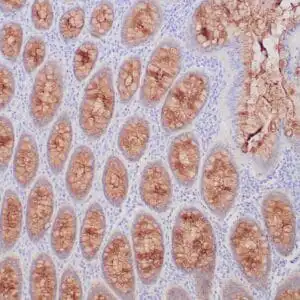
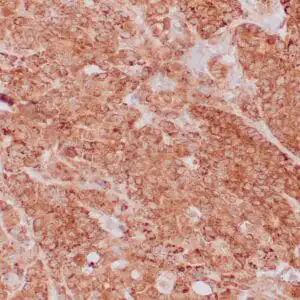
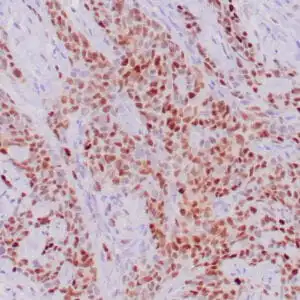
- Control: Tonsil, lymph node or small intestine
- Visualization: Nucleus, cytoplasm
- 0.1, 0.5, 1.0 mL concentrated, 7 mL prediluted
rabbit anti-PCNA monoclonal antibody ZR378 6324
| target relevance |
|---|
| Homo sapiens PCNA DNA sliding clamp PCNA |
| Protein names DNA sliding clamp PCNA |
| Alternative names Cyclin, Proliferating cell nuclear antigen |
| Gene names PCNA |
| Protein family Belongs to the PCNA family |
| Function Confers DNA tethering and processivity to DNA polymerases and other proteins (PubMed:24695737, PubMed:24939902, PubMed:35585232). Auxiliary protein of DNA polymerase delta and epsilon, is involved in the control of DNA replication by increasing the polymerases' processivity during elongation of the leading strand (PubMed:35585232). Induces a robust stimulatory effect on the 3'-5' exonuclease and 3'-phosphodiesterase, but not apurinic-apyrimidinic (AP) endonuclease, APEX2 activities. Has to be loaded onto DNA in order to be able to stimulate APEX2. Plays a key role in DNA damage response (DDR) by being conveniently positioned at the replication fork to coordinate DNA replication with DNA repair and DNA damage tolerance pathways (PubMed:24939902). Acts as a loading platform to recruit DDR proteins that allow completion of DNA replication after DNA damage and promote postreplication repair: monoubiquitinated PCNA leads to recruitment of translesion (TLS) polymerases, while 'Lys-63'-linked polyubiquitination of PCNA is involved in error-free pathway and employs recombination mechanisms to synthesize across the lesion (PubMed:24695737) |
| Subcellular location Nucleus |
| Structure (Microbial infection) Interacts with herpes virus 8 protein LANA1 |
| Post-translational modification Phosphorylated. Phosphorylation at Tyr-211 by EGFR stabilizes chromatin-associated PCNA Acetylated by CREBBP and p300/EP300; preferentially acetylated by CREBBP on Lys-80, Lys-13 and Lys-14 and on Lys-77 by p300/EP300 upon loading on chromatin in response to UV irradiation (PubMed:19419956, PubMed:24939902). Lysine acetylation disrupts association with chromatin, hence promoting PCNA ubiquitination and proteasomal degradation in response to UV damage in a CREBBP- and EP300-dependent manner (PubMed:24939902). Acetylation disrupts interaction with NUDT15 and promotes degradation (PubMed:19419956) Ubiquitinated (PubMed:20227374, PubMed:24939902). Following DNA damage, can be either monoubiquitinated to stimulate direct bypass of DNA lesions by specialized DNA polymerases or polyubiquitinated to promote recombination-dependent DNA synthesis across DNA lesions by template switching mechanisms. Following induction of replication stress, monoubiquitinated by the UBE2B-RAD18 complex on Lys-164, leading to recruit translesion (TLS) polymerases, which are able to synthesize across DNA lesions in a potentially error-prone manner. An error-free pathway also exists and requires non-canonical polyubiquitination on Lys-164 through 'Lys-63' linkage of ubiquitin moieties by the E2 complex UBE2N-UBE2V2 and the E3 ligases, HLTF, RNF8 and SHPRH. This error-free pathway, also known as template switching, employs recombination mechanisms to synthesize across the lesion, using as a template the undamaged, newly synthesized strand of the sister chromatid. Monoubiquitination at Lys-164 also takes place in undamaged proliferating cells, and is mediated by the DCX(DTL) complex, leading to enhance PCNA-dependent translesion DNA synthesis. Sumoylated during S phase Methylated on glutamate residues by DCPH1/C6orf211 |
| Involvement in disease Ataxia-telangiectasia-like disorder 2 A neurodegenerative disorder due to defects in DNA excision repair. ATLD2 is characterized by developmental delay, ataxia, sensorineural hearing loss, short stature, cutaneous and ocular telangiectasia, and photosensitivity. |
| Keywords 3D-structure, Acetylation, Deafness, Direct protein sequencing, Disease variant, Disulfide bond, DNA damage, DNA repair, DNA replication, DNA-binding, Dwarfism, Host-virus interaction, Isopeptide bond, Methylation, Neurodegeneration, Nucleus, Phosphoprotein, Proteomics identification, Reference proteome, Ubl conjugation |
| Sequence MFEARLVQGSILKKVLEALKDLINEACWDISSSGVNLQSMDSSHVSLVQLTLRSEGFDTY RCDRNLAMGVNLTSMSKILKCAGNEDIITLRAEDNADTLALVFEAPNQEKVSDYEMKLMD LDVEQLGIPEQEYSCVVKMPSGEFARICRDLSHIGDAVVISCAKDGVKFSASGELGNGNI KLSQTSNVDKEEEAVTIEMNEPVQLTFALRYLNFFTKATPLSSTVTLSMSADVPLVVEYK IADMGHLKYYLAPKIEDEEGS |
| UniProt accession: P12004 |
Data
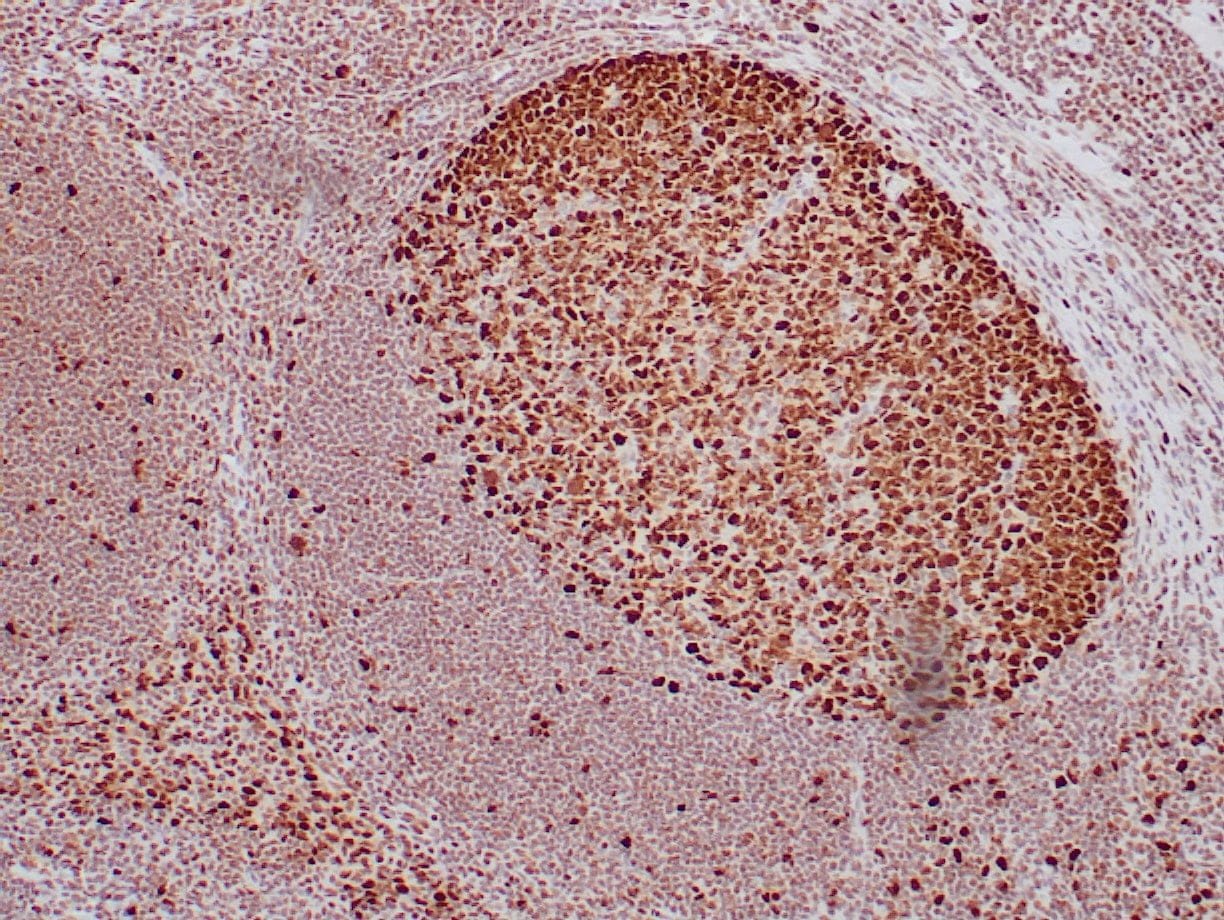 |
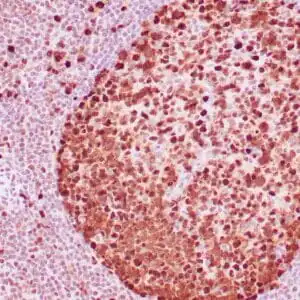
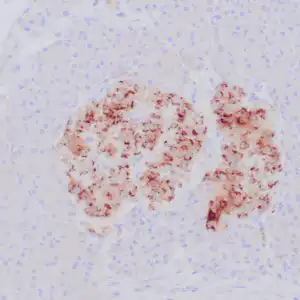
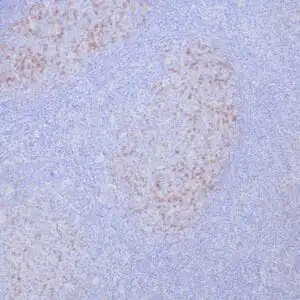
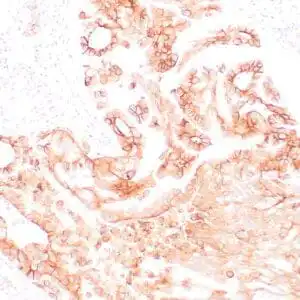
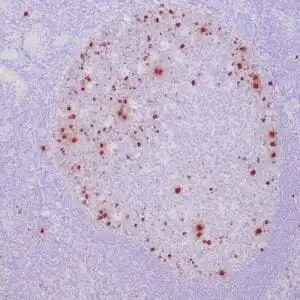
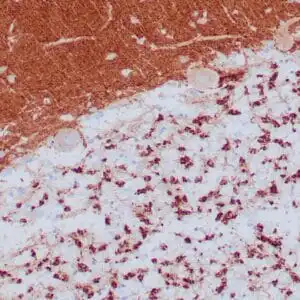
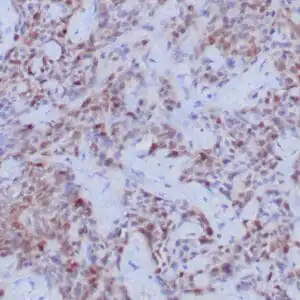
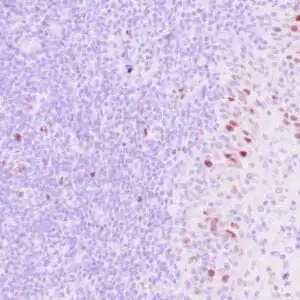
| Formalin-fixed, paraffin-embedded human tonsil stained with anti-PCNA antibody using peroxidase-conjugate and DAB chromogen. Note the nuclear staining of follicular center cells |
FAQ & Publications
Frequently Asked Questions
What is the recommended dilution range for using the rabbit anti-PCNA monoclonal antibody (ZR378) in immunohistochemistry?
For immunohistochemistry applications, the concentrated rabbit anti-PCNA monoclonal antibody (ZR378) is recommended to be diluted at 1:100 to 1:200.
How should the rabbit anti-PCNA monoclonal antibody (ZR378) be stored to ensure stability over time?
The antibody should be stored at 2-8°C for short-term use. For long-term storage, keep the antibody at -20°C and avoid freeze/thaw cycles to maintain its stability.
Publications
| pmid | title | authors | citation |
|---|---|---|---|
| We haven't added any publications to our database yet. | |||
Published literature highly relevant to the biological target of this product and referencing this antibody or clone are retrieved from the PubMed database provided by the United States National Library of Medicine at the National Institutes of Health.
Protocols
| relevant to this product |
|---|
| IHC |
Documents
| Batch Number | QC File | SDS |
|---|---|---|
| To view batch-specific Safety Datasheets and Quality Certificates associated with your account, please Log In. | ||
Only logged in customers who have purchased this product may leave a review.

Reviews
There are no reviews yet.